
Introduction
The EU Cyber Resilience Act (CRA) is not another voluntary cybersecurity framework a manufacturer can adopt at its own pace, it's binding regulation with real compliance deadlines and real market-access consequences for products sold into the EU. EU Cyber Resilience Act compliance for embedded products now belongs on the same planning timeline as CE marking and other mandatory conformity requirements, because a connected embedded product that can't demonstrate compliance simply can't legally be placed on the EU market once the relevant deadlines pass.
In short: the CRA requires manufacturers of products with digital elements sold in the EU to build security in by design, provide a defined vulnerability-disclosure and incident-reporting process, and maintain that security posture throughout the product's expected lifetime, with the essential requirements phased in over several years starting from the regulation's entry into force, and teams already following IEC 62443 or ISO 21434 have a real head start but still need to map that existing work explicitly against the CRA's specific requirements rather than assuming equivalence.
What the Cyber Resilience Act Actually Requires, in Plain Terms
Stripped of its regulatory language, the CRA requires that products with digital elements, essentially anything with software or connectivity, are designed and manufactured with an appropriate level of cybersecurity built in, are shipped without known exploitable vulnerabilities, provide security updates for a defined support period, and come with clear information for users about the product's security properties and how to report or receive information about vulnerabilities. It also requires manufacturers to maintain a vulnerability-handling process for the product's entire support life, not just at initial release, formalizing an ongoing obligation that many embedded manufacturers previously treated as optional best practice rather than a legal requirement.
Which Products Are in Scope: Most Connected Embedded Products
The CRA's scope is deliberately broad: any product with digital elements that has a direct or indirect logical or physical data connection to a device or network falls within scope, which captures the overwhelming majority of connected embedded products, IoT devices, industrial controllers, medical devices with connectivity, automotive electronics, consumer electronics, with only narrow carve-outs for product categories already covered by equivalent sector-specific regulation, such as certain medical devices already regulated under the EU's Medical Device Regulation. A subset of products deemed "critical" or "important" under the CRA's risk classification, certain network equipment, security products, and industrial control components among them, face additional, more stringent conformity assessment requirements beyond the baseline obligations that apply to all in-scope products.
Key Deadlines and What Happens If You Miss Them
The CRA entered into force with its essential cybersecurity and vulnerability-handling requirements phased in over a multi-year transition period, giving manufacturers a defined but finite runway to bring existing and in-development products into compliance before enforcement begins in earnest. Missing the applicable deadline means a product can't legally carry the CE mark and can't be placed on the EU market, a market-access consequence with direct revenue impact, separate from the additional fines and enforcement action national market surveillance authorities can pursue against non-compliant manufacturers once the requirements are fully in force. Given how long embedded product development cycles typically run, a team whose product is still in active development today needs its compliance plan finalized well before the applicable deadline, not started after.
Secure-by-Design Requirements for Connected Embedded Products, Concretely
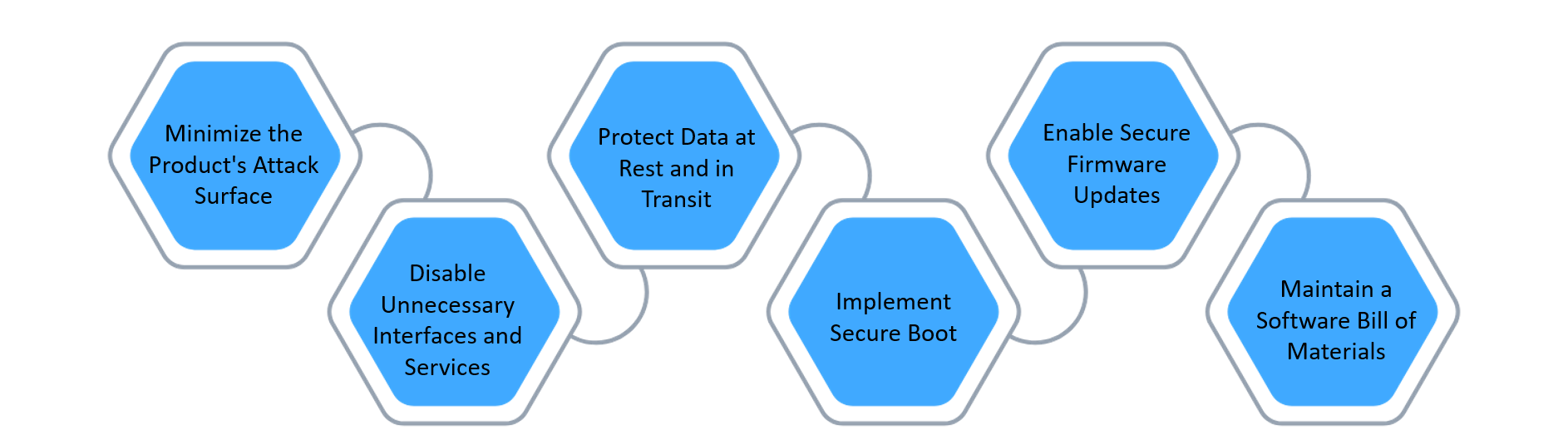
Secure-by-design requirements for connected embedded products under the CRA translate into specific engineering practices: minimizing the product's attack surface by disabling unnecessary interfaces and services by default, protecting data confidentiality and integrity both at rest and in transit, implementing a secure boot and firmware-update mechanism that can deliver security patches over the product's committed support period, and maintaining a software bill of materials that tracks third-party and open-source components well enough to identify and respond when a vulnerability is disclosed in one of them. These aren't new concepts to teams already building for functional safety or industrial cybersecurity standards, but the CRA makes them a legal conformity requirement rather than an engineering best practice a team can choose to deprioritize under schedule pressure.
How This Compares to IEC 62443 and ISO 21434, Which Some Teams Already Follow
Teams already building industrial control products against IEC 62443 or automotive products against ISO 21434 have real, substantive overlap with what the CRA requires, both frameworks already demand secure-by-design engineering practices, vulnerability management processes, and lifecycle security maintenance conceptually similar to the CRA's requirements. The gap that still needs closing is one of formal mapping and evidence, demonstrating explicitly, through documentation and conformity assessment, that existing IEC 62443 or ISO 21434 compliance work actually satisfies the CRA's specific legal requirements, rather than simply assuming that following one respected security standard automatically satisfies a separate regulation with its own specific text and assessment procedures. Skipping that explicit mapping exercise is a common and costly mistake for teams who assume prior security diligence transfers automatically, and it is often the single largest gap standing between existing engineering practice and demonstrable EU Cyber Resilience Act compliance for embedded products.
Practical First Steps for a Team Starting From Zero
A team with no existing structured cybersecurity program should start with a genuine gap assessment: confirming which of its connected products fall within CRA scope, whether any fall into the higher-scrutiny "critical" or "important" categories, and where current engineering and documentation practices already meet, partially meet, or entirely miss the CRA's secure-by-design and vulnerability-handling requirements. From there, prioritizing the products closest to their applicable compliance deadline, and building the vulnerability-disclosure and incident-reporting process the CRA requires as organizational infrastructure rather than a per-product afterthought, gives a realistic path to compliance without a last-minute scramble once enforcement begins.
Working With Regulatory Compliance Experts Rather Than Guessing
The CRA's text, like most EU regulation, leaves real interpretive questions that specialists with hands-on embedded cybersecurity experience are better positioned to navigate than a product engineering team working from the regulation's text alone, particularly around scope boundaries, conformity assessment procedure selection, and how existing IEC 62443 or ISO 21434 evidence maps onto CRA requirements. Given the direct market-access consequences of getting this wrong, a formal gap assessment conducted with genuine regulatory and embedded security expertise, rather than an internal best-guess interpretation, is worth the investment for any manufacturer with meaningful EU market exposure.
What Does the EU Cyber Resilience Act Require of Manufacturers, in One Summary
What does the EU Cyber Resilience Act require of manufacturers? Boiled down: secure-by-design engineering evidenced through documentation and conformity assessment, a functioning vulnerability-disclosure and incident-reporting process maintained for the product's full support life, security updates delivered through that support period, and clear user-facing information about the product's security properties, all demonstrated before the applicable deadline for the product's risk category, with real market-access consequences for missing it.
Embien's Capabilities
Embien brings embedded cybersecurity and regulatory compliance experience spanning IEC 62443, ISO 21434, and secure-by-design firmware architecture, including secure boot, OTA update infrastructure, and software bill-of-materials practices directly relevant to CRA conformity. Our engineering process treats regulatory security requirements as design inputs from the earliest architecture decisions rather than a compliance exercise bolted on before certification.
To discuss EU Cyber Resilience Act compliance for embedded products or a gap assessment against secure-by-design requirements, reach out to Embien's engineering team.