
Introduction
An RF front-end for a consumer radio or a commercial telecom module optimizes for cost and volume manufacturing within a well-understood, cooperative RF environment. Defense platforms ask for something different: a front-end that keeps working when someone is actively trying to jam it, fits inside a size, weight, and power envelope the platform's structure dictates rather than one the electronics get to choose, and survives the same shock, vibration, and thermal extremes as everything else on the platform. RF front-end (RFFE) design services for defense electronics sit at the intersection of RF engineering, digital signal processing, and mechanical packaging in a way commercial RF work rarely does.
In short: defense-grade RF front-end design succeeds or fails on how well SWaP constraints, EMI/EMC discipline, and resilience to a contested RF environment are traded off against each other early, not on any single RF component's performance in isolation.
What's Different About Defense RF Front-End Requirements
A defense RF front-end typically has to operate across a wider frequency range than a commercial equivalent, often spanning several GHz to tens of GHz for multi-band or multi-mission platforms, while meeting stricter dynamic range and spurious-emission requirements to avoid interfering with co-located systems on the same platform. It also has to interoperate with legacy protocols and control interfaces already deployed across a fleet, RS422 and MIL-STD-1553 remain common in fielded systems, while still supporting the modern configuration, monitoring, and update capabilities a program needs going forward. Designing for both constraints at once, legacy compatibility and modern capability, is a recurring theme in defense RF work that a purely greenfield commercial design never has to address.
Size, Weight, and Power (SWaP) Constraints in Practice
SWaP-constrained RF antenna design for defense electronics means the RF front-end rarely gets to dictate its own enclosure or power budget, the platform's available volume, mass allocation, and power bus set the envelope, and the RF design has to fit inside it. In practice this drives component-level decisions throughout the signal chain: choosing RF switches, attenuators, and amplifiers rated for the required frequency range and power handling within the smallest available package, and often means favoring a highly integrated FPGA-based control architecture over discrete control logic specifically to reclaim board area and power budget for the RF path itself.
EMI/EMC Considerations Specific to Tactical RF Systems
An RF front-end is, almost by definition, an intentional radiator, which makes its EMI/EMC design fundamentally different from a purely digital subsystem's. The front-end has to meet MIL-STD-461 conducted and radiated emissions limits on its own supporting digital and power electronics, while simultaneously being engineered to radiate cleanly and predictably at its intended operating frequencies without spurious emissions that could interfere with co-located receivers on the same platform, a concern that has no real analog in a typical digital embedded system's EMC design.
Electronic Warfare (EW) System Design and Anti-Jam Resilience
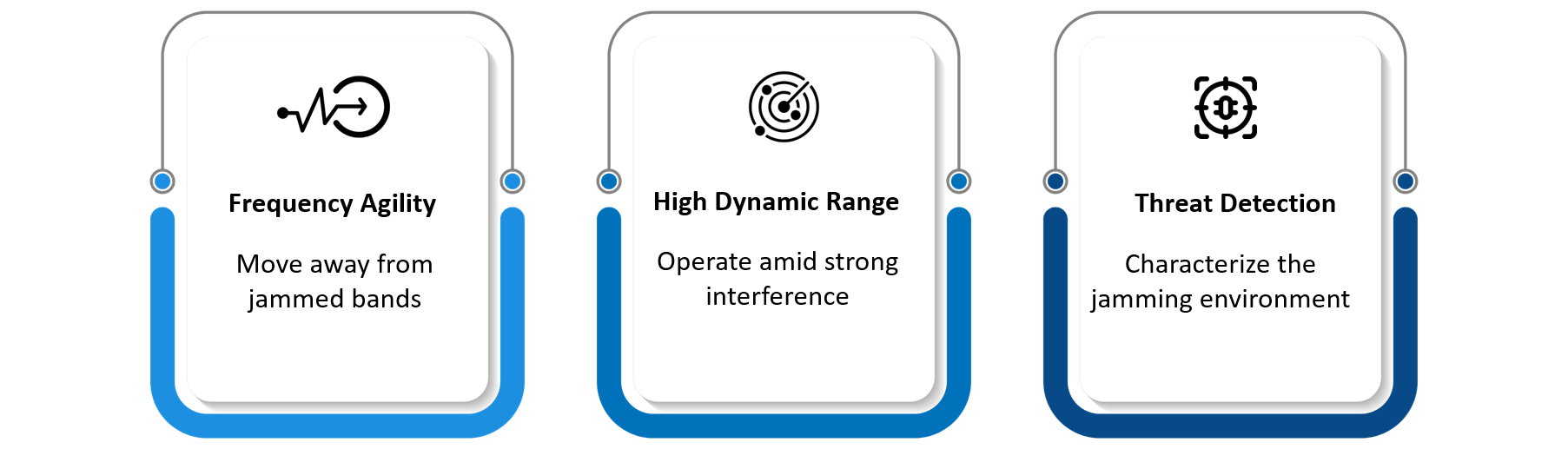
Electronic warfare (EW) system design treats the RF environment as actively hostile rather than merely noisy. A defense RF front-end intended for a contested environment needs frequency-agility to move away from a jammed band, sufficient dynamic range to keep operating in the presence of strong interfering signals without desensitizing, and often direction-finding or threat-detection capability to characterize the jamming environment it's operating in. These capabilities live at the boundary between RF hardware and real-time digital signal processing, which is exactly where the choice of control and processing architecture starts to matter as much as the RF components themselves.
FPGA Signal Processing for EW and High-Speed Signal Chains
FPGA signal processing for EW applications, and for defense RF front-ends generally, exists because the latency and determinism requirements involved, real-time threat detection, adaptive filtering, agile frequency control, exceed what a general-purpose processor can reliably guarantee. FPGA design services for high-speed signal processing in this context typically combine hardware-described control logic for the deterministic, timing-critical paths with an embedded soft or hard processor core for configuration, monitoring, and higher-level control logic that doesn't need hardware-level determinism, giving a program a single chip that handles both without splitting the design across separate FPGA and microcontroller boards.
Antenna Integration Challenges in Constrained Platforms
Antenna placement on a defense platform is rarely a clean-sheet decision, it has to work around existing structure, other antennas' mutual coupling and isolation requirements, and the platform's own RF signature management goals. Integrating a new or modernized RF front-end into an existing platform adds a further constraint: the new electronics typically have to interface with a legacy antenna array and control protocol exactly as the system it's replacing did, so the platform's operators and other subsystems see no difference in interface even though the underlying RF front-end has been completely redesigned.
Embien's FPGA-Based Antenna Front-End Controller Project
Embien's own project history includes exactly this class of challenge: partnering with a leading German defense OEM to modernize the controller for a mission-critical Antenna Front-End (AFE) system managing RF switches and digital control attenuators across a 0.5-40GHz frequency range. The new controller, built around a Xilinx Artix-7 FPGA (XC7A100T) running an embedded MicroBlaze soft processor and RTOS, had to decode the existing master controller's legacy 49-bit RS422 command protocol with full backward compatibility while adding a modern Ethernet interface for configuration, status monitoring, and secure in-field firmware updates, all on an industrial-grade platform built for defense-application reliability. That combination, legacy protocol fidelity, modern connectivity, and SWaP-conscious FPGA-based integration, reflects the same tradeoffs described throughout this post.
Embien's Capabilities
Embien delivers RF front-end (RFFE) design services spanning custom hardware design, FPGA design, and embedded software development for defense RF systems, including antenna front-end controllers, signal-path modernization, and legacy-protocol-compatible upgrades. Our RF and FPGA teams work SWaP, EMI/EMC, and resilience requirements into the architecture from the first design review rather than treating them as compliance gates applied after the RF path is finalized.
To discuss an RF front-end, antenna, or FPGA-based signal processing requirement for a defense platform, reach out to Embien's mission-critical engineering team.