
Introduction
Right to Repair is no longer a consumer-advocacy talking point, it's real, enforceable law across multiple US states and the European Union, and it changes decisions that used to be purely a manufacturer's discretionary call: what fasteners hold an enclosure together, whether firmware and diagnostic tools are accessible to independent repair shops, and whether spare parts are actually available to anyone outside the manufacturer's own service network. Consumer electronics design now has to account for these requirements from the earliest design decisions, not as a compliance checklist applied after a product is otherwise finished.
In short: Right to Repair legislation, now in force in a growing number of US states and across the EU, requires manufacturers to make spare parts, repair documentation, and in many cases diagnostic tools available to consumers and independent repair shops, which directly affects fastener and adhesive choices, modular component design, and firmware access policy, intersects meaningfully with the broader sustainability push toward repairable, longer-lived products, and forward-looking manufacturers are already adapting design practices ahead of enforcement deadlines rather than treating compliance as a future problem.
What Right to Repair Laws Actually Require, Region by Region
Right to Repair requirements vary by jurisdiction but share a common core: manufacturers must make repair parts, tools, and documentation available to consumers and independent repair providers on fair and reasonable terms, not exclusively through the manufacturer's own authorized service network. Several US states have passed Right to Repair legislation covering consumer electronics specifically, with varying scope and enforcement timelines, while the EU's approach, layered alongside its broader ecodesign and sustainability regulatory framework, extends similar requirements with its own specific documentation and parts-availability obligations. The practical result for a manufacturer selling into multiple of these jurisdictions is that Right to Repair compliance can't be treated as a single, uniform requirement, region-specific obligations need to be tracked and designed around individually even when the underlying design changes overlap significantly across regions.
Design Decisions This Affects: Fasteners, Adhesives, Modular Components
The most immediate design impact shows up in how a product's enclosure and internal components are physically assembled. Fasteners that a standard screwdriver can remove, rather than proprietary or security-pattern screws designed specifically to deter non-authorized disassembly, are increasingly a practical necessity rather than an optional nicety. Permanent or excessive adhesive use, particularly for components like batteries that have a genuine, predictable need for replacement over a product's service life, faces real design scrutiny under repairability requirements that specifically penalize adhesive-bonded, difficult-to-separate construction. And modular component design, structuring a product so a commonly-failing part, a battery, a display, a connector, can be replaced as a discrete module rather than requiring an entire subassembly or the whole product to be replaced, directly reduces both repair cost and the waste a non-modular design generates when a single component fails.
Firmware and Diagnostic Access Requirements
Beyond physical design, Right to Repair increasingly extends into firmware and software territory: some jurisdictions require that diagnostic tools and error codes be accessible to independent repair providers, not locked exclusively behind manufacturer-proprietary diagnostic software, and firmware update mechanisms increasingly can't be designed specifically to block a legitimately repaired device, one with a replaced component, from continuing to function normally. This is a meaningfully different design consideration than the physical fastener and modularity changes, since it touches security architecture and update infrastructure decisions that were historically made with cost and IP-protection in mind rather than third-party repair accessibility, requiring a genuine architectural review rather than a straightforward mechanical design change.
Spare-Parts and Documentation Obligations
Making spare parts genuinely available, not just theoretically available at a price and lead time that make independent repair impractical, is a substantive obligation under most Right to Repair frameworks, and manufacturers increasingly need a defined parts-distribution channel and pricing approach for exactly this purpose. Repair documentation, service manuals, exploded assembly diagrams, torque specifications and disassembly sequences, historically produced only for a manufacturer's own authorized service network, increasingly needs to be prepared for external publication or provision to independent repair shops and consumers, a real documentation-effort increase that needs to be planned into the product development timeline rather than treated as an afterthought produced hastily once a compliance deadline is imminent.
Right to Repair Legislation and Consumer Electronics Design: Where the Two Meet Most Directly
The two intersect most directly at the point where a design choice made for cost, aesthetics, or a manufacturer's business-model preference for controlling the service and parts channel runs up against a legal requirement to enable third-party repair. Getting ahead of that tension means evaluating fastener choice, adhesive use, and modularity against repairability requirements during initial product architecture, not after industrial design and mechanical engineering have already locked in choices that a later compliance review then has to unwind at real cost and schedule impact.
Where This Intersects With the Sustainability and Green Electronics Trend
Right to Repair and the broader sustainability-driven green electronics trend share the same underlying design principles, repairability, modularity, and avoiding artificial barriers to component replacement or recycling, even though they're driven by distinct regulatory and market pressures. A product designed well for Right to Repair compliance is very often, by the same design choices, also better positioned against sustainability-focused buyer expectations and separate environmental regulation, making it worth treating these as one coordinated design effort rather than two separate compliance initiatives competing for the same engineering attention and budget.
Designing Repairable Consumer Electronics for Right to Repair Compliance: A Practical Checklist
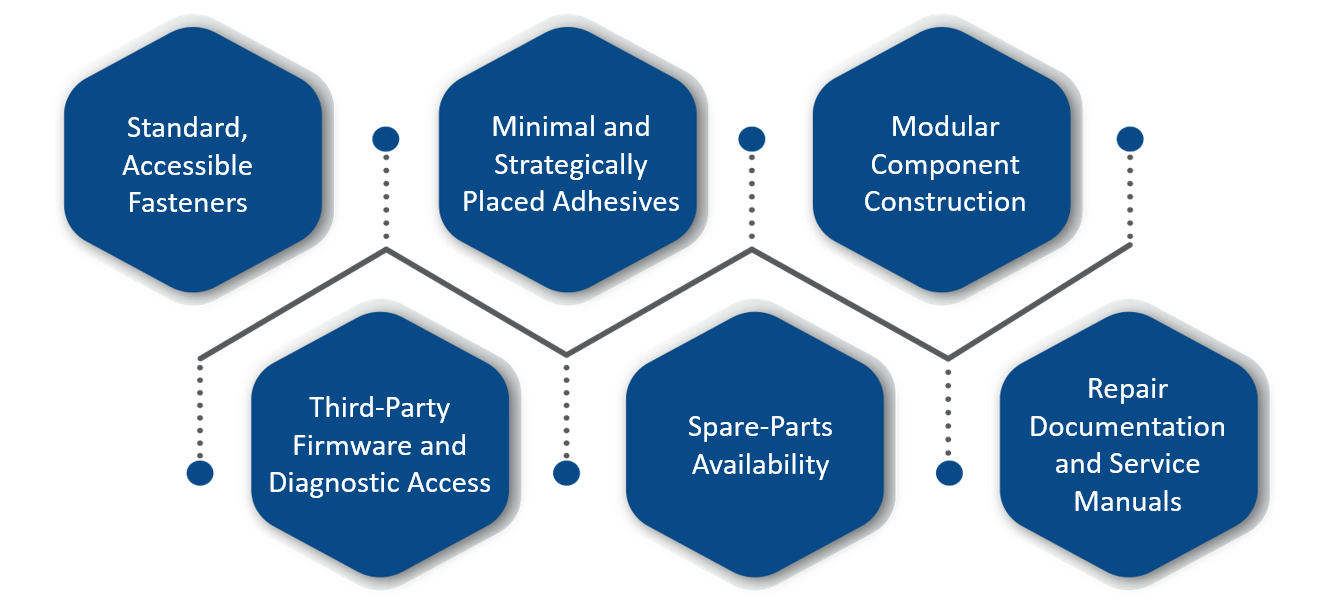
That effort comes down to a practical set of design habits: standard, accessible fasteners in place of proprietary security screws wherever functionally possible, minimal and strategically-placed adhesive use rather than default reliance on it, modular construction for components with a predictable replacement need, firmware and diagnostic architecture that doesn't actively block legitimate third-party repair, and a parts and documentation distribution plan established well before a product ships rather than assembled reactively once a compliance deadline or enforcement action forces the issue.
What Forward-Looking Manufacturers Are Doing Ahead of Enforcement
Manufacturers ahead of the compliance curve are treating repairability as a design requirement evaluated during initial product architecture, alongside cost, manufacturability, and industrial design, rather than a legal risk assessed only once a product is otherwise finished. This means involving mechanical and firmware engineering in repairability planning from the earliest concept stage, establishing spare-parts and documentation processes as standing organizational capability rather than a per-product scramble, and, in many cases, finding that repairability-driven design choices, modular construction in particular, deliver genuine manufacturing and warranty-cost benefits independent of the regulatory requirement driving the initial decision.
Consumer Electronics Design Services: Building Repairability in From the Start
Embien's consumer electronics design services incorporate repairability and Right to Repair compliance as a design input from the earliest architecture and industrial design decisions, covering fastener and enclosure design, modular component architecture, and firmware access policy evaluated against the specific jurisdictions a product will ship into, rather than treating compliance as a retrofit exercise applied to an otherwise-finished design.
Why Use Embien for Consumer Electronics Design?
Why use Embien for consumer electronics design? Because repairability, sustainability, and regulatory compliance are treated as integrated engineering requirements from day one of the design process, not separate initiatives layered on after a product's mechanical and firmware architecture is already fixed, giving product teams a design partner who understands how a fastener choice, an adhesive decision, or a firmware access policy connects directly to real compliance and market-access consequences down the line.
Embien's Capabilities
Embien brings consumer electronics design experience spanning mechanical architecture, modular component design, and firmware access policy for products needing to meet Right to Repair and broader sustainability requirements across multiple jurisdictions. Our engineering process evaluates repairability alongside cost, manufacturability, and industrial design from the earliest product architecture decisions.
To discuss consumer electronics design for a product needing Right to Repair compliance across US and EU markets, reach out to Embien's engineering team.