
Introduction
What is TinyML? is a question worth answering on its own terms rather than as one entry in a longer survey of edge AI frameworks, because TinyML represents a genuinely distinct point on the machine-learning deployment spectrum: models small enough to run within the kilobytes of RAM and flash a general-purpose microcontroller has available, not the gigabytes of memory a typical edge AI accelerator or embedded GPU assumes. That constraint changes nearly everything about how a TinyML model gets built, compressed, and deployed compared to conventional edge inference.
In short: TinyML is machine learning inference running directly on a microcontroller with no operating system, no GPU, and often less than a megabyte of usable memory, made possible through aggressive model compression techniques like quantization and pruning, well suited to always-on, battery-powered sensing tasks like keyword spotting, anomaly detection, and predictive maintenance, with real limitations around model complexity and accuracy that any team evaluating it needs to plan around honestly rather than optimistically.
What TinyML Actually Means: ML on Kilobytes, Not Gigabytes
Conventional edge AI, running a model on an embedded GPU, an NPU, or a Linux-capable application processor, typically has hundreds of megabytes to gigabytes of RAM and flash available, room for models with millions of parameters and rich floating-point precision. TinyML operates in an entirely different regime: a target microcontroller might have as little as tens of kilobytes of RAM and a few hundred kilobytes of flash total, memory that has to be shared between the model itself, its runtime, and the rest of the application firmware. A real TinyML deployment, a water-leakage detection model Embien built for an industrial water-distribution customer, ran within roughly 15 kilobytes of RAM and 819 kilobytes of flash on an STM32L4R5 microcontroller, memory budget figures that illustrate just how far removed TinyML's constraints are from conventional edge AI's assumptions.
The Model Compression Techniques That Make It Possible
Fitting a useful machine-learning model into that kind of memory budget requires deliberate compression, not just picking a smaller model architecture. Quantization, converting a model's weights and activations from 32-bit floating point down to 8-bit integers or lower, is the single most impactful technique, typically shrinking a model's memory footprint by four times or more with only modest accuracy loss when done carefully. Pruning, removing weights and connections that contribute little to the model's output, further reduces model size and computation on top of quantization's gains. And architecture selection matters enormously, deliberately choosing simpler model architectures, smaller neural networks, classical machine-learning models like a one-class support vector machine, or an autoencoder tuned for anomaly detection, rather than starting from a large architecture and trying to compress it down, frequently produces a better result for genuinely constrained TinyML targets.
TinyML Model Quantization Services: What the Work Actually Involves
TinyML model quantization services cover the full path from a trained floating-point model to a deployable quantized artifact: converting the model, commonly through a toolchain like TensorFlow Lite for Microcontrollers, into a quantized format, validating that the accuracy loss from quantization stays within acceptable bounds for the specific application, and tuning the quantization approach, per-layer versus per-tensor quantization, calibration dataset selection, when default settings produce unacceptable accuracy degradation. This validation step matters more than it might seem, a quantized model that looks fine on paper can behave meaningfully differently on real sensor data than the floating-point model it was derived from, making empirical validation against representative real-world data essential rather than optional.
Common TinyML Use Cases: Keyword Spotting, Anomaly Detection, Predictive Maintenance
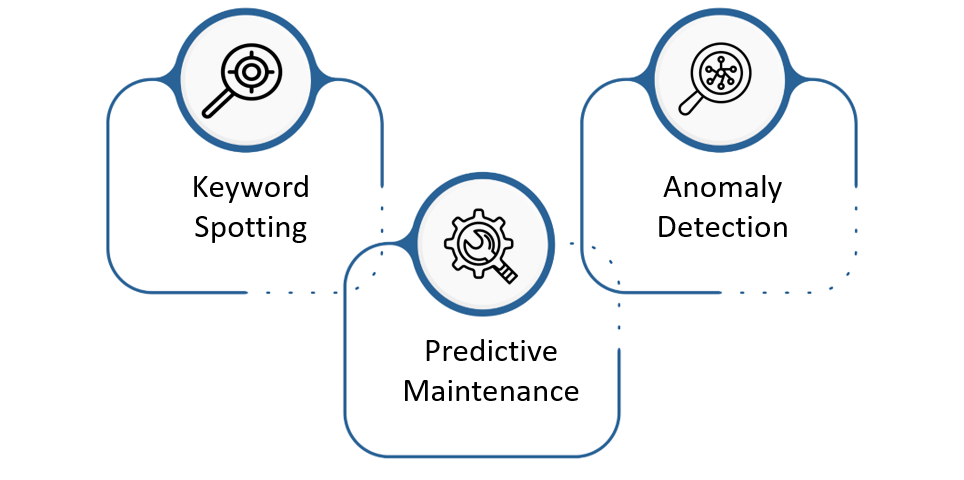
TinyML's sweet spot is always-on, battery-powered sensing tasks where a full application processor's power draw would be unacceptable but some on-device intelligence is still needed. TinyML keyword spotting development, detecting a wake word or simple voice command locally without streaming continuous audio to the cloud, is one of the most mature and widely deployed TinyML use cases, valued for both its power efficiency and the privacy benefit of never transmitting raw audio off-device. Anomaly detection, flagging unusual sensor patterns, vibration, current draw, flow rate, against a learned baseline of normal behavior, and predictive maintenance, catching early signs of equipment degradation from the same kind of sensor data before a failure occurs, are the other recurring categories, both well matched to TinyML's strength at running a lightweight, continuously-active inference loop on a low-power microcontroller rather than needing to wake a more capable processor for every sensor reading.
A Concrete Case: Water Leakage Detection With a One-Class SVM and Autoencoder
Embien's water-leakage detection system for an industrial equipment OEM illustrates TinyML's practical value directly. The customer needed to monitor a water distribution network at scale, for a smart-city-style deployment, ruling out both a computationally powerful system and any continuous cloud-subscription connectivity model on cost grounds, and needing something simple enough for non-technical local government operators to use. Embien's team trained two complementary models, an autoencoder-based TensorFlow model detecting anomalies in demand-pattern data, and a one-class support vector machine detecting leaks during off-peak, low-noise periods, both ultimately converted to TensorFlow Lite and deployed to run directly on an STM32L4R5 microcontroller, reading flowmeter data over an RS485 Modbus connection and triggering a simple LED and buzzer alert on detected leakage, with no cloud dependency and no ongoing subscription cost, exactly the low-cost, low-complexity deployment profile TinyML makes possible.
Neural Network Deployment on Microcontrollers: Framework Options and How to Choose
Neural network deployment on microcontrollers today has several viable framework options, each with different tradeoffs worth weighing against a specific project's constraints. TensorFlow Lite for Microcontrollers is the most widely adopted, with broad hardware support and an active ecosystem, making it a reasonable default absent a specific reason to look elsewhere. Alternative runtimes optimized for particular vendor silicon or for even tighter memory budgets exist and can outperform a general-purpose framework on a specific target, at the cost of a narrower hardware and community support base. The right choice depends on the target microcontroller's specific memory and compute budget, the model architecture and training framework the team is already using, and how much the project can invest in framework-specific tuning versus wanting a broadly supported, well-documented default.
Realistic Limitations Teams Should Plan Around
TinyML's constraints are real and worth stating plainly rather than glossing over. Model complexity is fundamentally limited by the available memory, meaning TinyML is well suited to focused, well-scoped classification or anomaly-detection tasks and poorly suited to complex, general-purpose inference that would need a much larger model. Accuracy tradeoffs from aggressive quantization and pruning are real and need empirical validation against the specific application's tolerance for false positives and false negatives, not assumed acceptable by default. And the specialized skill set TinyML deployment requires, quantization-aware model design, careful memory budgeting, cross-team collaboration between data science and embedded firmware engineering, is a genuine team-capability investment that a project should plan for explicitly rather than assume falls out naturally from either machine-learning or embedded engineering experience alone.
How to Deploy TinyML on a Microcontroller: A Practical Path
How to deploy TinyML on a microcontroller? in practice follows a consistent path regardless of the specific use case: train a model on representative data using a standard machine-learning framework, convert and quantize that model for the memory-constrained target using a toolchain like TensorFlow Lite for Microcontrollers, validate the quantized model's accuracy against real sensor data rather than only the original training set, and integrate the resulting inference code into the target microcontroller's firmware alongside the sensor acquisition and application logic it needs to work alongside. Each step benefits from realistic memory budgeting done early, since discovering a memory shortfall only after model training is largely complete forces costly rework that earlier constraint-aware planning avoids.
Embien's Capabilities
Embien brings TinyML deployment experience spanning model quantization, training pipeline development, and microcontroller integration, including a deployed water-leakage detection system running dual anomaly-detection models on an STM32L4R5 with a combined memory footprint under a megabyte. Our engineering process pairs machine-learning model development with the embedded firmware expertise needed to get a compressed model actually running reliably on constrained hardware.
To discuss what is TinyML? for a specific product idea, or TinyML model quantization and deployment for a resource-constrained embedded product, reach out to Embien's engineering team. Whatever stage the question starts from, what is TinyML? is always worth answering against the target hardware's real memory budget first.