
Introduction
Every ADAS component on a test bench can pass its unit tests, every ECU can be free of hardware faults, and a vehicle can still misbehave in the field because its sensors and algorithms, working exactly as designed, simply couldn't correctly interpret an unusual real-world scene: heavy glare washing out a camera's dynamic range, a stationary object shaped just unusually enough to confuse an object-classification model, or radar clutter from a specific road surface the training data never covered. SOTIF ISO 21448 for ADAS systems exists precisely because this category of hazard, correct hardware and software behaving exactly as intended and still causing harm, sits entirely outside what ISO 26262's fault-based safety framework was built to catch. What is SOTIF and how does it differ from ISO 26262? is the question every ADAS program eventually has to answer once functional safety alone stops explaining certain field incidents.
In short: Safety of the Intended Functionality for autonomous driving systems addresses hazards that arise from a system's functional insufficiencies or reasonably foreseeable misuse, even when every component performs exactly as designed and no fault has occurred, and it has become mandatory engineering discipline for any ADAS or autonomous driving program precisely because sensor and perception limitations, not just electronic faults, are now a primary source of real-world safety incidents.
The Gap ISO 26262 Doesn't Cover
ISO 26262's entire framework is built around a specific hazard model: a system malfunctions because of a fault, a bit flip, a short circuit, a software defect, and functional safety engineering exists to detect, tolerate, or safely react to that fault. This model works well for a braking ECU that fails to actuate because of a stuck relay. It works far less well for a camera-based lane-keeping system that performs exactly as its algorithm was designed to perform, correctly classifying every training example it was ever shown, and still steers incorrectly because a real-world lane marking pattern, faded paint merging with a shadow at a specific sun angle, falls outside what the perception algorithm was ever validated against. Nothing malfunctioned in the ISO 26262 sense; the system did precisely what it was built to do. That gap, a system's intended function itself being insufficient for a real-world situation, is exactly what SOTIF was written to address.
What SOTIF Actually Defines as a Hazard
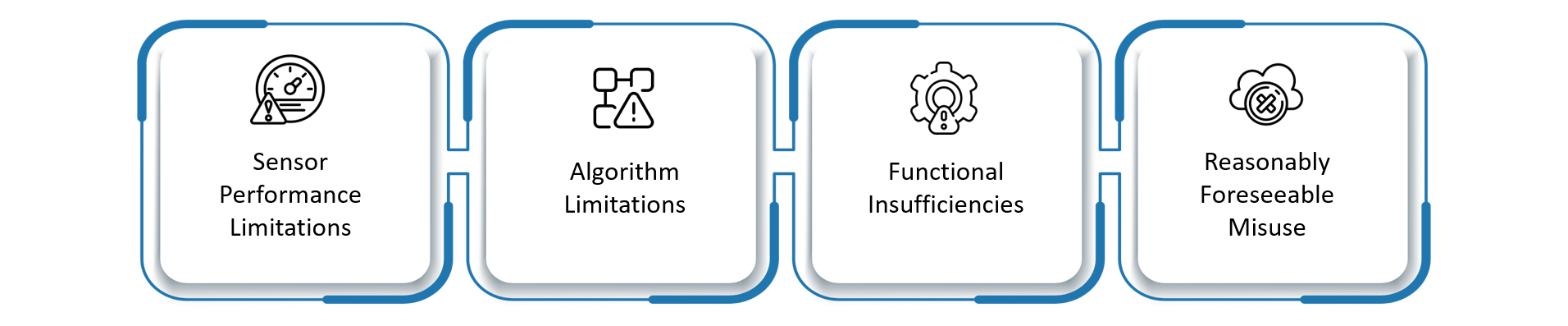
ISO 21448 defines two hazard sources that fall outside conventional fault-based safety: functional insufficiencies, where the system's specified function or its implementation is inadequate to correctly handle a situation it will foreseeably encounter, and reasonably foreseeable misuse, where a human interacts with the system in an unintended but predictable way, over-relying on a driver-assist system's capability beyond its actual design scope, for instance. Sensor performance limitations, an ultrasonic sensor that can't reliably detect a thin vertical pole, a camera that loses object detection confidence in direct low-sun glare, algorithm limitations, an object classifier trained on a dataset that underrepresents certain vehicle types or occlusion patterns, and unclear or exceeded operational design domain boundaries all fall within SOTIF's scope precisely because they represent the intended system behaving as designed and still producing an unsafe outcome.
The SOTIF Process: From Known-Unsafe to Known-Safe
ISO 21448 organizes a system's scenario space into four categories that the SOTIF process works to shrink and reclassify over a program's development: known-safe scenarios the system handles correctly, known-unsafe scenarios that have been identified as hazardous and require mitigation, unknown-unsafe scenarios not yet identified but potentially hazardous, and unknown-safe scenarios not yet identified but which the system in fact handles correctly. The SOTIF development process is fundamentally about moving scenarios out of the unknown-unsafe category through structured hazard identification, scenario-based testing, simulation, and field data analysis, and reducing residual risk in known-unsafe scenarios through algorithm improvement, sensor redundancy, or functional restriction, an ADAS function that disables itself or hands control back to the driver when it detects it's operating outside a validated scenario.
ADAS Solutions: Where Sensor and Algorithm Limitations Actually Surface
Building robust ADAS solutions under a SOTIF framework means treating sensor and algorithm performance limitations as first-class engineering requirements to be characterized and tested against, not incidental implementation details to be tuned after the fact. A camera-radar sensor fusion architecture designed with SOTIF in mind explicitly characterizes each sensor's known weak scenarios, radar's difficulty distinguishing a stationary object from background clutter, camera degradation in low light or glare, and designs the fusion logic and operational design domain restrictions around those known limitations rather than discovering them through field incidents. This is a meaningfully different design posture than treating sensor selection purely as a cost-versus-capability tradeoff, SOTIF requires the tradeoff analysis to explicitly account for each sensor's functional insufficiency scenarios and how the overall system compensates for them.
ADAS Visualization and Scenario-Based Validation
ADAS visualization tools, scenario replay, sensor data overlay against ground truth, and simulation environments that can systematically generate edge-case scenarios, are central to SOTIF validation because the standard's core challenge is identifying and testing against scenarios that are, by definition, not yet fully known. Visualizing how a perception stack's confidence and classification output behaves across thousands of simulated lighting conditions, weather variations, and object configurations lets an engineering team surface functional insufficiencies systematically rather than waiting for them to appear in field data. This scenario-based validation approach, generating and visualizing large populations of parameterized test scenarios rather than relying solely on a fixed set of physical test-track cases, is quickly becoming standard practice for SOTIF compliance across the industry, because physical testing alone can't practically cover the scenario space SOTIF requires evidence against.
How SOTIF and ISO 26262 Work Together on a Real Program
SOTIF doesn't replace ISO 26262, the two standards address different hazard sources and both apply to most modern ADAS and autonomous driving programs simultaneously. A production ADAS ECU needs ISO 26262's fault-detection and hardware/software safety mechanisms to handle conventional electronic faults, and it separately needs SOTIF's scenario-based validation and functional insufficiency mitigation to handle hazards arising from correct-but-inadequate perception and decision-making. In practice this means a program's safety case has two complementary bodies of evidence: an ISO 26262 safety case demonstrating fault tolerance and safe-state behavior, and a SOTIF safety case demonstrating that known-unsafe scenarios have been identified and mitigated and that residual unknown-unsafe risk has been reduced to an acceptable level through validated testing and field monitoring.
Why This Matters More as Automation Level Increases
SOTIF's importance scales directly with how much decision-making authority a system takes from the driver. At lower automation levels, driver-assist features where the driver remains the primary safety layer, functional insufficiencies are more likely to be caught and corrected by attentive human oversight before they cause harm. As automation level increases toward conditional or high automation, where the system is expected to handle more scenarios without human intervention, functional insufficiencies in perception and decision-making become directly safety-relevant in a way they weren't when a human was there as a backstop. This is precisely why regulatory and industry attention to SOTIF ISO 21448 for ADAS systems has intensified specifically alongside the industry's push toward higher automation levels, rather than remaining a niche concern for basic driver-assist functions alone.
Embien's Capabilities
Embien brings ADAS embedded engineering experience spanning sensor fusion architecture, camera and radar integration, and functional safety engineering aligned with both ISO 26262 and SOTIF principles. Our engineering process treats sensor and algorithm functional insufficiency scenarios as explicit design inputs from the architecture stage, not issues to be discovered during validation, applying SOTIF ISO 21448 for ADAS systems requirements alongside conventional functional safety analysis.
To discuss SOTIF ISO 21448 for ADAS systems or sensor fusion architecture for an ADAS or autonomous driving program, reach out to Embien's engineering team.