
Introduction
Wearable technology development has matured considerably from the early smartwatch era's relatively basic step-counting and notification-mirroring functionality, and 2026's product landscape reflects that maturity: smart rings competing seriously with watches on continuous health monitoring, gesture-based interaction moving from novelty demo to genuine product feature, and the underlying sensor and low-power engineering that makes multi-day battery life on a genuinely small form factor achievable in ways that weren't practical even a few product generations ago.
In short: smart rings have emerged as a genuinely competitive form factor to the smartwatch for continuous health monitoring, driven by miniaturized PPG and motion sensing that fits a ring's tiny power and space budget, gesture control is moving from demo-stage novelty toward real shipped functionality on wrist-worn devices with the right sensor fusion, and the wearable products succeeding commercially in 2026 are consistently the ones that treat battery life, sensor accuracy, and form factor as inseparable engineering constraints rather than features that can be optimized independently.
Health Wearables: The Category Driving Most of the Innovation
This category remains the single biggest driver of wearable technology investment and innovation, continuous heart-rate and activity monitoring having moved from a differentiating feature to a baseline market expectation, with newer generations of products pushing further into sleep-stage tracking, blood-oxygen monitoring, and early-stage stress and recovery metrics derived from heart-rate-variability analysis. The engineering challenge driving most of the meaningful year-over-year improvement in this category isn't adding new sensor types so much as extracting more reliable, clinically-meaningful signal from existing sensors, particularly PPG-based heart-rate sensing, through better signal processing, motion-artifact rejection, and sensor placement optimization specific to each form factor.
Smart Rings: A Genuinely Competitive Form Factor for Continuous Monitoring
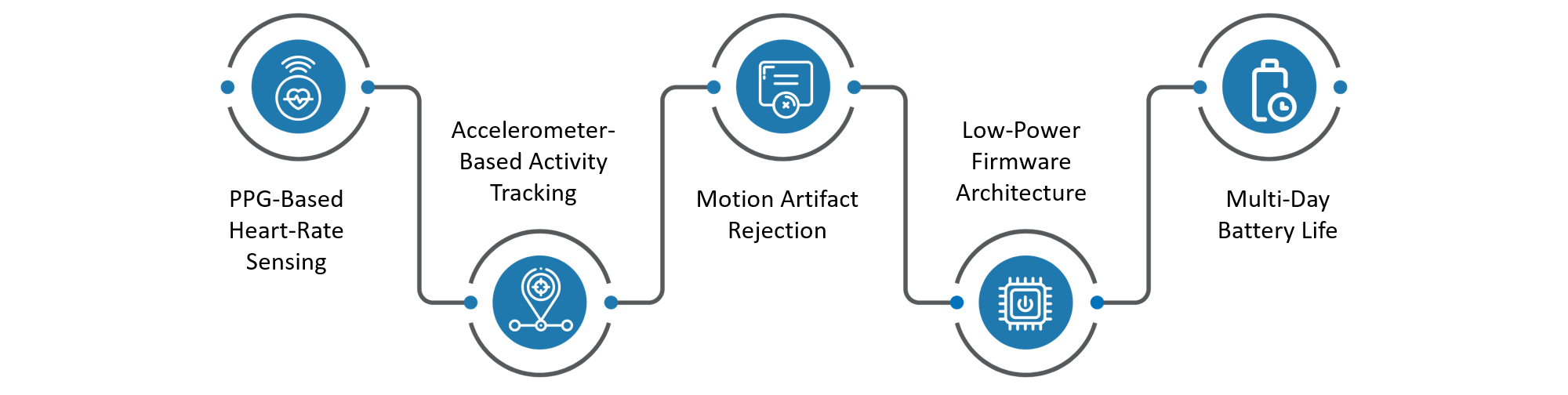
Smart rings have moved from a niche curiosity to a genuinely competitive wearable category specifically because they solve a problem smartwatches never fully addressed: comfortable, unobtrusive, truly continuous wear, including overnight, without the bulk and charging interruption a watch typically requires. Embien's work developing production firmware for a smart health ring built on Nordic's nRF52832 BLE SoC illustrates the specific engineering discipline this form factor demands, PPG-based heart-rate sensing using the SI1153 optical sensor tuned to the ring's specific optical geometry, accelerometer-based activity tracking fused with the PPG signal to reject motion artifacts, and aggressive power management, peripheral power gating, tuned BLE advertising intervals, system-off sleep between wake events, delivering the multi-day continuous wear battery life a ring's tiny form factor and power budget demands. That combination of miniaturized sensing and disciplined low-power firmware architecture is what makes the ring form factor viable at all for continuous health monitoring.
Gesture Control Implementation in Wearable Technology: From Demo to Real Product Feature
This category has historically lagged its own hype, early demos of wrist-gesture-based device control rarely translated into reliable, shipped product functionality, largely because distinguishing an intentional control gesture from ordinary arm and wrist movement reliably enough for real-world use is a genuinely hard sensor-fusion and signal-processing problem. 2026's more mature gesture-control implementations lean on fused accelerometer, gyroscope, and in some cases electromyography-style muscle-signal sensing, combined with on-device machine-learning models trained to distinguish deliberate gestures from incidental movement with the false-positive rate low enough for genuine daily use, moving gesture control from an occasional demo feature to something users can depend on for hands-free device interaction.
Wearables Beyond the Wrist and Finger: Where Elderly Care and Specialized Monitoring Fit
Wearable innovation in 2026 extends well beyond mainstream consumer fitness tracking into specialized categories with their own distinct engineering priorities. Embien's work on a turnkey BLE wearable for a Chicago-based elderly-care startup, a neck- or wrist-worn device built specifically around fall detection and optimized low-power BLE firmware, illustrates how a specialized wearable use case shifts the engineering priority list, reliable fall-detection algorithm performance and continuous, dependable connectivity for alerting mattering more for that product category than the broader activity-tracking feature set a mainstream fitness wearable emphasizes. This specialization pattern, tailoring sensor selection, algorithm design, and power budget to a specific use case's actual priorities rather than a generic wearable feature checklist, is a recurring theme across the more specialized end of the 2026 wearable landscape.
Smart Wearables & IoT Devices: The Connectivity and Data Layer Behind the Sensor
Smart wearables & IoT devices increasingly share a common architecture pattern regardless of form factor: on-device sensing and initial signal processing paired with a BLE or cellular connectivity layer feeding data to a companion app and, increasingly, a cloud platform providing longer-term trend analysis and, in health-focused products, integration with broader health data ecosystems. Getting this connectivity and data layer right, reliable BLE pairing and reconnection behavior, efficient data synchronization that doesn't drain battery life, and a companion app experience that actually surfaces meaningful insight rather than raw sensor dumps, is as much a determinant of a wearable product's real-world success as the sensor hardware and algorithm quality on the device itself.
What's Actually Shipping vs What's Still Hype in 2026
A useful filter for evaluating 2026's wearable trend coverage is distinguishing what's genuinely shipping in volume from what remains demo-stage or aspirational. Continuous PPG-based health monitoring across both watches and rings, accurate sleep-stage tracking, and basic gesture-based media and notification control are genuinely mature and widely shipping today. More ambitious claims, clinically-validated continuous blood-pressure monitoring without cuff calibration, fully reliable EMG-based gesture control across arbitrary hand positions, and non-invasive continuous glucose monitoring in a consumer wearable form factor, remain considerably earlier-stage, with real engineering and regulatory hurdles still standing between current prototypes and dependable consumer products, worth keeping in mind before betting a product roadmap on capability that isn't reliably deployable yet.
Wearable Tech Trends 2026: Smart Rings and Watches, the Engineering Constant Underneath
Wearable tech trends 2026: smart rings and watches may compete on form factor and feature marketing, but the underlying engineering constant across every genuinely successful product in the category is the same: miniaturized, power-efficient sensing, disciplined firmware power management, and sensor-fusion algorithms tuned specifically to the target form factor's physical and power constraints, rather than a generic algorithm ported unchanged across different device shapes and battery budgets.
Embien's Capabilities
Embien brings wearable product firmware experience spanning smart ring and wristband form factors, PPG and motion sensor fusion, ultra-low-power BLE firmware architecture, and Docker-based CI/CD pipelines for agile wearable firmware development. Our engineering process treats battery life, sensor accuracy, and form factor as one integrated design constraint from the earliest architecture decisions rather than three separately optimized targets.
To discuss wearable technology development for a health, fitness, or specialized-monitoring wearable product, reach out to Embien's engineering team. From smart rings to specialized elderly-care devices, our wearable technology development work is grounded in the same power and sensor-fusion discipline throughout.