
Introduction
The two-wheeler EV boom, particularly across India and Southeast Asia, looks from the outside like a straightforward story of swapping an internal combustion drivetrain for a battery and motor. From an engineering standpoint, it's a far more localized challenge than that framing suggests. Custom ECU software development for electric vehicles (EVs) in these markets has to account for price sensitivity that rules out simply porting a global OEM's premium electronics stack, road and charging infrastructure realities that differ meaningfully from mature EV markets, and connectivity and mapping requirements specific to the region the vehicle actually ships into. How to develop embedded systems for electric vehicles? in this segment is really a question about localization engineering as much as it is about core EV powertrain electronics.
In short: two-wheeler EV localization engineering for emerging markets means designing the digital cluster, telematics, and vehicle ECUs around local cost constraints, local mapping and connectivity providers, and local rider behavior and safety needs, rather than adapting a design built for a different market's assumptions, and this localization work is now as central to a successful two-wheeler EV program as the underlying powertrain engineering itself.
Why Two-Wheeler EVs Aren't Just Small Four-Wheeler EVs
It's tempting to treat two-wheeler EV electronics as a scaled-down version of four-wheeler EV electronics, and that assumption causes real problems. Two-wheeler EVs operate under far tighter bill-of-materials constraints, a compute platform and sensor suite that's a rounding error in a four-wheeler EV's cost structure can be a meaningful fraction of a two-wheeler's total cost. Two-wheeler EVs also have a fundamentally different rider interaction model, a rider glancing at a small cluster display while balancing and steering has different attention and readability constraints than a driver in an enclosed cabin, and two-wheeler EV buyers in emerging markets are frequently first-time EV owners for whom range anxiety, charging accessibility, and vehicle health transparency matter enormously to purchase confidence. Electronics architecture that ignores these differences and simply scales down a four-wheeler design tends to be both over-engineered for the price point and poorly matched to how the vehicle is actually used.
ECUs in Electric Vehicles: What's Actually Different From ICE Two-Wheelers
ECUs in electric vehicles take on responsibilities that simply didn't exist, or existed in much simpler form, on a comparable ICE two-wheeler: motor controller logic replacing engine and transmission control, battery management system monitoring cell health and state of charge in real time, and a vehicle control unit coordinating power delivery, regenerative braking, and thermal management across the drivetrain. These ECUs also generate a different, richer stream of vehicle health data, battery state of health, motor temperature trends, charge cycle history, that a well-designed digital cluster and telematics system can surface to build the ownership confidence first-time EV buyers particularly need. Getting this ECU architecture right the first time matters more in the cost-sensitive two-wheeler segment than in four-wheeler programs, because the margin for a costly hardware respin is much thinner.
Digital Instrument Cluster for Two-Wheelers: Where Localization Shows Up Most Visibly
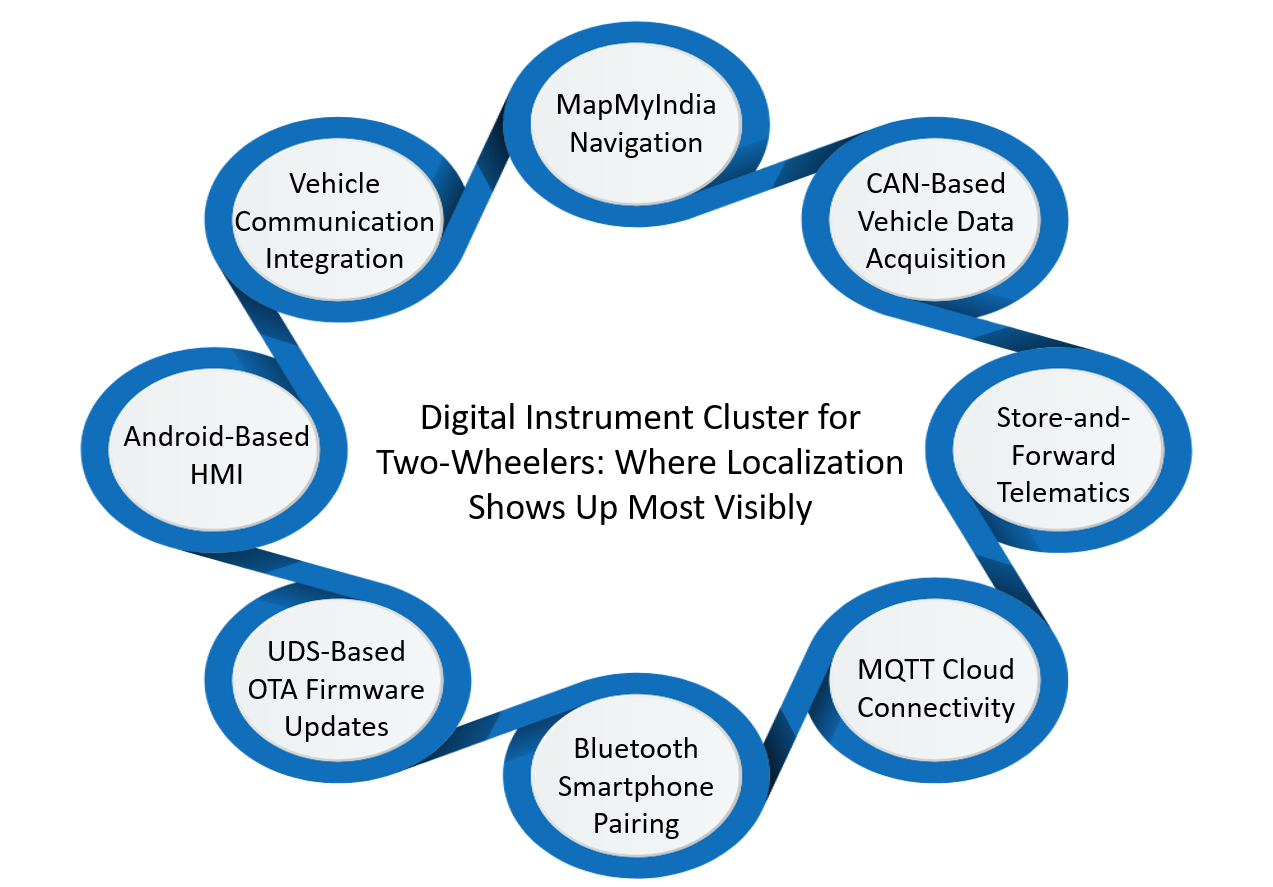
A digital instrument cluster for two-wheelers is where localization engineering becomes most visible to the end rider, and where a design built for a different market's assumptions fails most obviously. Embien's engineering work on Android-based two-wheeler clusters for Indian EV manufacturers has covered exactly this territory: an Android 14 HMI cluster application built on a Qualcomm SM6115 platform with a custom Vehicle HAL and RH850 D1MV2 handling vehicle communication, engineered for seamless dual-core display handoff on boot and integrated MapMyIndia navigation rather than a global mapping provider poorly suited to local road data quality and address formats. A related production program delivered an Android 10 HMI cluster on a Quectel SC200 platform combining CAN-based vehicle data acquisition, MapMyIndia SDK navigation, a telematics engine with store-and-forward for intermittent connectivity, MQTT cloud connectivity, Bluetooth smartphone pairing, and UDS-based over-the-air firmware update of vehicle ECUs, all engineered around the specific connectivity, mapping, and cost realities of the Indian two-wheeler EV market rather than adapted from a design built for a different region.
Store-and-Forward Telematics: Designing for Real-World Connectivity Gaps
Emerging-market two-wheeler EV telematics has to be architected around connectivity that isn't always reliable, cellular coverage gaps in rural or semi-urban areas, intermittent signal in dense urban environments, in a way telematics design for more uniformly connected markets doesn't need to prioritize as heavily. Store-and-forward telematics architecture, buffering vehicle data locally when connectivity drops and syncing once a connection is restored, ensures ride and vehicle health data isn't simply lost during gaps rather than requiring continuous connectivity as an assumption baked into the system design. This kind of connectivity-resilient architecture is a direct consequence of designing for the actual infrastructure conditions a two-wheeler will encounter in its target market, not a generic telematics best practice applied uniformly regardless of where the vehicle ships.
Edge-AI Driver Behavior Analysis and Insurance-Linked Telematics
Beyond navigation and vehicle health, telematics on emerging-market two-wheeler EVs increasingly extends into rider safety and behavior analysis. Embien's work developing a two-wheeler telematics system for a Middle East startup incorporated edge-AI algorithms that analyze ride patterns in real time to generate driver safety ratings directly on the vehicle, data that feeds into insurance models and fleet safety programs without requiring every data point to round-trip through the cloud before being useful. This edge-AI approach to driver rating reflects a broader pattern in two-wheeler EV localization engineering: processing rider behavior data locally on cost-constrained hardware, rather than assuming the cloud connectivity and compute budget four-wheeler telematics platforms often take for granted.
How to Develop Embedded Systems for Electric Vehicles in Cost-Constrained Markets
How to develop embedded systems for electric vehicles at two-wheeler price points starts with an honest bill-of-materials discipline that four-wheeler EV engineering doesn't face nearly as acutely: selecting a compute platform sized precisely for the cluster and telematics functionality actually needed rather than over-provisioning for headroom the price point can't absorb, choosing regional connectivity modules and mapping SDKs that match local infrastructure and cost structures, and designing the software architecture so that OTA update capability, a genuine long-term cost and safety advantage, doesn't require compute or connectivity hardware the vehicle's price point can't support. Programs that get this balance wrong typically end up either over-engineered and unable to hit target price points, or under-engineered in ways that show up as poor real-world reliability and rider trust issues after launch.
Why Localization Engineering Is Now a Competitive Differentiator
As the two-wheeler EV segment matures beyond its earliest adopters, the differentiation between competing platforms increasingly comes down to exactly this localization engineering rather than headline battery specifications alone. A cluster and telematics experience that feels genuinely built for the rider's actual market, responsive local mapping, telematics that keeps working through real-world connectivity gaps, driver safety features tied to locally relevant insurance and fleet programs, builds ownership confidence and brand trust in a way a generically adapted global design struggles to match. This kind of market-specific engineering has moved from a nice-to-have refinement to a genuine competitive requirement for manufacturers competing in these fast-growing markets.
Embien's Capabilities
Embien brings direct engineering experience delivering Android-based digital instrument clusters and telematics systems for two-wheeler EV manufacturers, including dual-core display architectures on Qualcomm and RH850 platforms, MapMyIndia-integrated navigation, store-and-forward telematics engines, and edge-AI driver behavior analysis for insurance-linked fleet safety programs. Our engineering process is built around the specific cost, connectivity, and regulatory realities of the markets our two-wheeler EV customers actually ship into, and it draws on the same discipline we bring to custom ECU software development for electric vehicles (EVs) across body, battery, and motor control domains.
To discuss custom ECU software development for electric vehicles (EVs) or digital cluster and telematics engineering for a two-wheeler EV program, reach out to Embien's engineering team.