
How to design an automated test bench for industrial devices? The short answer is that it starts from the failure modes a manual bench cannot catch reliably: a technician re-wiring a device under test between runs, eyeballing a scope trace, and hand-logging a pass or fail is fine for a handful of prototypes, but it does not scale to the hundreds of regression runs a firmware team needs across a product's life, and it introduces exactly the kind of run-to-run variability that hides real defects. An automated test bench for embedded devices replaces that manual loop with repeatable stimulus generation, automated measurement, and scripted pass/fail logic, so the same test sequence produces the same result whether it runs today or six firmware revisions from now. The justification for building one is rarely a single dramatic failure; it is the accumulated cost of engineers re-verifying the same behavior by hand every time a driver, protocol stack, or calibration routine changes.
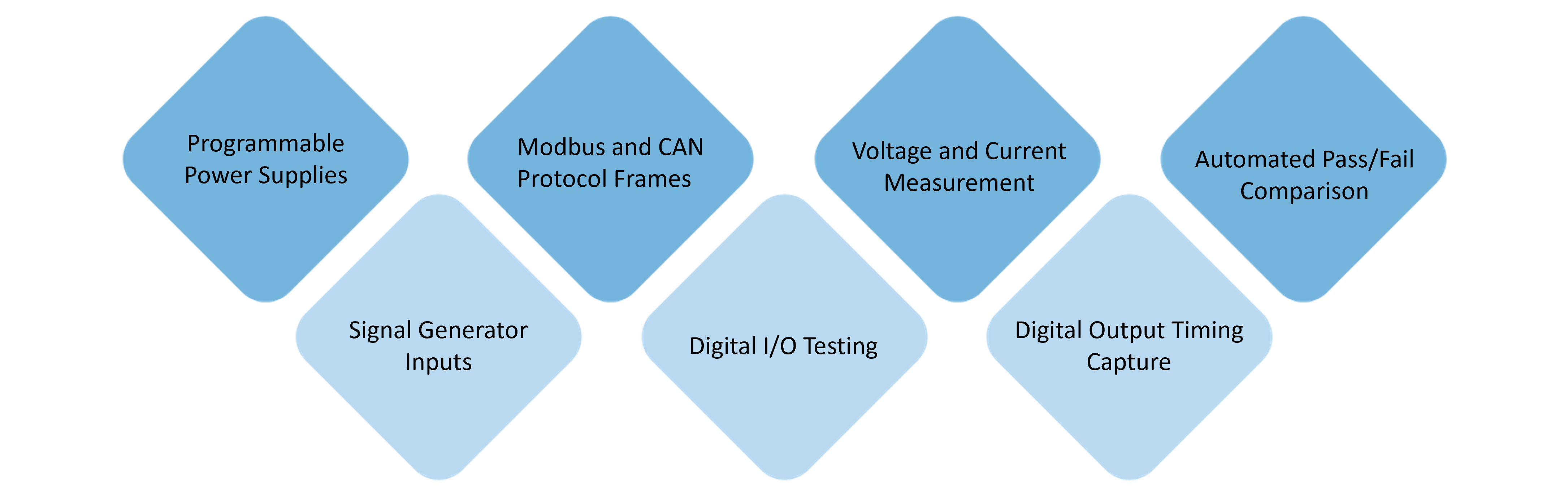
The architecture of an automated test bench for embedded devices splits cleanly into three layers. Stimulus generation drives the device under test with the same inputs it would see in the field, programmable power supplies, signal generators, protocol masters issuing Modbus or CAN frames, and digital I/O forcing GPIO states, all under host control rather than a human hand on a knob. Measurement captures the device's response, voltage and current on its power rails, timing on its digital outputs, and the actual data it reports back over its communication interface, using instrumentation the host can read programmatically rather than a technician reading a meter. Pass/fail logic is the layer that turns raw measurements into a verdict, comparing captured data against expected limits, timing windows, and protocol-level responses, and it is this layer, not the instrumentation itself, that most often separates a bench that merely automates data collection from one that genuinely automates the test.
Good custom embedded test bench design lives or dies on the fixture, the physical interface between the bench and the device under test. A fixture that requires careful hand-alignment of connectors, or that makes inconsistent contact depending on how firmly a technician seats a board, reintroduces exactly the run-to-run variability an automated bench exists to eliminate. Custom embedded test bench design for an industrial device typically means a bed-of-nails or edge-connector fixture purpose-built for that board's connector layout and mechanical tolerances, spring-loaded pogo pins for repeatable low-resistance contact, and keying or sensors that confirm a device is correctly seated before a test sequence begins rather than discovering a bad contact as a false failure partway through. Getting custom embedded test bench design right up front pays back every time the bench runs a regression pass, since a fixture-induced false failure costs an engineer's investigation time just as surely as a real one. This is the fixture-level discipline that separates good automated test bench design for industrial embedded devices from a bench that merely looks automated on paper.
An automated test bench earns its keep over the life of a product, not just at first bring-up, and that means test sequencing and data logging have to be designed for regression testing from day one. A well-structured test sequence runs the same ordered set of stimulus, measurement, and pass/fail steps against every firmware build, and logs full measurement data, not just a pass or fail summary, so an engineer can pull up last month's run and this month's run side by side when a regression appears. Tagging every logged result with the exact firmware version, bench fixture identifier, and timestamp under test turns the log into a searchable history rather than a pile of spreadsheets, and it is this historical trail, more than any single test run, that lets a team catch a slow parametric drift across firmware versions before it becomes a field failure.
The bench a team builds for engineering validation, running a handful of units through a deep characterization sequence, is rarely the bench that belongs on a production line, where the priority shifts to throughput and a simpler go/no-go verdict per unit. Test automation services that plan for this transition from the outset design the test sequence itself as the portable asset, the stimulus, measurement, and pass/fail logic developed and proven during engineering validation, and then adapt the fixture and cycle time for production volume rather than rewriting the test logic from scratch. Treating test automation services as covering the full arc from first-article validation through production test, rather than as two disconnected efforts, is what keeps a device's release-to-production transition from becoming its own re-verification project.
Embien Technologies has designed and delivered an automated test bench for an industrial DAQ device, covering stimulus generation, measurement automation, and pass/fail sequencing purpose-built for that device's fixture and regression needs. That work sits alongside Embien's broader testing and quality assurance engineering, spanning custom embedded test bench design, hardware bring-up validation, and test automation services for industrial and IIoT product lines. Teams evaluating whether to invest in an automated test bench for embedded devices are welcome to discuss their specific device, fixture, and regression requirements with Embien's engineering team.

Embien serves industrial and embedded product markets with engineering expertise in hardware, firmware, device integration, and validation, supporting the development and testing of reliable industrial and IIoT products.

Embien's embedded software development services cover firmware development, device drivers, protocol integration, test automation, and software validation, helping engineering teams build repeatable test sequences and verify embedded device performance across firmware releases.

A case study on developing an automated test bench for an industrial data acquisition device, covering test stimulus generation, measurement automation, and pass/fail sequencing to support repeatable device validation and regression testing.