
Generally, the industrial communication networks used for distributed control of devices and process automation are called the Fieldbus. Of the many fieldbuses in use today, the Profibus Protocol — short for Process Field Bus — is a widely used industrial communication standard that enables reliable and efficient data exchange between devices in automation systems. It was initially developed in the late 1980s/1990s by a consortium of companies in Germany to address the need for a standardized fieldbus communication solution in the industrial sector. Today, the Profibus Protocol has become a global standard via IEC 61158 Type 3, which covers the Application Layer service and protocol, while IEC 61784 specifies the Communication Profile. The Profibus Protocol provides seamless integration of various devices such as sensors, actuators, controllers, and drives. As the first part of a series of articles on the Profibus Protocol, this will focus on the physical layer while later articles deal with the higher-layer protocols.
The Profibus Protocol finds applications in various industries, ranging from manufacturing and industrial process automation to building management and transportation systems. Some common applications include:
Factory automation:The Profibus Protocol enables seamless integration of various devices in a manufacturing environment, such as sensors, drives, and controllers. It facilitates real-time fieldbus communication and control, improving productivity and efficiency.
Process control:The Profibus Protocol is widely used in industrial process automation, including sectors like oil and gas, chemicals, and pharmaceuticals. It enables precise monitoring and control of critical parameters, enhancing safety and productivity.
Building automation:The Profibus Protocol is employed in building management systems to control and monitor various building services such as HVAC (Heating, Ventilation, and Air Conditioning), lighting, and access control. It allows for efficient energy management and centralized control.
Transportation systems:The Profibus Protocol is utilized in transportation systems, including railways and airports, for communication between control systems and devices such as sensors, actuators, and switches. It ensures reliable and timely data exchange for smooth operation and passenger safety.
The Profibus Protocol is an open fieldbus standard that uses a common bus topology where all the devices are connected. Though a common name is used, the Profibus Protocol actually offers different communication profiles to cater to the specific requirements of different end applications. While there are 3 profiles specified — PROFIBUS FMS, Profibus DP, and Profibus PA — the last two are in widespread use today. Let us explore all of them briefly.
PROFIBUS FMS (Fieldbus Message Specification) is a communication profile primarily designed for complex applications that require a high degree of data exchange. It provides advanced features such as message routing, time synchronization, and event-driven fieldbus communication. PROFIBUS FMS is commonly used in industrial process automation and manufacturing execution systems (MES). But due to its complexity, a much simpler profile — Profibus DP — was specified which became the de facto Profibus Protocol standard.
Profibus DP (Decentralized Periphery) is the most used variant of the Profibus Protocol. It focuses on efficient real-time fieldbus communication between automation devices and control systems. As the name indicates, network decentralization is allowed where all the devices can be connected to a single bus without a centralized bus master. Profibus DP employs a master-slave communication mechanism where the master is always in charge of bus control and manages the slave. It is possible to have multiple masters which are managed via a token ring protocol.
Profibus DP is widely adopted in factory automation industries such as automotive, packaging, and food processing. It offers excellent reliability, high-speed data transfer, and easy integration with various devices. Profibus DP can support up to 32 nodes in a typical linear topology that can be expanded using repeaters. Organizations adopting Profibus DP for large-scale industrial process automation benefit from structured digital transformation services that include fieldbus network design, migration planning, and protocol stack integration.
Profibus PA (Process Automation) is a communication profile specifically designed for the process industry. It provides a seamless integration of field devices such as sensors, transmitters, and actuators with control systems. Profibus PA operates on a two-wire Manchester-encoded Bus Powered physical layer that is intrinsically safe, allowing for long cable lengths and adoption in hazardous industrial environments. Though the throughput is slower compared to Profibus DP, Profibus PA offers advanced features like device parameterization and diagnostics, making it ideal for industrial process automation applications with a maximum of 32 nodes.
It is possible to connect both the Profibus DP network and the Profibus PA network together using specialized couplers. Teams integrating Profibus PA into complex plant environments often engage industrial automation services to ensure correct segment sizing, coupler selection, and commissioning across both DP and PA layers.
With an introduction to the different Profibus Protocol communication profiles, let us see how they are mapped to the standard Open Systems Interconnection (OSI) model. The below picture captures the same.
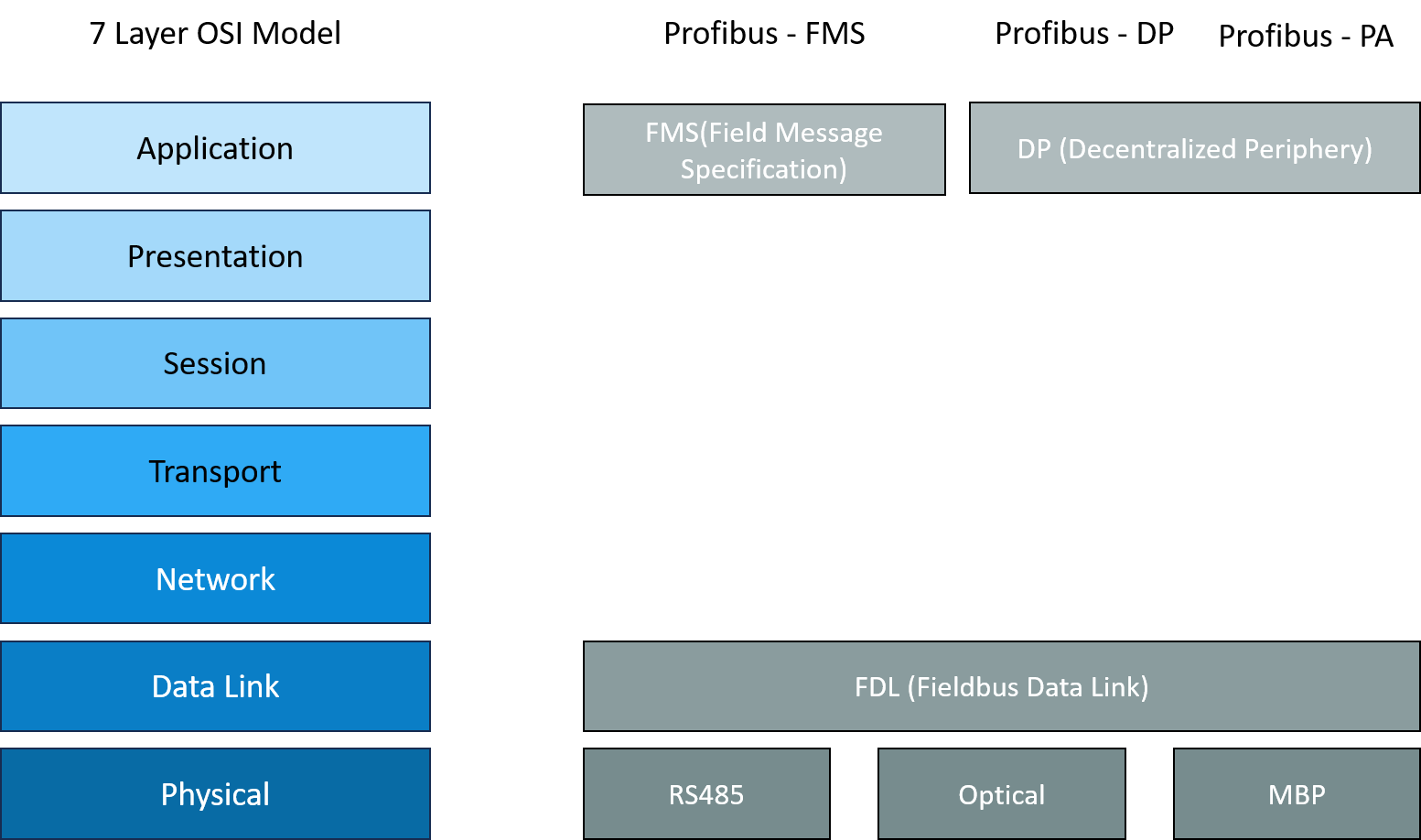
Each layer serves a specific purpose in the data exchange process.
Physical Layer:This layer defines the electrical and mechanical characteristics of the communication medium used in Profibus Protocol networks. It includes specifications for different physical layers such as EIA-485, optical, and MBP (Manchester Coded Bus Powered).
Data Link Layer:The data link layer handles the reliable transmission of data packets over the physical medium. It is responsible for error detection and correction, as well as flow control.
Application Layer:The application layer is where the actual application-specific data is exchanged between devices. It defines the protocols and data structures used in the application layer communication. On top of this, various Profibus Protocol application profiles sit.
None of the intermediate layers like Network, Transport, Session, and Presentation Layers are defined in the specification.
EIA-485 is one of the most commonly used physical layers in Profibus Protocol networks. It is a differential signaling standard with NRZ (no return to zero) encoding that allows for reliable data transmission over long distances. EIA-485 supports multi-drop configurations, where multiple devices can be connected to a single bus. The communication speed can range from 9.6 to 12,000 Kbit/s over a simple twisted, shielded two-wire cable with lengths ranging from 1200 m to 100 m per segment. It can support up to 32 nodes per segment and a maximum of 126 per network with repeaters. This makes it suitable for factory automation systems using the Profibus Protocol.
Optical physical layers utilize fiber-optic cables for data transmission in Profibus Protocol networks. They offer several advantages over traditional copper-based physical layers, such as immunity to electromagnetic interference and longer communication distances. Data speeds can range from 9.6 to 12,000 Kbit/s over multi-mode and single mode glass/PCF/plastic fibers coded with NRZ encoding. The devices in an optical Profibus Protocol network are typically connected in star and ring topology while line is also possible, with the maximum number of nodes going up to 126. Optical Profibus Protocol networks are commonly used in applications where noise and harsh environments are a concern, such as power plants and petrochemical facilities.
MBP, or Manchester Coded Bus Powered, is a physical layer specifically designed for Profibus PA networks within the Profibus Protocol ecosystem. It utilizes a bus-powered approach, where the communication signal is derived from the bus voltage itself. This eliminates the need for external power supplies for field devices, simplifying installation and reducing costs. As the name implies, it uses bit-synchronous Manchester coding at 31.25 Kbit/s over simple twisted, shielded two-wire cables. Like its RS485 counterpart, the count of devices in a segment can go up to 32 nodes with a maximum of 126 nodes per network. Possible bus topologies include line and tree. The MBP physical layer is well-suited for industrial process automation applications in hazardous industries where power availability and safety are a concern. Embien’s expertise in product engineering and manufacturing automation enables seamless integration of PROFIBUS-based industrial networks.
The Profibus Protocol stands as a foundational fieldbus communication standard, enabling deterministic and reliable data exchange between controllers, sensors, and actuators in factory and industrial process automation environments. Whether deploying Profibus DP for high-speed factory networks or Profibus PA for intrinsically safe process environments, the Profibus Protocol's multi-profile architecture ensures it meets the demanding requirements of modern industrial operations.

Strategic digital transformation services for industrial operations, enabling seamless Profibus Protocol and fieldbus network modernization to meet Industry 4.0 requirements.

Comprehensive industrial automation services covering Profibus DP and PA integration, network commissioning, and device configuration for process and factory automation.

A case study on implementing automated instrument panel testing using a panel key controller for efficient embedded system validation.