
Edge AI vs Cloud AI: The Core Trade-Off

Edge AI runs machine learning inference directly on the device or local gateway — no internet connectivity required, decisions in milliseconds. Cloud AI sends data to remote servers for inference, then returns results. The edge AI vs cloud AI choice determines your product's latency, privacy posture, connectivity dependency, operating cost, and hardware complexity. Most modern IoT and embedded AI products use both, intelligently routing inference decisions between edge and cloud.

When Edge AI Wins: Key Use Cases

Latency-Critical Applications

Latency in AI inference is the primary driver for choosing edge AI over cloud AI. A cloud round-trip adds 50–200ms in ideal conditions — catastrophic for:

  • Autonomous vehicle ADAS — an object detection miss at 100 km/h during a 100ms cloud latency is a 2.8-metre blind zone.
  • Industrial machine vision — production lines running at 1000 parts/minute require sub-10ms defect detection decisions.
  • Surgical robotics — haptic feedback loops must complete in under 1ms; cloud AI is physically impossible here.
  • Wake-word detection — always-on voice recognition must run in under 30ms with sub-milliwatt power; only on-device machine learning achieves this.

Privacy and Data Sovereignty

On-device machine learning keeps sensitive data on the device, never transmitting it to external servers. This is critical for:

  • Medical wearables processing biometric data under HIPAA or GDPR.
  • Industrial systems in air-gapped OT networks where external connectivity is prohibited.
  • Consumer devices where users reject cloud surveillance of their environment.

Connectivity-Constrained Environments

Edge AI operates without internet connectivity — essential for agricultural IoT sensors in rural areas, offshore industrial equipment, underground mining automation, or any deployment where connectivity is intermittent or expensive (cellular data costs).

Cost at Scale

Cloud AI inference costs scale with API calls and data transfer. At IoT scale — millions of devices making thousands of inferences per day — on-device machine learning eliminates per-inference cloud costs entirely. A TinyML model running on a $2 microcontroller replaces a cloud API subscription costing hundreds of dollars per month per device.
When Cloud AI Wins

When Cloud AI Wins

Despite edge AI's advantages, cloud AI remains better for:

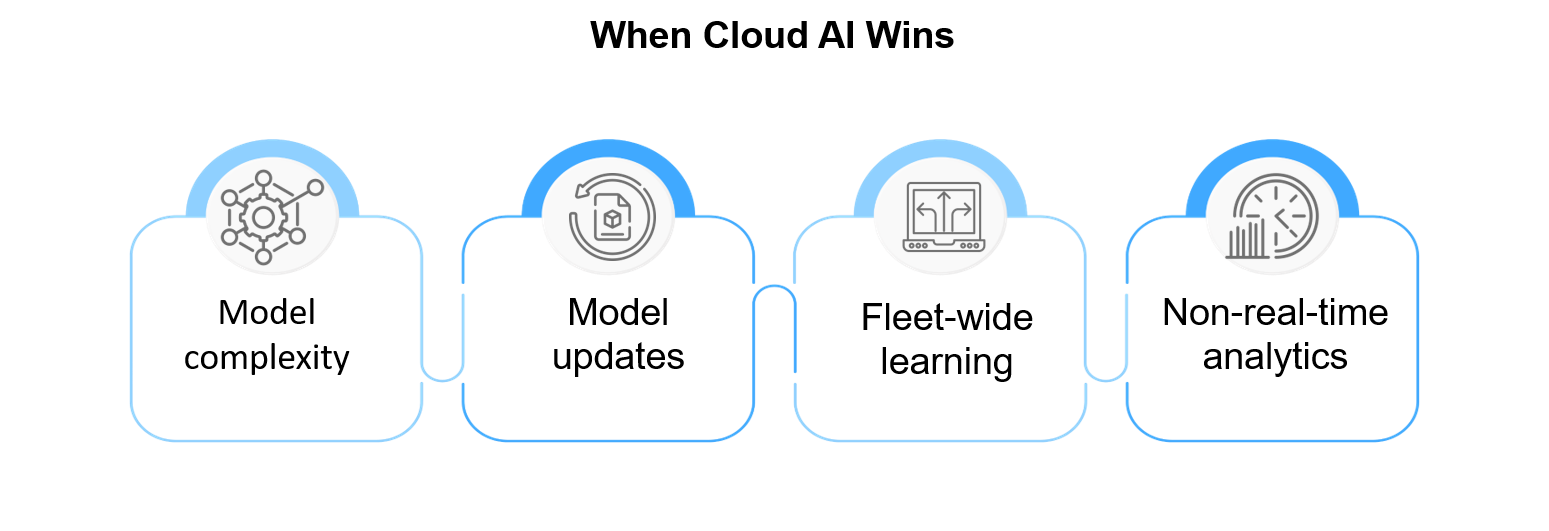
  • Model complexity: Large language models, high-resolution image classification with thousands of classes, and complex recommendation systems require compute resources no embedded device can provide economically.
  • Model updates: Cloud AI inference uses the latest model version automatically. Edge AI requires OTA firmware updates to deploy new models — adding engineering overhead.
  • Fleet-wide learning: Federated learning aside, centralised cloud AI can learn from the entire fleet's data simultaneously, improving accuracy faster than any single edge device could.
  • Non-real-time analytics: Batch reporting, trend analysis, and long-horizon prediction — supply chain forecasting, predictive maintenance across a factory fleet — are ideal cloud AI workloads.

The Hybrid Edge-Cloud AI Architecture

The most common approach in sophisticated embedded AI products is a hybrid edge AI vs cloud AI architecture:

  1. Edge AI layer: Lightweight TinyML or optimised CNN running on the embedded device handles time-critical inference (anomaly detection, keyword spotting, object presence). Results are acted on immediately.
  2. Local gateway AI: A more powerful edge server or gateway (NVIDIA Jetson, industrial PC) handles more complex inference (full object detection, vibration spectrum analysis, multi-camera processing) for the local site without cloud dependency.
  3. Cloud AI layer: Aggregated events, model retraining data, and fleet-wide analytics are sent to the cloud for large-model inference, trend analysis, and model improvement pipelines.

Embien's Edge AI and Embedded ML Engineering

Embien Technologies designs and develops edge AI solutions across the full edge AI vs cloud AI spectrum. Our embedded ML team works with TensorFlow Lite for Microcontrollers (TinyML), NVIDIA TensorRT on Jetson, NXP eIQ on i.MX processors, and Xilinx Vitis AI on FPGA platforms to deploy the right inference stack for each product's latency and power requirements.

We help clients architect the optimal hybrid AI system — defining which inference tasks belong at the edge, which at a local gateway, and which in the cloud — and then implement the complete solution from embedded hardware design through ML model optimisation and cloud backend development.

« WHAT IS PHYSICAL AI? DEFINITION, EXAMPLES AND EMBEDDED DEVELOPMENT GUIDE
WHAT IS EMBEDDED PRODUCT ENGINEERING? DEFINITION, LIFECYCLE AND BEST PRACTICES »

Related Content

Edge Computing Services
insight image

Build low-latency Edge AI solutions with on-device intelligence, real-time data processing, and reliable operation at the network edge.

Read More


Cloud Services
insight image

Embien develops scalable cloud platforms for AI model management, fleet analytics, device connectivity, and hybrid edge-cloud deployments.
Read More


Modbus RTU to Cloud Gateway Development with IP40 Enclosure
insight image

A case study on developing an industrial Modbus RTU-to-cloud gateway with IP40 enclosure, enabling secure remote monitoring, protocol conversion, and cloud connectivity.

Read More


Subscribe to our Insights