What is Embedded Product Engineering?
Embedded product engineering is the end-to-end discipline of designing, developing, and validating products whose core function is delivered by an embedded computing system — a combination of purpose-built hardware (microcontrollers, SoCs, FPGAs), real-time firmware, and application software running together to perform a specific task. Unlike general-purpose computing, embedded product engineering targets products where hardware and software are co-designed as a single integrated system.
Embedded product engineering covers the complete journey from initial product concept through hardware design, PCB layout, FPGA development, firmware, BSP, application software, testing, certification, and production readiness.
The Embedded System Development Lifecycle
The embedded system development lifecycle in embedded product engineering follows a structured process:
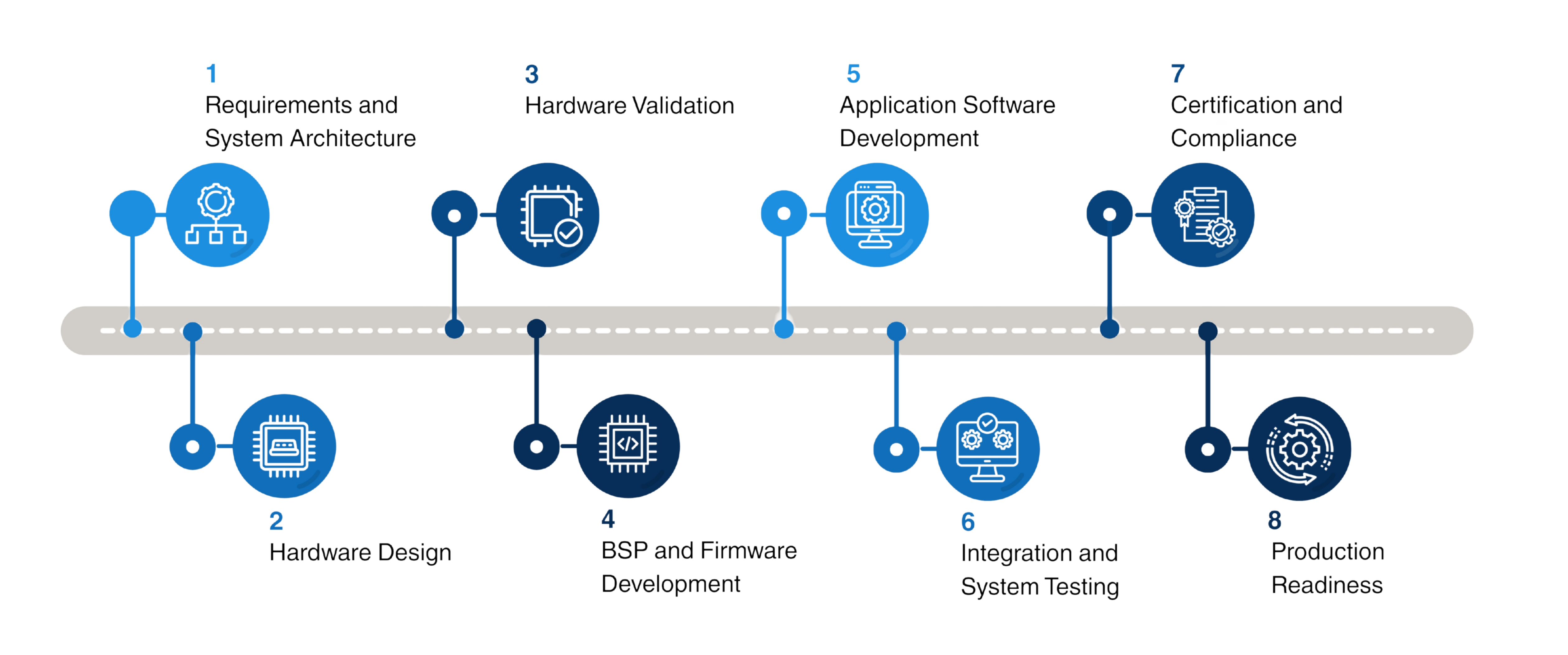
- Requirements and System Architecture: Defining functional requirements, non-functional constraints (power, size, cost, BOM target), safety and regulatory requirements (ISO 26262, IEC 62304, IEC 61508), and the high-level hardware-software partitioning.
- Hardware Design: Schematic capture, component selection, PCB stack-up design, EMI/EMC mitigation, thermal analysis, and DFM (Design for Manufacturability) review. FPGA design (RTL coding in VHDL/Verilog, synthesis, place-and-route, timing closure) is often part of this phase.
- Hardware Validation: Bring-up of prototype boards, functional verification, signal integrity measurements, power sequencing validation, and pre-compliance EMC testing.
- BSP and Firmware Development: Writing the Board Support Package — bootloader configuration, device drivers for all peripherals, OS porting (Linux, RTOS, bare-metal), and system initialisation. Hardware software co-design is critical here: firmware choices impact hardware requirements and vice versa.
- Application Software Development: Building the domain-specific application logic on top of the BSP/OS — control algorithms, communication stacks, user interface, data logging, OTA update clients.
- Integration and System Testing: Validating the complete embedded system against requirements — unit tests, integration tests, HIL (Hardware-in-the-Loop) simulation, and system-level functional testing.
- Certification and Compliance: Preparing technical files and executing test campaigns for regulatory certifications (FCC, CE, UL, RoHS, automotive functional safety, medical device regulations).
- Production Readiness: NPI (New Product Introduction) support, test fixture development, JTAG/ICT test coverage, manufacturing test strategy, and initial production supervision.
Hardware Software Co-Design in Embedded Product Engineering
Hardware software co-design is the defining characteristic that separates embedded product engineering from either pure hardware design or pure software development. The embedded system development lifecycle requires:
- Hardware engineers understanding firmware timing requirements and driver architecture before finalising peripheral selection.
- Firmware engineers understanding PCB constraints — bus speeds, pin assignments, interrupt routing — before writing device drivers.
- Joint decisions on which functions to implement in hardware (FPGA/ASIC) versus firmware (MCU) versus application software.
This hardware software co-design discipline is what embedded product engineering companies like Embien bring — teams that can reason across the entire stack simultaneously, rather than handing requirements over a wall between hardware and software teams.
Key Technical Domains in Embedded Product Engineering
- Microcontroller and SoC Firmware: Bare-metal or RTOS-based embedded C firmware for ARM Cortex-M/A, RISC-V, NXP, Renesas, STM32 platforms.
- Embedded Linux BSP: Yocto/Buildroot-based Linux distributions, U-Boot bootloader, kernel device drivers, and board-specific customisation.
- FPGA Design: RTL design and verification (Xilinx Vivado, Intel Quartus), IP integration, high-speed interface bridging (MIPI, PCIe, Ethernet), and custom logic acceleration.
- Communication Stacks: CAN, CAN FD, Ethernet, SOME/IP, Modbus, Profinet, BLE, Wi-Fi, cellular — selecting and integrating the right communication architecture for the product.
- Edge AI Integration: Deploying ML models on embedded hardware using TensorFlow Lite, ONNX Runtime, NXP eIQ, or NVIDIA TensorRT.
Embien Technologies: A Full-Lifecycle Embedded Product Engineering Company
Embien Technologies is a full-lifecycle embedded product engineering company founded in 2010, with engineering teams in the USA, India, Germany, and Israel. We deliver complete embedded product engineering services across automotive, industrial, medical, IoT, and consumer electronics.
Our embedded system development lifecycle capability spans hardware design and PCB layout, FPGA design, BSP and embedded Linux, RTOS firmware, protocol stack development, edge AI integration, and regulatory compliance support. As an NXP Independent Design House (IDH) and Renesas partner, Embien brings deep silicon expertise to embedded product engineering engagements.