
In the world of automotive fleet management, "telematics" has been the gold standard for a decade. But as any CTO or Engineering Manager knows, a GPS coordinate and a fuel level reading are no longer enough to win the war on operational efficiency. We have reached the limits of reactive data. To truly optimize a fleet, we must move from tracking to twinning.
The "Digital Twin" is often dismissed as a buzzword, yet the engineering reality is far more rigorous. It is the high-fidelity, bidirectional synchronization of a physical vehicle with a virtual model that accounts for its history, current state, and future trajectory.
For companies seeking Digital Twin implementation services, the challenge isn't just "gathering data",it’s architecting a system that survives the harsh environment of the road while delivering actionable intelligence in the cloud. In this article, let us have a look at Fleet Management Digital Twin and how it can increase overall efficiency by among others performing Predictive Maintenance for Fleets, doing Remaining Useful Life (RUL) estimation etc.
Despite advancements, fleet operators still grapple with three core engineering hurdles:
High-Latency Decision Making: Traditional telematics sends data to the cloud, waits for processing, and alerts a manager. By then, the engine had already overheated, or the driver has already completed an inefficient route.
Data Fragmentation: A fleet is rarely homogeneous. Integrating data from disparate ECUs (Engine Control Units), aftermarket sensors, and legacy J1939 or CAN-based systems into a unified model is a significant roadblock.
The Predictive Gap: Knowing that a truck broke down is easy. Predicting when a specific water pump will fail based on unique vibration patterns and ambient temperature is where most implementations fail.
A robust Automotive Digital Twin architecture for fleet use isn’t a single software package; it’s a multi-layered ecosystem that forms the foundation of any production-grade Fleet Management Digital Twin.
At the heart of the vehicle is the Telematics Control Unit (TCU). To build a twin, the TCU must do more than "pass-through" data. It requires high-speed access to the vehicle's internal nervous system,the CAN-FD (Controller Area Network Flexible Data-Rate) or Automotive Ethernet.
Protocol Mastery: The system must parse thousands of PGNs (Parameter Group Numbers) from the J1939 stack or use UDS (Unified Diagnostic Services) to pull deep-seated error codes.
Edge Filtering: Sending raw CAN data (1 Mbps+) to the cloud is cost-prohibitive. The "Engineering Reality" dictates that the edge must perform feature extraction,computing FFTs for vibration or detecting anomalies locally before transmitting only the "delta" to the twin.
For a twin to be "live," the connection must be stateful. We favor MQTT with Sparkplug B or SOME/IP for cloud communication. These protocols ensure that even during cellular dead zones, the twin maintains a "last known good state" and resynchronizes with high temporal accuracy once back online.
This is where intelligence resides. A true Fleet Management Digital Twin uses a hybrid approach:
Physics-Based Modeling: Simulating the thermodynamics of the engine or the discharge rate of an EV battery based on mathematical equations.
Data-Driven AI: Using Machine Learning to identify patterns that physics models miss, such as the correlation between specific driver habits and premature brake pad wear.
Traditional maintenance is based on mileage (e.g., change oil every 10k miles). Predictive Maintenance for Fleets via Condition-Based Maintenance changes this entirely. By monitoring oil viscosity sensors and engine load history, the Fleet Management Digital Twin calculates the Remaining Useful Life (RUL) of components. This Predictive Maintenance for Fleets approach prevents "over-maintenance" while eliminating "catastrophic failures."
A digital twin of the route (including elevation, traffic, and weather) interacts with the digital twin of the vehicle (current weight, tire pressure, fuel efficiency). This allows for Real-Time Route Optimization that accounts for the vehicle’s specific state, not just the shortest path on a map.
For Electric Vehicles, the digital twin is indispensable. It monitors state-of-charge (SoC), state-of-health (SoH), and discharge patterns. By simulating the impact of uphill climbs or cold weather on a specific vehicle's battery twin, fleet managers can guarantee range with 99% accuracy.
When companies look for Digital Twin implementation services, they often focus on the "cloud dashboard." This is a mistake.
In the automotive domain, the fidelity of your Fleet Management Digital Twin is strictly capped by the quality of your Embedded Firmware and Middleware. If your firmware cannot handle a high concurrency CAN stream without dropping frames, your digital twin is effectively blind. If your middleware doesn't support secure, atomic FOTA (Firmware-Over-The-Air) updates, your twin will become obsolete as new sensors are added.
Essential Technical Checklist for Implementation:
Data Synchronization: Ensuring timestamps from various ECUs are synchronized within milliseconds (Time-Sensitive Networking).
Cybersecurity: Implementing ISO/SAE 21434 standards to prevent "Twin Injection" attacks where false data is sent to the cloud.
Scalability: Handling 10,000+ twins concurrently without hitting cloud throughput bottlenecks.
At Embien Technologies, we approach Digital Twins from the ground up. Our philosophy is simple: You cannot have digital intelligence without physical integrity.
With over a decade of experience in Product Engineering, Automotive Telematics and Predictive Maintenance for Fleets, we provide more than just one platform; we provide the foundational "brains" of the vehicle.
Our RAPIDSEA Automotive Stacks:Our production-ready UDS, J1939, and CAN-FD stacks ensure that your data acquisition is flawless from day one.
Embedded Expertise:We specialize in the "Middleware Gap", creating the secure, low-latency bridge between complex vehicle electronics and cloud-based AI models.
Telematics Solutions:From custom TCU hardware design to secure FOTA pipelines, we ensure your physical assets are as agile as your digital models.
If you are looking to move beyond simple tracking and want to build a high-fidelity Fleet Management Digital Twin that drives real ROI, reach out to Embien’s engineering team today. We don’t just build twins; we engineer the reality that makes them possible. Embien’s product engineering services cover the full TCU and telematics stack — from custom hardware design and FOTA pipelines to secure middleware that bridges vehicle electronics with cloud-hosted fleet twins. Our semiconductor development support ensures the silicon platforms powering iot solutions for fleet management are validated for automotive-grade reliability across extended deployment lifetimes. Edge computing enables Digital Twins to move beyond telematics by delivering low-latency insights and faster operational decisions.
A Fleet Management Digital Twin is only as intelligent as the firmware feeding it data — high-concurrency CAN-FD parsing, accurate J1939 decoding, and latency-tolerant MQTT synchronisation determine whether the Automotive Digital Twin reflects vehicle reality or a distorted approximation. Combining robust fleet tracking and telematics firmware with proven Predictive Maintenance for Fleets strategies delivers the reliability and ROI that modern fleet operators demand.

Explore how Embien's cross-domain embedded expertise — spanning automotive, industrial, and IoT — underpins fleet management digital twin platforms that go beyond basic telematics.

Learn how Embien's automotive electronics development services deliver the TCU firmware, CAN-FD stacks, and FOTA pipelines that feed accurate, real-time data into Fleet Management Digital Twin systems.
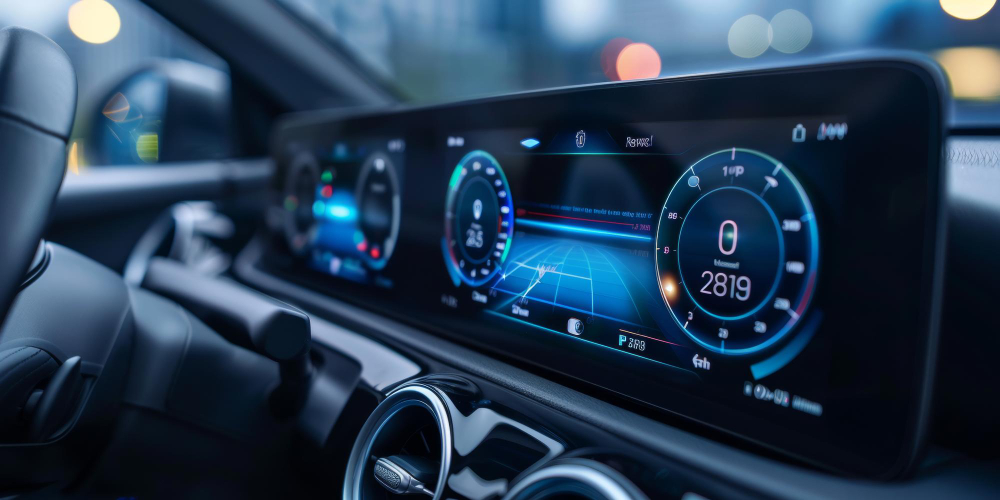
A real-world fleet embedded case study: Embien developed an Android Automotive smart cluster on i.MX8 — showcasing the vehicle-side embedded engineering that drives fleet management digital twin accuracy.