
The healthcare industry is standing at the precipice of a paradigm shift. As we move from reactive care to proactive, data-driven interventions, the integration of Digital Twins in Healthcare is no longer a futuristic concept, it is a technical necessity. At Embien Technologies, we view Digital Twin as the ultimate bridge between hardware-constrained physical assets and high-level digital intelligence.
In this installment of The Engineering Reality of Digital Twins, we explore the technical architecture, regulatory hurdles, and implementation strategies for Medical Device Twins and their role in Remote Patient Monitoring (RPM) and IoMT development.
In the context of the Internet of Medical Things (IoMT), a Digital Twin is more than a 3D CAD model. It is a dynamic, high-fidelity virtual representation of a physical medical device or a biological system, synchronized via real-time data streams.
For developers and stakeholders, the implementation of Medical Device Twins involves tripartite architecture:
The Physical Edge: The medical device (e.g., an infusion pump or MRI scanner) equipped with high-precision sensors.
The Communication Layer: Secure, low-latency protocols (MQTT, CoAP, or LwM2M) that transport telemetry data.
The Digital Entity: A cloud-based or edge-based model that utilizes physics-based simulation and machine learning to predict behavior.
By leveraging IoMT Development best practices, we can create bidirectional synchronization where the digital twin not only monitors the device but can also send optimized configuration parameters back to the physical hardware. Let us now look at the two types of Digital Twins in Healthcare.
For high-capital medical equipment like MRI and CT machines, downtime isn't just a financial loss, it’s a patient safety risk. Medical Device Engineering is now shifting toward "Asset Health Twins."
A robust device twin for an MRI suite requires monitoring critical parameters:
Cryogen Levels & Pressure: Predicting helium leaks or quench risks.
Gradient Coil Thermal Profiles: Using thermal modeling to predict insulation breakdown.
Bearing Wear in Gantry Rotation: Vibration analysis via MEMS sensors to detect mechanical fatigue.
The Engineering Reality: Developers must implement "Edge Intelligence" to filter high-frequency sensor data before it hits the cloud. One can utilize advanced signal processing algorithms on the edge to identify "anomalous signatures" without overwhelming the bandwidth, ensuring that predictive maintenance alerts are generated weeks before a failure occurs.
While device twins focus on hardware, Patient Twins represent the synchronization of physiological data to simulate drug reactions or disease progression. This is the bedrock of future Remote Patient Monitoring systems.
The Evolution of RPM: Traditional RPM collects data (heart rate, SpO2) and sets thresholds. A Digital Twin approach, however, creates a baseline "Normal" for a specific individual.
In Silico Simulation: By feeding a patient’s historical and real-time data into a physiological model, clinicians can simulate how a patient might react to a specific dosage of a drug (e.g., insulin or anticoagulants) before it is administered.
Closed-Loop Systems: In devices like the artificial pancreas, the Digital Twin acts as a controller, predicting blood glucose trends and adjusting insulin delivery in real-time.
Engineering a Digital Twins in Healthcare use is not the same as building one for a factory floor. The regulatory scrutiny is significantly higher.
IEC 62304 Compliance: This standard governs the life cycle of medical device software. When building a Medical Device Twins, the "software-as-a-medical-device" (SaMD) components must adhere to rigorous configuration management, unit testing, and risk management protocols.
FDA Premarket Submissions: The FDA increasingly looks for "Verification and Validation" (V&V) of the computational models used in Digital Twins. If your twin makes diagnostic or treatment recommendations, it must be validated against clinical data.
Data Privacy (HIPAA/GDPR): Since Digital Twins deal with highly sensitive Patient Health Information (PHI), end-to-end encryption and robust identity management are non-negotiable.
To help visualize the implementation, we propose the following architectural layers for the Medical Device Twins:
Data Acquisition Layer: Multi-sensor fusion (Temp, Flow, Bio-impedance) + ARM Cortex-M/M-based Edge processing.
Connectivity Layer: TLS 1.3 secured pipes, utilizing Wi-Fi 6 or 5G for high-bandwidth medical imaging data.
Modeling Layer:
Physics-Based: Finite Element Analysis (FEA) for mechanical stress.
Data-Driven: RNN/LSTMs for time-series physiological data.
Application Layer: Clinician Dashboards, Predictive Maintenance Portals, and API gateways for EHR integration.
At Embien Technologies, we don't just build software; we engineer medical-grade solutions. Our experience in Medical Electronics allows us to understand the nuances of low-power design, electromagnetic compatibility (EMC), and the critical nature of deterministic performance.
Why partner with Embien for your Digital Twin implementation and IoMT Development?
Deep Domain Expertise: We have a proven track record in developing Class II and Class III medical device software.
End-to-End Capability: From FPGA-based high-speed data acquisition to cloud-scale AI modeling, we cover the entire "Sensor-to-Cloud" spectrum.
Regulatory Readiness: Our internal processes are aligned with ISO 13485 and IEC 62304, significantly reducing your time-to-market.
Customizable Frameworks: We offer pre-built IoT frameworks that can be tailored to your specific device, ensuring a cost-effective Digital Twin rollout. From FPGA-accelerated data acquisition to cloud-scale AI modelling for remote patient monitoring, Embien covers the full spectrum of healthcare IoT device development. Our product engineering services include Class II and Class III medical device software development aligned with ISO 13485 quality systems, and our semiconductor development support ensures the silicon platforms driving your Medical Device Twins deliver the EMC performance and long-term supply chain stability that MedTech programmes require.
Medical Device Twins represent the convergence of IoMT Development rigour and clinical data intelligence — every sensor interface, communication protocol, and ML inference pipeline must satisfy IEC 62304, ISO 13485, and FDA premarket submission requirements. Spanning from device asset health monitoring to Digital Twins in Healthcare for in silico trials, IoMT Solutions grounded in regulatory-ready embedded engineering are what transform this technology from a research concept into a certified clinical tool.

Explore how Embien's digital transformation services help medtech companies adopt IoMT Development practices and build the connected data pipelines that power Medical Device Twins and in silico clinical trials.

Learn how Embien's medical device engineering services deliver IEC 62304-compliant firmware, sensor fusion, and Digital Twins in Healthcare — from Class II device prototyping through regulatory submission support.
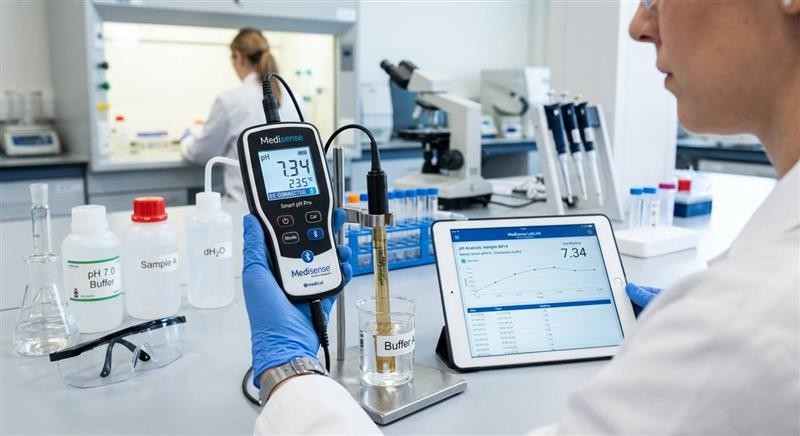
A real-world IoMT case study: Embien built a BLE-connected smart pH meter for medical instrumentation — the kind of connected medical device that generates the clinical data streams feeding a Medical Device Twin.