
The way humans interact with machines is undergoing its most profound transformation since the invention of the graphical user interface. Next-Gen Human-Machine Interfaces are no longer just about buttons, knobs, or even touchscreens — they are becoming truly intuitive, predictive, context-aware, and increasingly invisible.
Today's operators, drivers, surgeons, and technicians don't want to "operate" a machine — they want to communicate with it as naturally as they would with another human being. This shift from mechanical control to intuitive experience is not optional. It is now a competitive necessity across every major industry. Human machine interface hmi development has accordingly matured from a niche discipline into a core product engineering competency.
In automotive cockpits, a poorly designed HMI directly correlates with driver distraction and accidents. NHTSA studies continue to show that interfaces requiring more than 2 seconds of visual attention dramatically increase crash risk. Next-Gen Human-Machine Interfaces that combine voice, gesture, and haptic feedback have been shown to reduce driver eyes-off-road time by up to 70%.
In industrial automation, legacy panel-based HMIs contribute to 20–30% of operator errors during critical tasks. Companies that have migrated to multimodal HMI systems (voice + gesture + touch) report 15–25% productivity gains and significant reductions in training time. Thorough HMI Design is what enables this productivity step change — it is not simply about aesthetics but about reducing cognitive load at every interaction point.
Medical devices represent the highest stakes: intuitive Next-Gen Human-Machine Interfaces in surgical robots (da Vinci, Medtronic Hugo) have reduced procedure times by 18–22% while improving precision. In consumer electronics and smart manufacturing, the HMI is now the primary brand differentiator — Tesla's minimalist cockpit, John Deere's voice-first tractor interfaces, and Siemens' context-aware factory panels are prime examples.
The message is clear: organizations that treat HMI Design as an afterthought will be outpaced by those who treat it as a strategic advantage.
The foundation of Next-Gen Human-Machine Interfaces is the explosion of sensing and feedback technologies that finally make "natural" interaction possible. Modern human machine interface hmi development draws on a broad stack of hardware and software components that must be co-designed from the outset.
High-resolution capacitive touch is now table stakes. The real revolution in human machine interface hmi development comes from:
Recent times have seen haptic technology mature beyond simple vibration motors:
Large Language Models have finally delivered on the decade-old promise of natural voice control. Modern automotive and industrial Next-Gen Human-Machine Interfaces now feature:
The result? Operators can now say "Show me bearing temperature trends for line 3 last shift" and get an instant augmented overlay, without ever touching a screen. Qt embedded development frameworks are frequently the rendering engine of choice for these real-time voice-controlled dashboards on resource-constrained SoCs.
The smartphone generation has fundamentally changed what users will tolerate. Where once a 40-hour HMI Design training course was acceptable for a new factory line, today's technicians expect to be productive in under 2 hours. Drivers expect their car to understand "I'm cold" or "play something energetic" without predefined commands. Surgeons want interfaces that adapt to their handedness and preferred workflow automatically.
Research from Gartner shows that 68% of industrial enterprises cite "operator resistance to new systems" as their biggest digital transformation barrier — almost entirely due to poor HMI Design decisions made early in the product lifecycle.
Users now demand:
These expectations make HMI Design a multidisciplinary endeavor that spans ergonomics, embedded software, and AI — a reality that professional human machine interface hmi development teams must embrace from day one.
This is where recent years truly separate Next-Gen Human-Machine Interfaces from everything that came before. Advanced AI/ML algorithms are now embedded directly into the HMI stack. Key capabilities clients look for today include:
Delivering these AI capabilities on embedded hardware demands rigorous gui development for embedded devices — from framebuffer management and GPU shader optimisation to compositing pipelines that sustain 60 fps on microcontrollers and application processors alike.
Looking ahead, the convergence of several technologies will push Next-Gen Human-Machine Interfaces into genuinely cognitive territory:
Bringing these capabilities to market requires end-to-end expertise in qt embedded development for smooth real-time rendering on constrained SoCs, as well as comprehensive gui development for embedded devices that spans UX research through hardware-specific optimisation. The evolution of next-generation HMIs is driven by embedded graphics solutions like Embien's Sparklet, enabling rich and responsive interfaces.
Next-Gen Human-Machine Interfaces are redefining interaction across every industry — from automotive cockpits to surgical robots — by combining advanced sensing, AI-driven prediction, and multimodal feedback into experiences that feel intuitive rather than operated, and the teams that invest in rigorous HMI Design and human machine interface hmi development practices today will set the competitive standard for the next decade. Embien serves diverse domains including automotive, industrial automation, healthcare, and consumer embedded systems through next-gen HMI solutions.

Embien's product engineering services cover the full HMI development lifecycle — from GUI architecture and Qt embedded development to ISO 26262/IEC 61508 certified production delivery on automotive, industrial, and medical platforms.

Embien's UI/UX design services blend ergonomic research with embedded constraints to deliver multimodal HMI designs — voice, gesture, touch, and haptic — that reduce operator training time and improve safety outcomes.
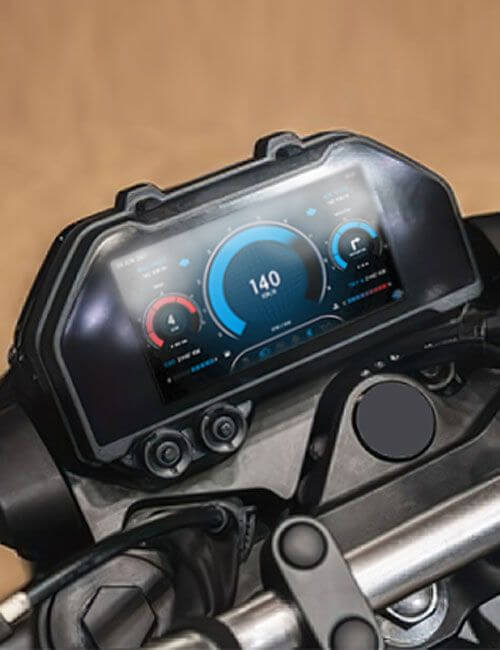
A showcase of Embien's GUI development for embedded devices: a high-performance interactive digital cluster built on the NXP i.MX RT1170 using the Sparklet embedded GUI framework, delivering smooth animations at 60 fps on a microcontroller.