For years, the engineering community viewed the Digital Twin as a mirror, a passive, high-fidelity reflection of a physical asset. We focused on the telemetry, the one-to-one mapping of sensors to virtual nodes, and the synchronization of state. But as we stand at a time when the "Mirror Age" is ending.
The next decade will be defined by Agency. We are moving from twins that tell us what is happening, to autonomous systems that decide what should happen and execute it without a human clicking "Confirm."
In this final installment of our series, The Engineering Reality of Digital Twins, we explore the convergence of Agentic AI, threaded intelligence, and the shift toward fully autonomous industrial ecosystems.
The most immediate shift in the Next Decade of Digital Twins isn't just better physics models; it is the move from Reflection to Agency — the death of the passive dashboard. For decades, the primary interface for a Digital Twin has been a complex UI of charts and 3D heatmaps. This creates a cognitive load for operators who must synthesize data to find insights.
We are now integrating Large Language Models (LLMs) and specialized Small Language Models (SLMs) as the semantic layer over the twin. Instead of querying a database for "vibration anomalies in Pump 4," an engineer simply asks the Twin: "Why is Pump 4's efficiency dropping compared to its baseline last summer?"
The AI agent doesn't just retrieve data; it performs Reasoning. It analyzes the correlation between ambient temperature, lubricant viscosity, and historical wear patterns. It acts as a translator between the raw binary of sensors and the strategic language of engineering.
In the traditional "Human-in-the-loop" model, the twin provides an alert, and a human intervenes. In the next decade, we transition to "Human-on-the-loop".
In this paradigm, the Digital Twin, powered by Reinforcement Learning (RL) and Agentic AI, proposes and executes micro-adjustments in real-time. The human role shifts from Operator to Supervisor, intervening only when the system’s confidence score falls below a specific threshold or when ethical/safety constraints are triggered.
The industry has largely mastered the single-asset twin. The next decade is about Scale and Interconnectivity. We are seeing the rise of Threaded Intelligence, where individual twins are woven together into a cohesive "Twin-of-Twins" (ToT) ecosystem.
Imagine a factory where the "Robotic Arm Twin" talks to the "Conveyor Twin," which in turn communicates with the "Inbound Logistics Twin." If a shipment of raw materials is delayed by a storm in the Atlantic, the Supply Chain Twin doesn't just notify the manager; it automatically signals the Factory Twin to recalibrate production speeds to prevent a bottleneck, optimizing energy consumption in the process.
This requires a move toward Semantic Interoperability. At Embien, we are seeing a shift from proprietary data formats to standardized frameworks like Asset Administration Shell (AAS) and Ontology-based Data Access (OBDA). This allows a twin created by one vendor to seamlessly "negotiate" with a twin from another.
The ultimate expression of this is the City-Scale Twin. By 2030, urban centers will utilize twins to manage the "Energy-Mobility Nexus", balancing EV charging loads with renewable energy production and traffic flow in real-time. The complexity of these systems will be managed by decentralized AI agents, each governing a specific node of the city’s infrastructure.
As global regulations around carbon accounting (like the EU's CSRD) tighten, the Digital Twin becomes the primary tool for sustainability. We are entering the era of the Carbon Twin.
The next decade will see every physical asset born with a "Digital Product Passport." This twin tracks the asset's carbon footprint from raw material extraction through manufacturing and into its operational life.
For the first time, we are engineering "End-of-Life Twins." These models simulate the disassembly and recycling potential of a product before it is even manufactured. By using the twin to predict how components will wear over 20 years, companies can design for the Circular Economy, ensuring that 90%+ of a product’s materials can be reclaimed.
The convergence of Agentic AI (AI that can use tools and take actions) and Digital Twins is the "Holy Grail" of Autonomous Industrial Systems.
Technically, this involves moving beyond simple predictive maintenance to Prescriptive Autonomy. We utilize the digital twin as a "sandbox" where the AI agent can run thousands of simulations, often called Synthetic Data Generation, in seconds to find the optimal path for a complex task.
For instance, an autonomous drone fleet inspecting a power grid uses its collective digital twin to simulate different flight paths based on real-time wind gusts, choosing the one that maximizes battery life while ensuring $100\%$ inspection coverage.
At Embien Technologies, we aren't just watching this future unfold; we are building the substrate for it. Our deep investment in AI & ML Development, from Edge AI modules that process data in microseconds to cloud-scale orchestration of twin ecosystems, is designed to bridge the final gap between physical reality and digital intelligence.
We believe the next decade belongs to the bold. The transition to autonomous systems is fraught with challenges, data security, simulation-reality drift, and ethical AI governance. However, the rewards, a 30% increase in industrial efficiency and a significantly lower carbon footprint, are too great to ignore. The Next Decade of Digital Twins is not about better pictures; it’s about smarter actions. Embien’s product engineering services provide the embedded and edge foundation enabling Industrial Digital Twins to evolve from monitoring tools into autonomous systems, while our semiconductor development support ensures the silicon underpinning these next-decade ecosystems meets compute density and energy efficiency demands. Embien’s AI and ML development services enable Digital Twins to evolve from passive monitoring systems to intelligent, autonomous decision-makers.
The Next Decade of Digital Twins belongs to organisations that invest today in the journey from Reflection to Agency — semantic interoperability, agentic AI integration, and Twin-of-Twins architectures are not future concepts but engineering decisions being made right now. Coupling proven Digital Twin Development Services with deep Industrial Digital Twins expertise is what transforms this decade-long vision into a competitive advantage delivered in quarterly milestones.

Explore how Embien's edge computing services provide the always-on, low-latency compute substrate that enables digital twins to evolve from Reflection to Agency — running real-time AI inference on embedded hardware close to the physical asset.

Learn how Embien's predictive maintenance with digital twin services advance beyond reactive monitoring — applying machine learning and autonomous control loops to create agentic Twin-of-Twins architectures for industrial assets.
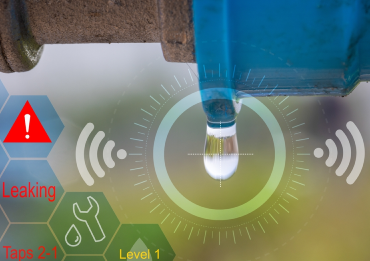
A forward-looking digital twin case study: Embien built a TinyML-powered water leakage detection system that autonomously identifies anomalies on-device — a practical demonstration of the Reflection to Agency transition in action.