
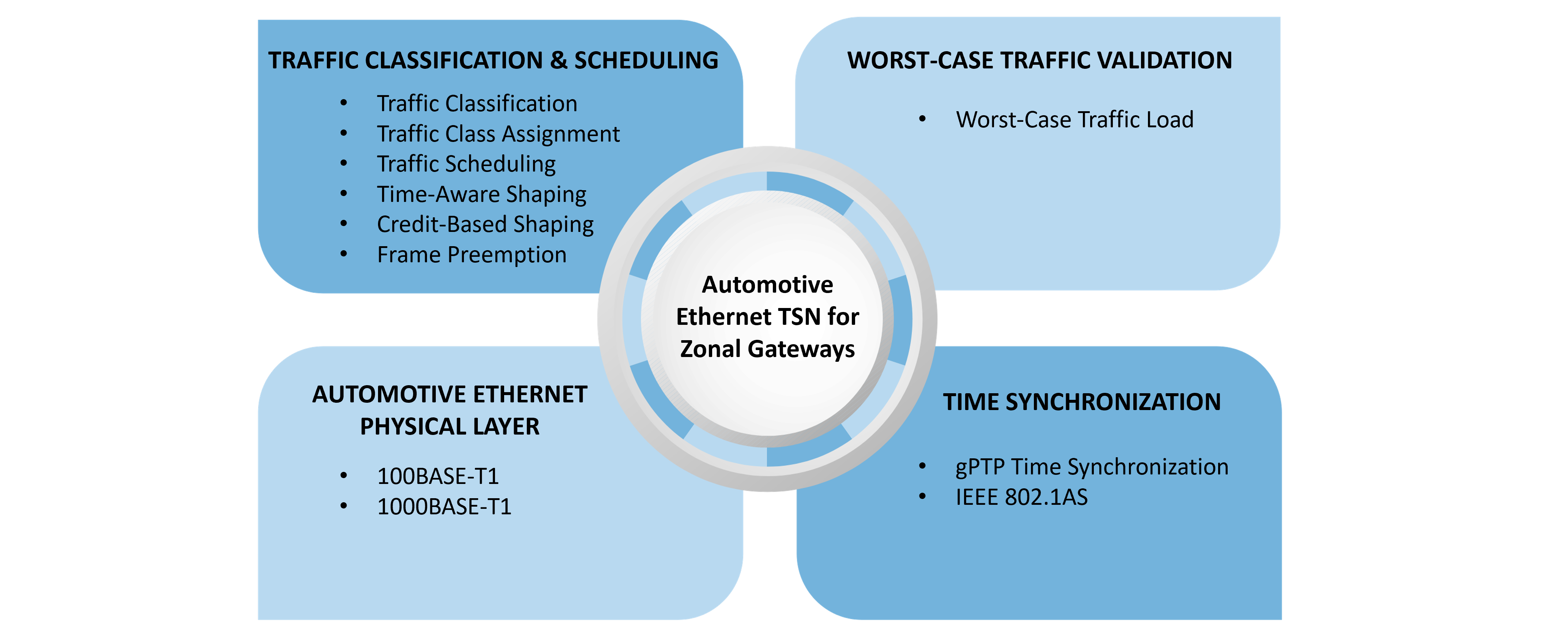
Automotive Ethernet TSN for zonal gateways has moved from a subsection worth a paragraph inside a broader physical-layer article to a topic that deserves its own technical treatment, because zonal architecture changed what automotive Ethernet actually has to carry. When Ethernet mainly moved camera and infotainment data, best-effort delivery was tolerable. Once zonal gateways started carrying safety-relevant control traffic on the same physical links as that same camera and infotainment data, automotive Ethernet TSN for zonal gateways became the mechanism that keeps a time-critical brake or steering message from sitting behind a large video frame in a switch queue.
Ethernet embedded into a zonal vehicle backbone has different real-time requirements than Ethernet embedded into an office network or even a typical industrial cell, because the traffic sharing that backbone spans everything from hard-real-time actuator commands to large, latency-tolerant camera streams on the same physical wiring. Ethernet embedded in this role needs standardized traffic shaping and scheduling, which is exactly what the IEEE 802.1 TSN set of standards, credit-based shaping, time-aware scheduling, and frame preemption among them, was built to provide. Getting Ethernet embedded correctly into a zonal gateway means treating TSN configuration as a first-class part of the network design, not a setting adjusted after the fact once bandwidth problems show up in vehicle testing.
TSN's core mechanism for automotive Ethernet TSN for zonal gateways is traffic classification and scheduling: frames get tagged by priority and traffic class, and TSN-capable switches use time-aware shapers and gates to guarantee that high-priority, safety-critical traffic gets a reserved transmission window regardless of how much lower-priority traffic, camera streams, diagnostic uploads, infotainment data, is queued behind it. Without that scheduling, a switch operating on simple best-effort or basic priority queuing can still let a large low-priority frame block a time-critical one for long enough to matter, since Ethernet frames are not preemptible by default; TSN's frame preemption extension exists specifically to solve that case.
Traffic shaping between domain controllers over automotive Ethernet is where TSN's abstract traffic classes become a concrete network design exercise: assigning traffic classes to every flow that crosses a zonal gateway, configuring credit-based shapers so bandwidth is allocated predictably rather than allowed to burst unpredictably, and validating, under worst-case traffic load, that the safety-critical classes still meet their latency budget. Traffic shaping between domain controllers over automotive Ethernet has to be designed against the vehicle's actual worst-case scenario, several camera streams active, a diagnostic session running, and a safety-relevant control message needing to cross a zonal gateway, not just against typical operating conditions.
100BASE-T1 and 1000BASE-T1 as the physical layer for automotive TSN matters because TSN's scheduling guarantees are only as good as the physical link underneath them; the automotive-specific single-pair Ethernet PHYs, 100BASE-T1 for lower-bandwidth links and 1000BASE-T1 for the higher-bandwidth zonal and backbone connections, are what actually carry TSN-scheduled traffic across a vehicle's wiring harness. Our Physical Layer of Automotive Ethernet and Layer 2 Protocols article covers 100BASE-T1 and 1000BASE-T1 as the physical layer for automotive TSN in more depth from the physical and link-layer side; this article picks up from there at the traffic-scheduling layer running on top of it.
Time synchronization across zonal gateways is a prerequisite most of TSN's scheduling mechanisms depend on directly: time-aware shapers can only open and close their transmission gates at the right moment if every switch and endpoint on the network agrees closely enough on what time it actually is. Automotive TSN networks typically use gPTP, a profile of IEEE 802.1AS, to distribute a shared time base across zonal gateways with the tight synchronization accuracy TSN scheduling needs, and a gPTP failure or a poorly designed synchronization topology degrades every other TSN guarantee built on top of it, which makes time synchronization across zonal gateways as much a safety-relevant design decision as the traffic shaping it enables.
The Industrial Insights folder covers TSN as a protocol-agnostic guide applicable across factory-floor Ethernet generally, in Time-Sensitive Networking (TSN) for Industrial Ethernet. Automotive Ethernet TSN for zonal gateways shares the same underlying 802.1 standards but operates under constraints that industrial deployments generally don't: a fixed, weight-constrained wiring harness instead of flexible factory cabling, a single-pair automotive PHY instead of standard Ethernet cabling, and safety-relevant traffic classes tied directly to vehicle functions that can affect occupants, not just production throughput.
An OEM that already runs automotive Ethernet without TSN, common on programs that adopted Ethernet mainly for camera and infotainment bandwidth before zonal architecture, covered in our companion piece on zonal E/E architecture and domain controllers, made safety-critical traffic a networking concern, faces a genuine migration project, not a firmware flag. Switch silicon needs TSN hardware support, gPTP time synchronization needs to be designed and validated across the topology, and every existing traffic flow needs to be classified and assigned a traffic class before scheduling guarantees mean anything. Retrofitting TSN onto an Ethernet backbone that wasn't designed with it in mind is materially harder than designing it in from the zonal architecture's first network topology decision.
Embien Technologies designs automotive Ethernet TSN for zonal gateways: traffic class design and scheduling, gPTP-based time synchronization across zonal gateways, and 100BASE-T1/1000BASE-T1 physical-layer integration, for OEMs and Tier 1 suppliers building or migrating to a zonal E/E architecture. To discuss a TSN network design for an upcoming zonal architecture program, reach out to Embien's automotive networking team.

Embien's Digital Transformation Services connect embedded systems, cloud platforms, data pipelines, and connected products to support scalable digital operations.

Embien's Connected Vehicle Development services support automotive connectivity, vehicle networking, diagnostics, OTA capabilities, and software-driven vehicle architectures.

A case study on implementing production-grade secure boot and HSM capabilities for an automotive TCU to strengthen device security and protect vehicle communications.