
General body control content covers the electronic architecture that ties comfort, access, and lighting functions together, but modern powered seats have grown into their own distinct embedded control problem, one that general body control module coverage doesn't fully capture. Automotive seat control systems: memory position massage and multi-motor ecu design spans coordinating anywhere from four to more than twenty individual motors per seat, storing and precisely recalling memory positions, sequencing massage actuator patterns, and doing all of it within a real-time control loop that also has to guard against pinch injuries at every moving joint.
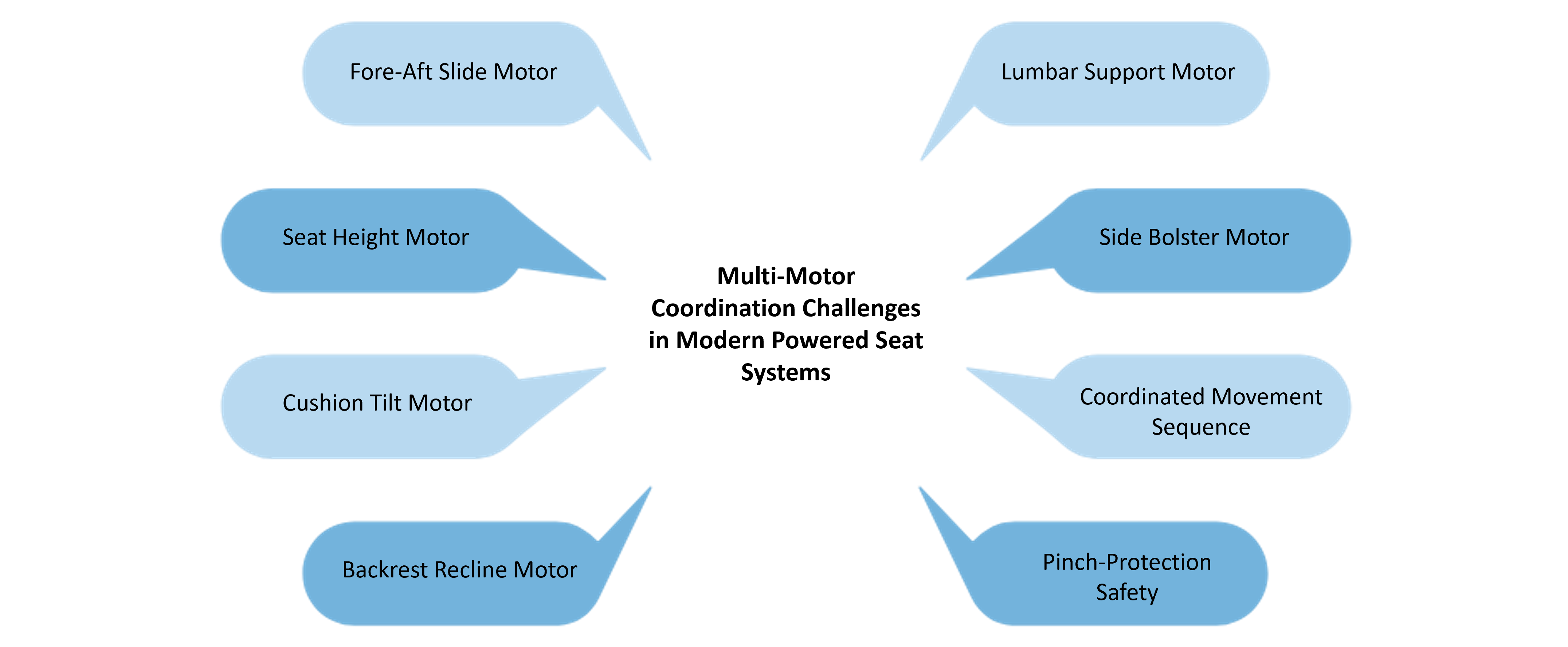
The multi-motor coordination challenges in modern powered seat systems start with sheer motor count: a premium seat can have separate motors for fore-aft slide, seat height, cushion tilt, backrest recline, lumbar support, side bolster, headrest position, and, where massage is included, several more dedicated massage actuator motors, all of which have to move in a coordinated sequence without mechanically binding against each other or drawing more current simultaneously than the seat's power budget allows. Multi-motor coordination challenges in modern powered seat systems also include sequencing, moving the seat cushion before the backrest during a large memory-position recall, for instance, to avoid a moving part colliding with the vehicle interior or with the occupant, a constraint that gets more complex as motor count grows.
Memory position storage and precise motor positioning control for seats relies on each motor reporting accurate position feedback, typically from a Hall-effect or potentiometer-based sensor geared to the motor shaft, so the seat control ECU can store a driver's preferred position as a set of precise motor position values and recall all of them accurately on demand, often keyed to a specific key fob or driver profile. Memory position storage and precise motor positioning control for seats has to account for motor and mechanism wear over the vehicle's life, recalibrating or compensating drift so a memory position recalled after years of use still lands in the same physical seat position it did when it was first stored.
Where a seat includes massage functionality, the control problem extends further into timed actuator sequencing rather than simple position control. Massage patterns, wave, pulse, or shiatsu-style kneading, are built from a library of pre-programmed actuator activation sequences that cycle specific motors on and off, or modulate their drive current, in a defined rhythm across the seat's cushion and backrest bladders or eccentric-cam actuators. Getting massage sequencing to feel smooth and intentional rather than mechanical and jerky requires the same kind of real-time motor control discipline used elsewhere in the seat ECU, just applied to comfort rather than positioning accuracy, and it is exactly the kind of comfort-function depth that separates thorough automotive seat control systems: memory position massage and multi-motor ecu design from a basic slide-and-recline implementation.
Lin bus usage patterns for automotive seat control modules reflect why LIN, rather than CAN, is the dominant network choice for seat electronics: seat motor and switch nodes are cost-sensitive, don't need CAN's bandwidth or determinism, and fit naturally into LIN's low-cost, single-master, multi-slave topology. A seat control module typically acts as a LIN master coordinating several motor driver and sensor slave nodes distributed around the seat frame, while the seat module itself connects up to the vehicle's CAN or CAN FD backbone to receive memory-recall commands and report status to the body control domain. LIN bus usage patterns for automotive seat control modules are a direct, practical application of the network fundamentals covered elsewhere on the site, applied to a component where wiring cost and complexity matter as much as control performance.
Current sensing for pinch-protection safety in powered seats is the safety layer underneath all of this motor coordination, since a powered seat moving under motor force has to detect an obstruction, an occupant's hand, a piece of clothing, a stray object, before it causes injury. Most designs monitor motor drive current continuously and treat a sudden current spike, indicating the motor has hit unexpected mechanical resistance, as a pinch event, immediately reversing or stopping the offending motor. Current sensing for pinch-protection safety in powered seats has to be tuned carefully to catch a genuine pinch quickly while not triggering false stops on normal mechanical load variation, a tuning problem similar in spirit to the power window and sunroof pinch protection already covered elsewhere in body electronics content.
Seat control modules sit as LIN-networked nodes reporting into the same body control domain described in our LIN protocol content, specifically our automotive LIN bus: introduction to Local Interconnect Network and LIN vehicle communication articles, which cover the bus fundamentals a seat control module builds directly on. Seat position and occupancy data also increasingly feeds the sensing systems described in our in-cabin occupant sensing article, since a radar or camera-based occupant sensor's field of view depends on where the seat is actually positioned, another reason seat ECUs and body control electronics are treated as one integrated system rather than two loosely connected ones in modern automotive seat control systems: memory position massage and multi-motor ecu design programs.
Embien Technologies engineers the multi-motor coordination, memory position control, and pinch-protection safety logic that automotive seat control systems: memory position massage and multi-motor ecu design requires, backed by deep LIN and CAN network integration experience across body electronics programs. To discuss seat control ECU design, multi-motor coordination, or pinch-protection safety engineering, reach out to Embien's engineering team.

Edge Computing Services support real-time embedded processing, sensor integration, and intelligent control for automotive electronics and connected vehicle systems.

Embien's Automotive Engineering Services cover embedded hardware and software development, ECU design, vehicle networking, and system integration for automotive applications.
A case study on developing an i.MX8-based Android automotive smart cluster, covering embedded platform integration, display functionality, and automotive software development.