
The motor control unit software that runs field-oriented control on an EV traction motor gets plenty of engineering attention, but the power electronics that software actually switches, the traction inverter itself, is going through its own significant technology shift. Automotive traction inverter design: sic/gan power electronics for ev powertrains increasingly means designing around wide-bandgap semiconductors rather than the silicon IGBTs that dominated traction inverter design for the past two decades. Our existing article on the automotive MCU for electric vehicle motor control covers the control software side; this article covers the power electronics hardware it drives.
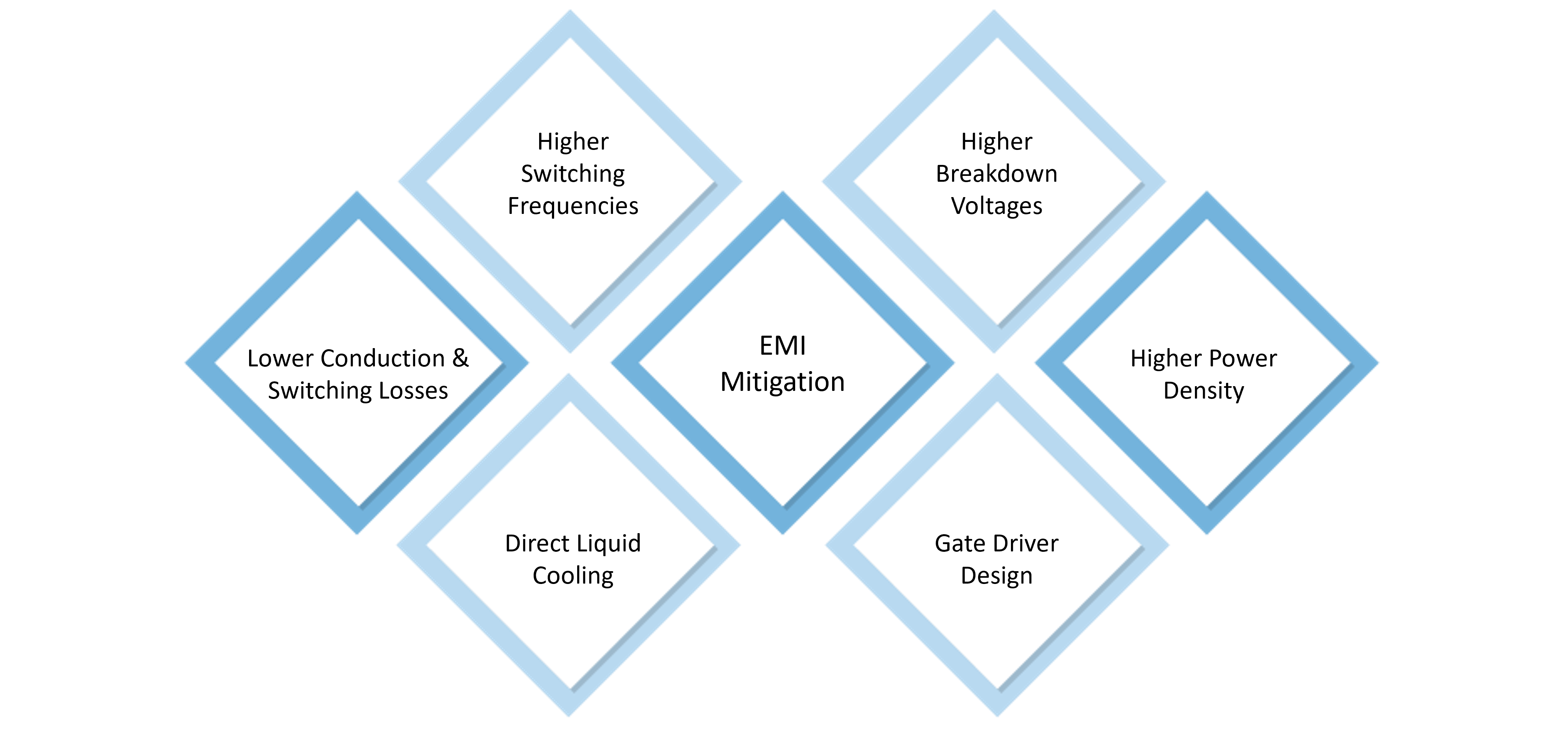
Why sic and gan are replacing silicon igbts in traction inverters comes down to fundamental material properties: silicon carbide and gallium nitride devices support higher switching frequencies, lower conduction and switching losses, and higher breakdown voltages than comparable silicon IGBTs, which translates directly into a smaller, lighter, more efficient inverter for the same power delivery. Why SiC and GaN are replacing silicon IGBTs in traction inverters is ultimately a systems-level answer, not just a device-level one: the efficiency gains compound into meaningfully more driving range from the same battery pack, which is valuable enough across an EV program's business case to justify the higher per-device cost of wide-bandgap silicon over mature, cheaper IGBTs.
Switching frequency and efficiency gains from wide-bandgap semiconductors are directly connected: SiC and GaN devices can switch at frequencies several times higher than silicon IGBTs while incurring lower switching losses per transition, which allows a traction inverter to use smaller passive filtering components, since higher switching frequency reduces the inductor and capacitor size needed to smooth the output waveform, in addition to the direct efficiency benefit of lower losses per switching event. Switching frequency and efficiency gains from wide-bandgap semiconductors together are the primary reason SiC-based traction inverters have become standard on premium EV platforms and are increasingly appearing in mainstream ones as device costs continue to fall with production volume.
Thermal design challenges specific to high-power traction inverters do not disappear with wide-bandgap devices, and in some respects they intensify: the higher switching frequency SiC and GaN enable also concentrates switching losses into shorter time windows, and the smaller physical die size of a wide-bandgap device compared to an equivalent-rated silicon IGBT means the same heat has to be extracted through a smaller thermal footprint, raising local power density considerably. Thermal design challenges specific to high-power traction inverters push cooling system design toward more aggressive direct liquid cooling of the power module, sometimes with coolant channels integrated directly beneath the die rather than through a conventional heat sink and thermal interface stack, specifically to manage that higher power density without compromising device reliability or lifetime.
Gate driver design considerations for sic/gan switching speeds become a first-order design problem once wide-bandgap devices are in play, because the very fast switching transitions that deliver SiC and GaN's efficiency advantage also demand a gate driver capable of sourcing and sinking gate current fast enough to actually achieve those transition speeds without introducing dangerous voltage overshoot or device stress. Gate driver design considerations for SiC/GaN switching speeds include tighter propagation delay matching across the inverter's multiple switching devices, careful gate resistor and drive voltage tuning specific to the device family, and, for GaN in particular, gate drive circuits that respect a much narrower safe gate voltage window than a silicon IGBT tolerates.
The same fast switching edges that make SiC and GaN efficient also generate higher-frequency electromagnetic interference than a slower-switching silicon IGBT design produces, which pushes EMI mitigation earlier and more deliberately into the traction inverter's layout and packaging design rather than treating it as a late-stage compliance fix. Careful power module layout to minimize parasitic inductance, gate drive circuit design that manages switching slew rate without sacrificing too much of the efficiency benefit, and shielding and filtering strategy all have to account for the higher-frequency EMI spectrum wide-bandgap switching produces, since an inverter design that ignores this until EMC testing typically requires expensive rework to pass automotive EMC requirements.
The motor control unit's field-oriented control software, covered in our companion automotive MCU article, has to be tuned specifically for the inverter hardware it drives, and wide-bandgap traction inverter design choices change that tuning meaningfully. Higher switching frequency changes the achievable current control loop bandwidth and the PWM resolution requirements the control software needs, and gate driver protection behavior around fast SiC/GaN transitions has to be reflected in the MCU's fault handling logic. Traction inverter design and motor control software are, in a wide-bandgap inverter program, much more tightly coupled than they were in a mature silicon-IGBT design where control software tuning was largely a solved problem.
Embien Technologies supports EV powertrain programs across both the motor control software and the power electronics side of the traction system, including automotive traction inverter design: sic/gan power electronics for ev powertrains work spanning gate driver design, thermal management for high-power switching devices, and EMI-conscious layout. This work connects naturally to our broader e-axle integration engineering, covered in our companion article on the motor-inverter-gearbox e-axle unit. To discuss traction inverter design for a new or existing EV powertrain program, reach out to Embien's engineering team.

Embien provides end-to-end product engineering services covering hardware design, embedded software, system integration, and product development for automotive and other technology applications.

Semiconductor Development Support covers embedded platform development, processor integration, board support, and software enablement to accelerate semiconductor-based product development.
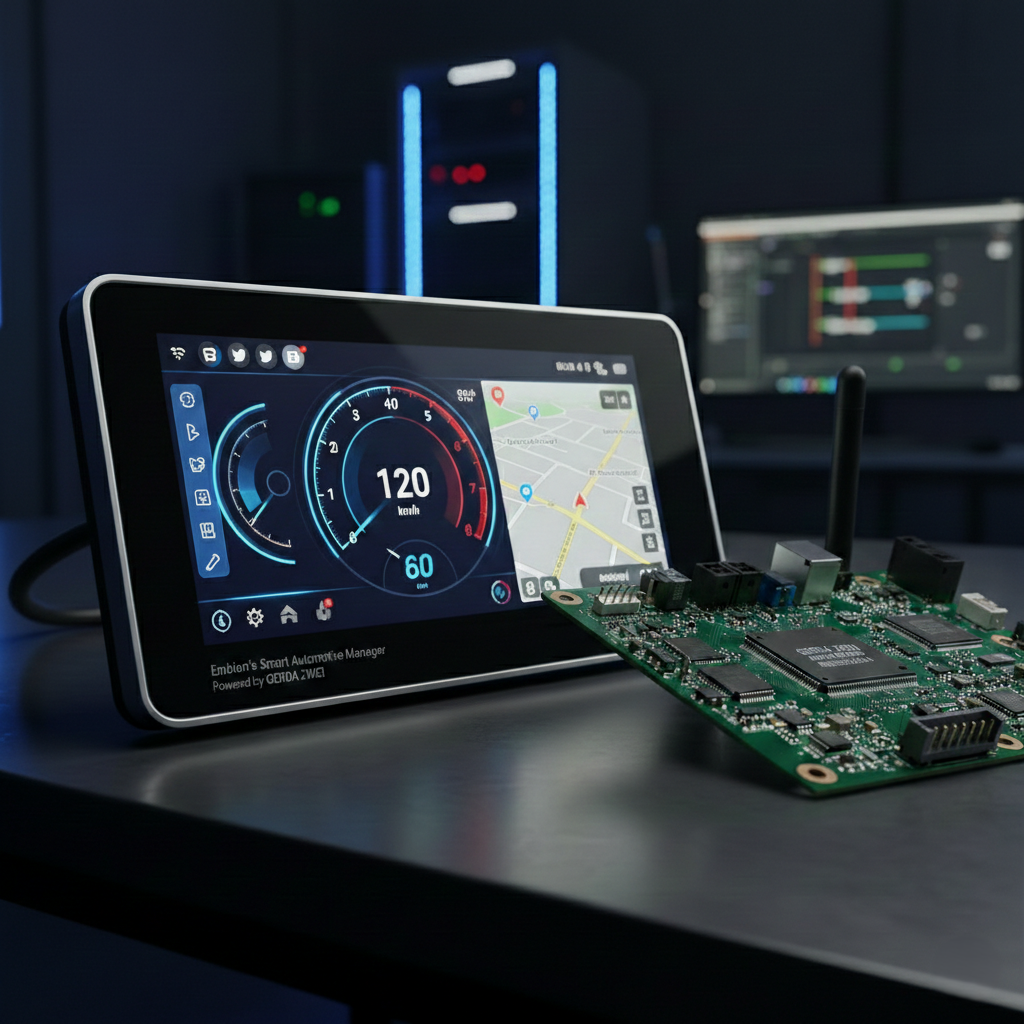
A case study on developing a cost-effective evaluation kit for the Gerda-Zwei MCU, supporting hardware evaluation and embedded software development.