
Every automotive ECU that leaves a production line has already been designed, validated, and proven correct on the bench, yet each individual unit still has to be tested again before it ships, because a design that's correct doesn't guarantee that every manufactured instance of it was built correctly. End-of-line testing for automotive ECUs: production test strategy and coverage is the discipline of designing that final production test, deciding what has to be verified on every single unit, how it gets verified fast enough to keep pace with a production line, and how the results get recorded so a defect can be traced back to its cause. Getting end-of-line test strategy wrong shows up either as escaped defects reaching the field or as a test station that becomes the production line's bottleneck, and avoiding both is a genuine engineering problem in its own right.
How does end-of-line test strategy differ from development-phase hil/sil testing? Development-phase HIL and SIL testing exists to validate that a design behaves correctly across the full range of conditions and fault scenarios it might encounter, run over hours or days against a comprehensive test suite on a small number of prototype or pre-production units. End-of-line testing operates under an entirely different constraint: it has to run in seconds to a few minutes per unit, against every single unit coming off the line, and its job isn't to validate the design at all, the design is already assumed correct, it's to catch manufacturing defects, a bad solder joint, a mis-programmed component, a connector that wasn't seated, before that unit ships. Confusing the two disciplines, or assuming HIL/SIL test coverage translates directly into an adequate end-of-line test plan, is a common and costly production-readiness mistake.
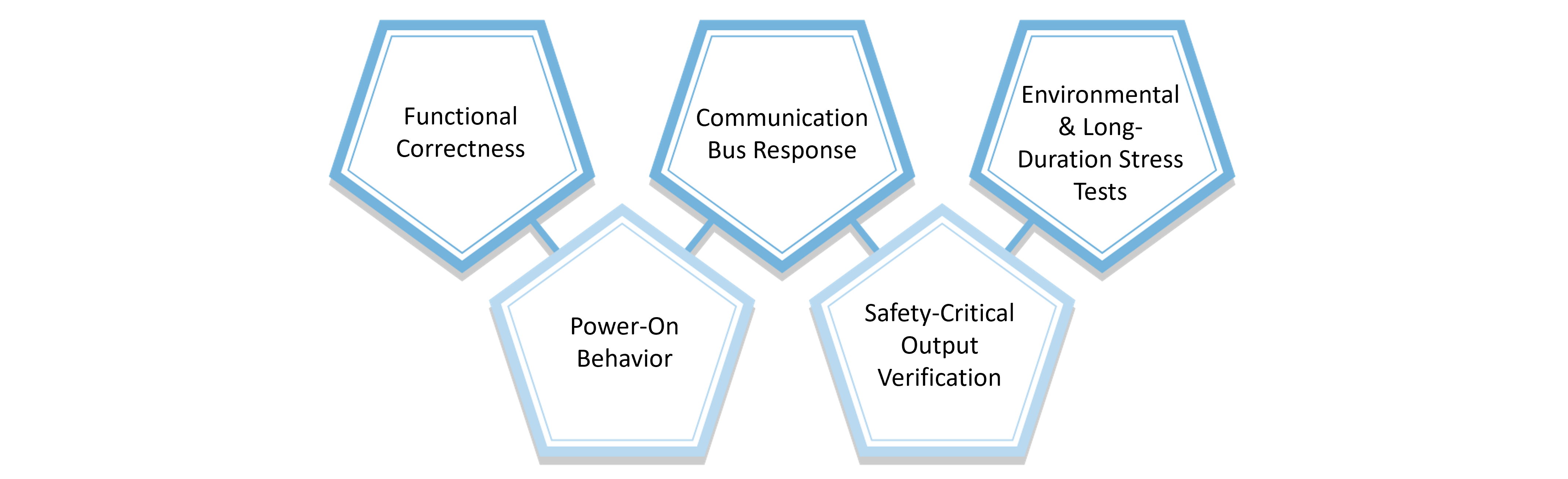
Not every characteristic that matters about an ECU can be tested on every unit within a production line's takt time, which makes test coverage a genuine engineering tradeoff rather than a simple checklist. Functional correctness, power-on behavior, communication bus response, and safety-critical output verification typically belong on every unit, since a defect there is exactly the kind of failure end-of-line testing exists to catch. Characteristics that are inherently stable across a well-controlled manufacturing process, certain environmental margin tests or long-duration stress characteristics, are more often handled through statistical sampling or periodic process-capability studies rather than full 100% testing, because testing them on every unit would add test time without materially improving the defect catch rate.
Automated test equipment (ate) architecture for automotive ecu production lines combines a test fixture that makes physical and electrical contact with the unit under test, instrumentation that stimulates inputs and measures outputs, and test software that sequences the test steps and makes the pass/fail decision, all coordinated to run unattended as part of the production flow. Automated test equipment (ATE) architecture for automotive ECU production lines has to be designed for the production environment specifically, fast fixture changeover for mixed-model lines, diagnostic capability that tells an operator what actually failed rather than a bare pass/fail result, and calibration and self-check routines that keep the test station itself from becoming an undetected source of measurement drift.
A test station that catches every conceivable defect but takes five minutes per unit is not a viable solution on a line with a sixty-second takt time, which means end-of-line test design is inseparable from production throughput planning. Parallelizing test stations, optimizing test sequence order so the fastest, highest-yield checks run first and can fail a bad unit out early, and choosing test coverage based on actual defect data from the process rather than theoretical worst-case concern, are the practical levers that keep test thoroughness and line throughput from working against each other. Programs that treat end-of-line test time as a fixed cost to be minimized after the fact, rather than a design constraint considered alongside coverage from the start, routinely end up retrofitting test stations under production pressure.
Traceability requirements linking test results to manufactured automotive ecus mean every unit's test results, pass or fail, along with the specific test station, software version, and calibration state used, get recorded against that unit's unique identifier and retained for the length of time automotive quality standards require. Traceability requirements linking test results to manufactured automotive ECUs exist for a concrete reason: if a field issue surfaces later, the manufacturer needs to determine whether it was tested correctly, what the actual measured values were, and whether other units from the same production window share the same risk, a question that's unanswerable without disciplined, unit-level test data retention built into the line from day one.
Most automotive ECU production runs through electronics manufacturing services partners rather than fully in-house lines, which makes end-of-line test strategy a shared responsibility between the ECU's design owner and the contract manufacturer running the line. Electronics manufacturing services providers bring production-line test experience and ATE infrastructure, but the test coverage decisions, what's safety-relevant, what's a real manufacturing risk for this specific design, still need to come from engineers who understand the ECU's design intent, which is why the strongest end-of-line test programs are built as a genuine collaboration rather than handed to the EMS partner as a specification to execute without engineering input.
End-of-line testing and development-phase validation aren't competing disciplines, they're sequential ones, and a production test strategy is strongest when it's informed by the failure modes HIL/SIL testing already characterized. Our HIL and SIL testing article covers how that earlier validation stage builds the automated test bench that proves the design correct; end-of-line testing inherits that understanding and applies it to the very different problem of verifying manufacturing quality at production volume. Programs that keep these two testing disciplines connected, informed by the same failure-mode knowledge, catch more real defects with less redundant test development effort than programs that build each in isolation.
Embien Technologies designs end-of-line testing for automotive ECUs: production test strategy and coverage programs, covering test coverage planning, ATE architecture and fixture design, and traceability infrastructure that links every manufactured unit's test record back to its design and process history. See our companion DFM/DFT for ECU production article for how design-phase decisions shape what's testable on the line in the first place.
To discuss end-of-line test strategy for an upcoming automotive ECU production ramp, reach out to Embien's engineering team.

Embien provides end-to-end product engineering services covering hardware design, embedded software development, system integration, testing, and product validation.

TestBot enables automated testing of embedded firmware, hardware interfaces, communication protocols, and connected applications through configurable, no-code test workflows.

A case study on developing an automated test bench for an industrial data acquisition device to streamline functional testing and improve test repeatability.