
Most electric vehicle powertrain content on the site treats the motor control unit, the traction inverter, and the reduction gearbox as separate engineering problems, and for a long time they largely were. E-axle integration: engineering the motor-inverter-gearbox unit for evs is the systems-integration story that sits on top of all three: combining motor, inverter, and gearbox into one mechanically and electrically unified housing that ships as a single procured, tested, and warrantied unit rather than three components an OEM integrates separately on the vehicle line. That consolidation changes the engineering problem in ways that don't show up when each subsystem is designed and validated on its own.
What drives the industry shift toward integrated e-axle units? comes down to packaging, cost, and weight pressure that individually optimized motor, inverter, and gearbox components can't address on their own. A separately housed motor, inverter, and gearbox each need their own enclosure, their own cooling interface, and their own mounting hardware, and each of those boundaries adds mass, connector count, and potential leak or fault points. An integrated e-axle collapses three enclosures into one, shares a single cooling circuit across all three subsystems, and removes the high-voltage cabling and connectors that would otherwise run between a standalone inverter and motor. For OEMs building EV platforms at volume, that reduction in part count and interface complexity is now a bigger lever on cost and mass than incremental efficiency gains within any one subsystem.
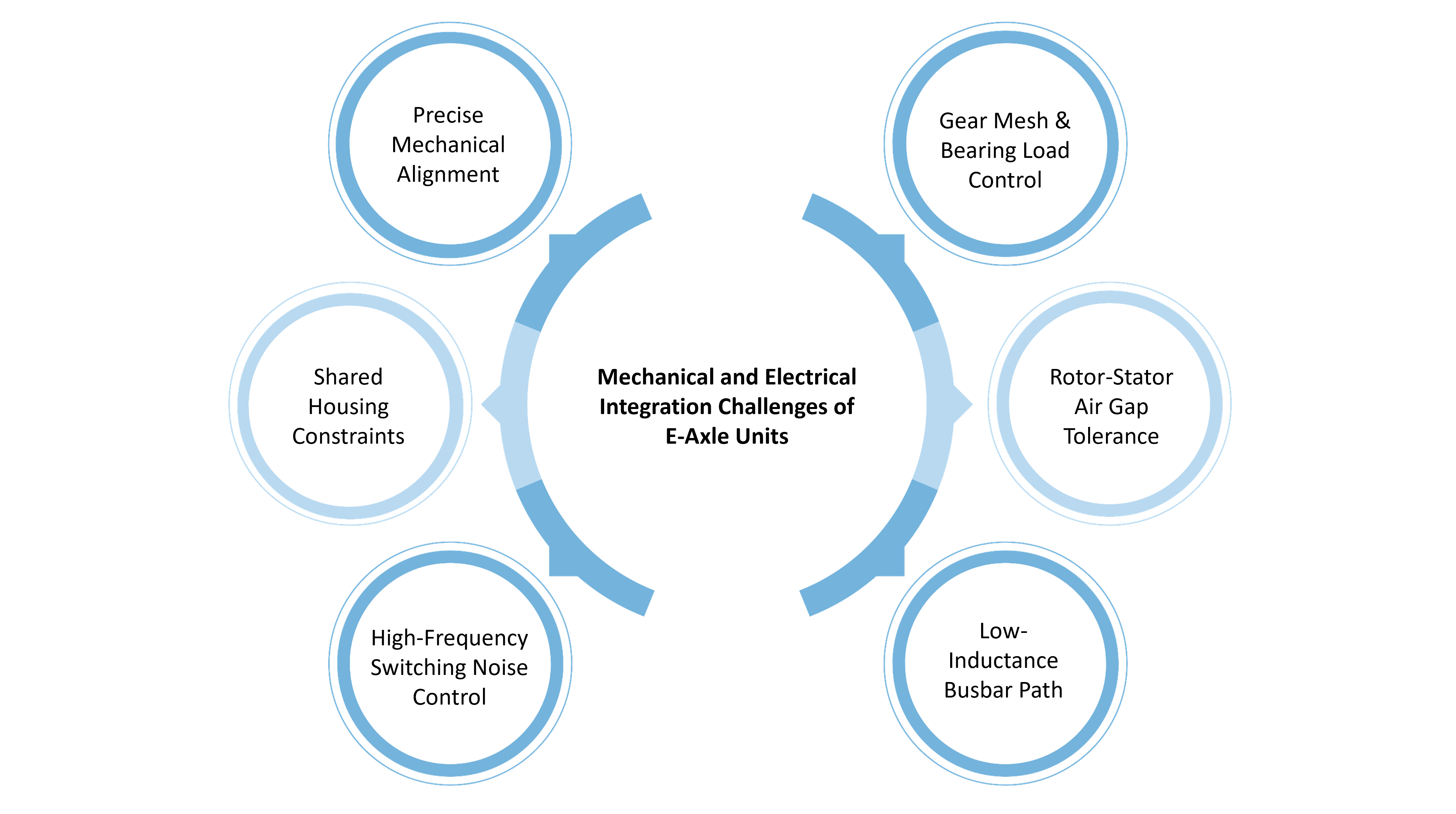
The mechanical and electrical integration challenges of e-axle units start with the fact that three subsystems designed for different tolerances, different thermal expansion behavior, and different maintenance philosophies now have to share a single housing. The gearbox side needs precise, rigid mechanical alignment to control gear mesh and bearing load; the motor side needs a rotor-stator air gap held to tight tolerance across the full operating temperature range; and the inverter side needs a low-inductance, well-shielded busbar path to the motor windings that avoids running high-frequency switching noise anywhere near the gearbox's sensors or wiring. Getting all three constraints to coexist in one housing without any one of them compromising the others is the mechanical and electrical integration challenge that distinguishes e-axle design from designing any of the three subsystems in isolation.
Thermal management across a single densely-packed e-axle housing is arguably the hardest of the integration problems, because the motor, the inverter's power electronics, and the gearbox's lubricant all generate or are sensitive to heat, and they're now sharing a footprint small enough that thermal isolation between them is limited. The inverter's SiC or IGBT switching devices need aggressive, localized cooling to stay within junction temperature limits; the motor windings generate distributed copper and iron losses across the stator; and the gearbox oil needs to stay within a viscosity range that keeps mechanical efficiency high without overheating the gear mesh. Thermal management across a single densely-packed e-axle housing typically means a shared coolant loop with carefully sequenced flow paths, sometimes with oil used both to lubricate the gearbox and to directly cool the motor windings, a design choice that adds its own sealing and contamination-control requirements.
Beyond the mechanical and thermal problems, e-axle integration is also a software problem. Control software integration between motor inverter and gearbox functions has to arbitrate between torque requests, inverter switching control, and, where the e-axle includes a multi-speed or clutch-actuated gearbox, shift logic, all within a single control domain that has to respond in real time to driver torque demand, regenerative braking requests, and thermal derating limits. Where a standalone MCU and a standalone transmission controller used to communicate over a vehicle bus with its own latency and message-loss failure modes, an integrated e-axle can run motor control, inverter switching, and gearbox actuation logic on a shared or tightly coupled compute platform, cutting cross-controller latency but concentrating more safety-relevant logic into a single software architecture that has to be verified as a whole.
Packaging a motor, inverter, and gearbox into one unit also changes the noise, vibration, and harshness (NVH) profile of the whole assembly. Gear mesh whine, motor electromagnetic noise, and inverter switching-frequency noise can now couple mechanically through a shared housing in ways that wouldn't occur if the three subsystems were mounted and isolated separately, and a resonance that's negligible in an isolated gearbox can become audible once it's structurally coupled to a motor housing. E-axle NVH engineering has to treat the combined unit as one vibro-acoustic system, tuning mount stiffness, housing rigidity, and gear design together rather than validating each subsystem's NVH signature independently and assuming the combined unit will behave the same way.
None of this replaces the motor control and vehicle control layers already covered elsewhere on the site; it reframes where they physically live. The motor control logic described in our automotive MCU: motor control unit for electric vehicles article still runs the same torque and commutation control loop inside an integrated e-axle, and the vehicle control unit (VCU) still arbitrates overall vehicle-level torque and energy decisions and sends a torque request down to the e-axle rather than to a standalone motor controller. On the power electronics side, the design tradeoffs covered in our traction inverter design article become tightly coupled to the e-axle's shared thermal and mechanical envelope rather than an independently packaged inverter module.
Embien Technologies works across the motor control, inverter, and vehicle-level control software that an integrated e-axle unit depends on, applying the same embedded and power-electronics engineering discipline used in standalone MCU, VCU, and inverter programs to the tighter coupling and shared thermal envelope that e-axle integration: engineering the motor-inverter-gearbox unit for evs demands. To discuss e-axle control software, thermal management, or systems-integration engineering for an EV powertrain program, reach out to Embien's engineering team.

Explore Embien's engineering expertise across Automotive, Medical Devices, Industrial Automation, Semiconductor, Consumer Electronics, and other technology domains.

Embien develops custom embedded hardware, including circuit board design, processor integration, power management, and hardware optimization for reliable electronic products.
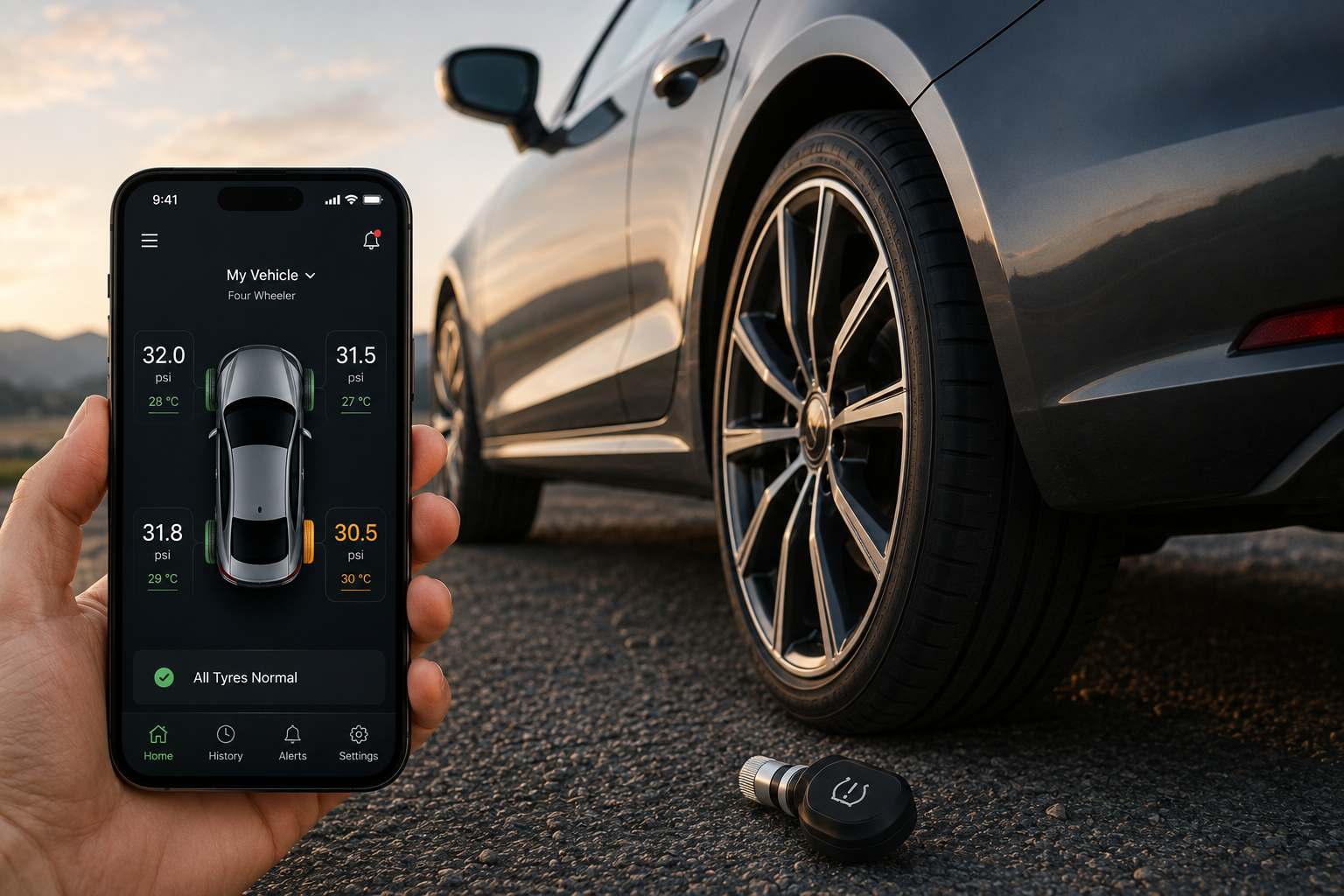
A case study on developing a tyre pressure monitoring application to display tyre pressure data and support vehicle safety through connected monitoring.