
Most engineering content, this site's included, is organized by topic: a bus protocol here, an ECU architecture pattern there, a cybersecurity standard somewhere else. That organization is useful for reference, but it obscures something a real vehicle program has to deal with directly — these pieces aren't independent, they're phases and dependencies of one connected engineering journey. From ecu to zonal architecture: mapping a modern vehicle program is an attempt to put that journey back together: to show where bus protocol decisions, ECU architecture, cybersecurity and functional safety requirements, and zonal consolidation actually connect across a real program's timeline rather than living as separate reference topics.
Vehicle programs are staffed, documented, and often even organizationally structured around subsystem boundaries: a powertrain team, a body electronics team, an ADAS team, a cybersecurity function that reviews everyone else's work near the end. That structure is practical for managing a large program, but it also means the connective tissue between decisions — how an early bus protocol choice constrains a later ECU consolidation option, or how a cybersecurity requirement decided in one phase reshapes an architecture decision made in another — often isn't documented anywhere a new engineer joining the program can easily find it. From ecu to zonal architecture: mapping a modern vehicle program exists to make those connections explicit.
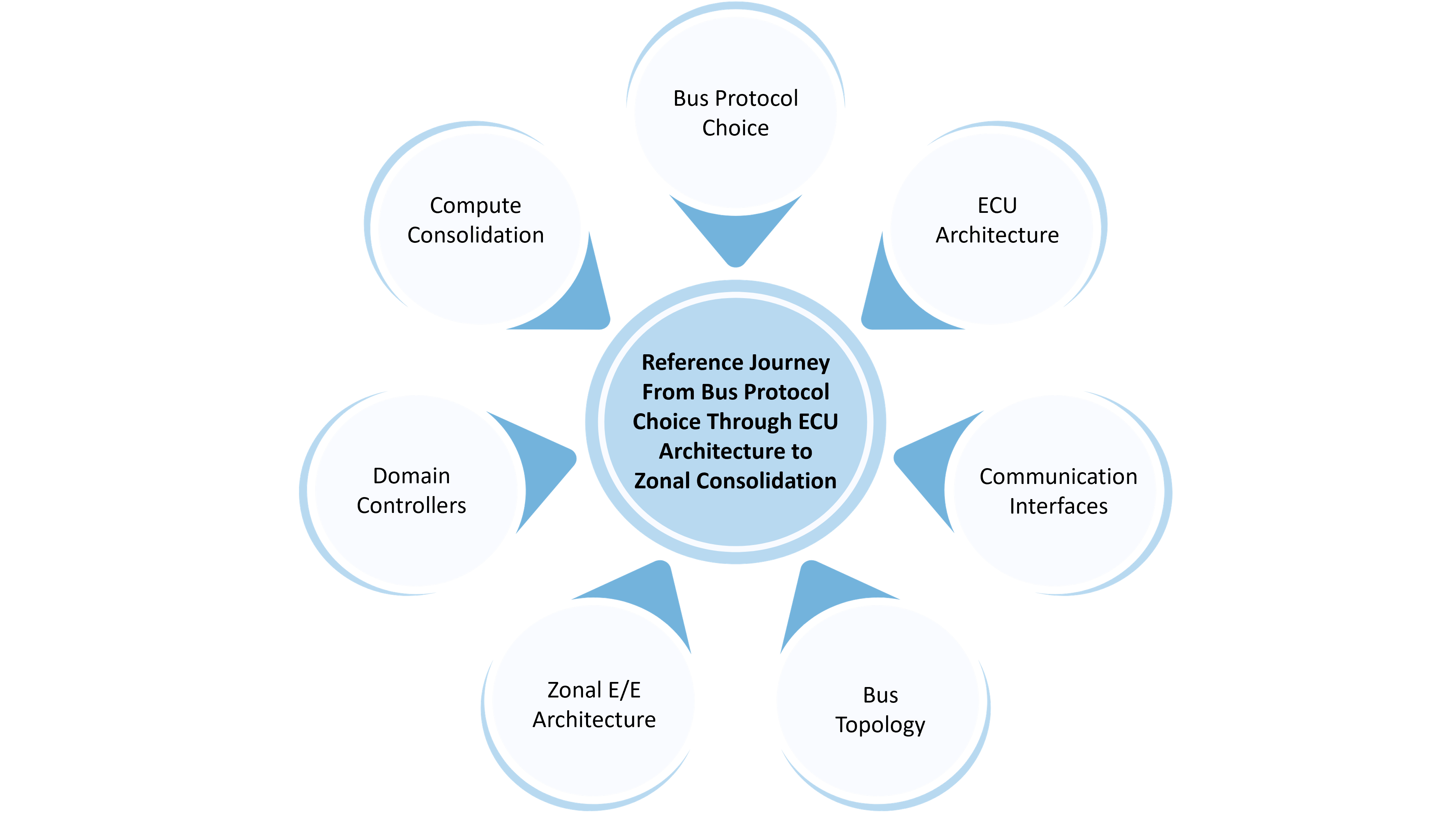
Reference journey from bus protocol choice through ecu architecture to zonal consolidation starts where most vehicle electrical architecture decisions still start: choosing CAN, LIN, FlexRay, or Automotive Ethernet for a given subsystem's communication needs, a decision covered across this site's protocol library. That protocol choice directly shapes what's practical for the next phase, the site's automotive ECU architecture content, since an ECU's communication interfaces have to match the bus topology it's actually deployed on. A reference journey from bus protocol choice through ECU architecture to zonal consolidation continues from there into zonal E/E architecture and domain controllers, where a program that has accumulated dozens of distributed ECUs across those earlier protocol decisions starts consolidating compute into a smaller number of zonal controllers — the same distributed architecture that made the earlier ECU decisions sensible becomes the problem zonal consolidation exists to solve.
Where cybersecurity and functional safety requirements enter a vehicle program is a question with a real answer, not just "throughout": functional safety, guided by ISO 26262, has to enter as early as concept and system architecture decisions, since a hazard analysis and risk assessment done after architecture is fixed can only work around decisions already made rather than shape them. Cybersecurity engineering under ISO 21434 follows a similar logic — a TARA run early enough to influence architecture is far more valuable than one run as a late-stage compliance exercise. Where cybersecurity and functional safety requirements enter a vehicle program matters most at exactly the bus-protocol and ECU-to-zonal transition points described above, since a zonal consolidation decision reshapes the attack surface and the safety architecture at the same time it reshapes the compute topology.
How do ota and sdv architecture change what finished means for a vehicle program? they remove the assumption that a vehicle program's engineering work ends at SOP. A traditional vehicle program treats the shipped ECU software as essentially final, with updates handled as rare, dealer-visit-only exceptions. Software-defined vehicle (SDV) architecture and OTA update capability change that assumption directly: the zonal consolidation and ECU architecture decisions made earlier in the program now have to support safe, validated over-the-air updates for the vehicle's full service life, which means the safety case and cybersecurity argument built earlier in the program can't be a one-time deliverable either — they have to account for a vehicle whose software will keep changing after it leaves the factory.
Mapping automotive insight content to a real engineering program's phases is ultimately the point of connecting these pieces at all. A protocol architect starting a new program can trace forward from bus protocol choice through ECU architecture to zonal consolidation and see where their early decisions constrain later ones. A safety or cybersecurity lead can trace backward from a zonal architecture decision to understand what functional safety and TARA work should have already happened by that point in the program. Mapping automotive insight content to a real engineering program's phases turns what would otherwise be a set of disconnected reference articles into something closer to a program roadmap.
No single article on bus protocols, ECU architecture, zonal consolidation, functional safety, or cybersecurity tells the whole story of a vehicle program on its own, and that's by design — each is deep enough to be useful as a standalone reference. From ecu to zonal architecture: mapping a modern vehicle program is the piece meant to sit above all of them, giving a reader planning a real program the sequence and dependencies that connect this site's automotive content into something closer to a program-level view than a topic index.
Embien Technologies works across every phase this journey covers: bus protocol implementation, ECU and zonal E/E architecture, and the functional safety and cybersecurity engineering that has to enter early enough to actually shape those architecture decisions rather than audit them after the fact.

Explore Embien's engineering expertise across Automotive, Medical Devices, Industrial Automation, Semiconductor, Consumer Electronics, and other embedded technology domains.

Embien provides cybersecurity engineering services covering threat analysis, security assessments, secure boot, firmware protection, and security integration for connected and embedded systems.
A case study on developing an ASIL D electric power steering technology demonstrator, highlighting functional safety engineering, redundant control architecture, and reliable steering system operation.