
Embien's Technology Insights content explains FMI/FMU as a general-purpose multi-domain modeling standard: what it is, why different simulation vendors adopted it, and how it lets independently built models talk to each other. Functional mock-up interface for vehicle co-simulation: hil testing with multi-domain models is the automotive-specific application of that standard: what it actually looks like to bring FMI/FMU-based co-simulation into a real hardware-in-the-loop (HIL) test bench, where the models being co-simulated have to interact with genuine ECU hardware running in real time, not just with each other in a purely software simulation.
Why does vehicle hil testing increasingly need multi-domain models together? because a modern vehicle subsystem's behavior is rarely governed by a single physical domain in isolation. A battery management system's control logic depends on electrical behavior, thermal behavior, and increasingly mechanical packaging constraints all interacting simultaneously, and validating that control logic against a HIL rig that only models the electrical domain misses exactly the cross-domain interactions most likely to expose a real design problem. Vehicle HIL testing increasingly needs multi-domain models together precisely because the failure modes engineers care about most — thermal runaway triggered by an electrical fault, a mechanical vibration affecting sensor accuracy — only show up when those domains are modeled and simulated together, not separately.
How fmi/fmu lets tools from different vendors co-simulate in a vehicle hil rig comes down to the standardized interface FMI defines and the packaged model format, the FMU, that implements it. A thermal model built in one vendor's tool and an electrical model built in another can each be exported as an FMU and co-simulated together inside a HIL orchestration environment, exchanging state at each simulation step through the same standardized interface regardless of which tool originally built each model. How FMI/FMU lets tools from different vendors co-simulate in a vehicle HIL rig is, in practice, what makes multi-domain HIL testing achievable at all without forcing every domain expert on a program onto a single simulation tool that may not be the best fit for their specific domain.
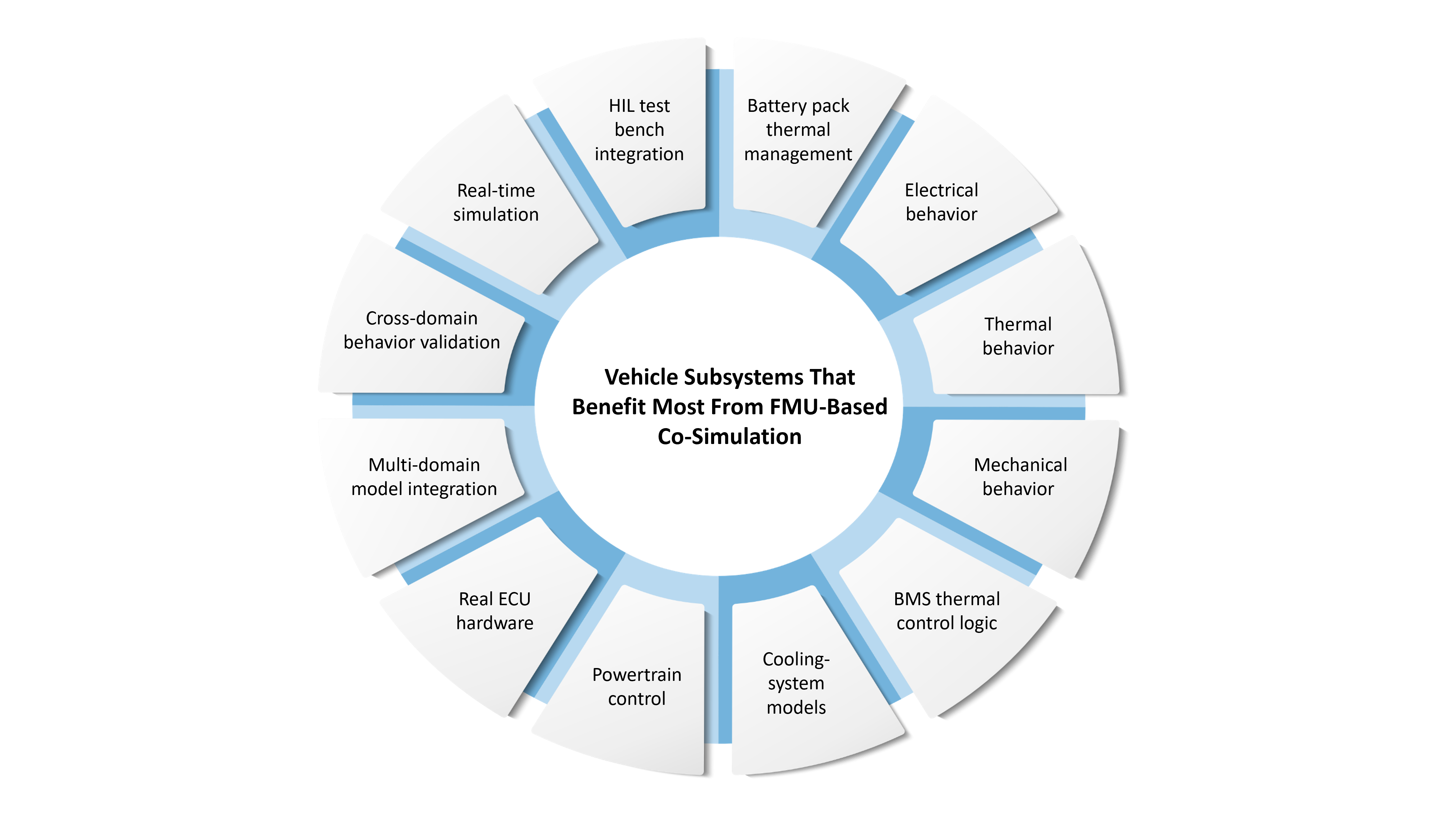
Vehicle subsystems that benefit most from fmu-based co-simulation tend to be exactly the ones where multiple physical domains interact tightly under real operating conditions. Battery pack thermal management is a clear case: validating a BMS's thermal control logic, covered in Embien's guide to automotive battery pack thermal management and BMS engineering, benefits directly from co-simulating electrical, thermal, and cooling-system models together against the real BMS control hardware. Powertrain control is another strong case, where mechanical, electrical, and thermal behavior all interact closely enough that single-domain simulation would miss meaningful validation coverage. Vehicle subsystems that benefit most from FMU-based co-simulation share a common trait: none of them can be adequately validated by any single domain's model in isolation.
Integration challenges combining fmu-based simulation with real ecu hardware center on timing. A pure software co-simulation between FMUs can run at whatever pace the simulation tools allow, but a HIL rig has real ECU hardware in the loop expecting sensor and actuator signals on real-world timing, which means the co-simulated FMU models have to execute fast enough to keep pace with that hardware in real time, not just produce eventually-correct results. Integration challenges combining FMU-based simulation with real ECU hardware also include managing the actual signal interface — converting FMU model outputs into the electrical signals a real ECU expects to see, and vice versa — which is a meaningfully different integration problem than the pure software-to-software FMU exchange a purely simulated co-simulation setup would require.
None of this replaces the foundational HIL and SIL testing methodology already covered in Embien's guide to HIL and SIL testing for automotive ECUs — it extends it. That article covers how a HIL test bench is built and automated around a real ECU under test; FMI/FMU-based co-simulation is what lets that same test bench incorporate multiple, independently authored physical-domain models rather than relying on a single simplified plant model built entirely in one tool. A program that has already invested in the automated HIL test bench described there is well positioned to extend it with multi-domain FMU co-simulation rather than starting from scratch.
For readers who want the underlying standard explained independent of the automotive HIL application, Embien's Technology Insights guide to digital twin co-simulation with FMI/FMU covers the general multi-domain modeling standard this article builds on. Functional mock-up interface for vehicle co-simulation: hil testing with multi-domain models assumes that general grounding and focuses specifically on what changes when the co-simulated models have to interact with real ECU hardware in a vehicle HIL rig rather than with each other alone.
Embien Technologies builds automated HIL test benches and integrates FMI/FMU-based multi-domain co-simulation into them, giving vehicle program teams a way to validate cross-domain behavior — thermal, electrical, and mechanical together — against real ECU hardware rather than a simplified single-domain plant model alone.

Embien's Digital Transformation Services support automotive engineering through embedded software development, system integration, simulation, and digital engineering solutions.
Embien's Automotive Cybersecurity Services support vehicle security through threat analysis, secure boot, secure firmware updates, and protection of connected automotive systems.

A case study on automating instrument panel testing to support repeatable validation of automotive display functions and system behavior.