
An ECU's embedded software can pass every unit test in a simulator and still fail the moment it meets a real vehicle harness, real sensor noise, or a real actuator's physical response time. Hil and sil testing for automotive ecus: building an automated test bench is how automotive teams close that gap before a vehicle ever leaves a test track: validating ECU software and hardware together, or ECU software against a simulated vehicle environment, in a repeatable, automated bench setup rather than relying on road testing to surface integration problems. This article covers what HIL and SIL testing each actually validate, how an automated test bench is architected, and how test case design and regression strategy make that bench a continuous part of ECU development rather than a one-time validation gate.
What's the difference between hil and sil testing for automotive ecus? comes down to what's real and what's simulated on each side of the test setup. Software-in-the-loop testing runs the ECU's actual software, or a close model of it, entirely in a simulated environment with no physical ECU hardware involved, letting a team test logic and algorithm behavior early, cheaply, and in parallel across many test cases at once. Hardware-in-the-loop testing instead runs the ECU's real physical hardware against a simulated vehicle and environment — simulated sensor signals feeding the ECU's actual inputs, simulated actuator loads receiving its actual outputs — catching hardware-software interaction issues SIL testing structurally cannot see. Neither replaces the other: SIL testing gives a team fast, early feedback on software logic, while HIL testing validates that the same software behaves correctly once it's running on the real target hardware it will ship on.
Test bench architecture for automotive ecu validation: real hardware simulated environment connects the ECU under test's real electrical interfaces — its wiring harness, its sensor and actuator connections, its communication buses — to a simulation platform that generates realistic sensor signals and vehicle dynamics in real time and reads back the ECU's actual control outputs. Building this bench correctly means matching real-world signal timing, electrical characteristics, and bus load closely enough that the ECU genuinely cannot distinguish the simulated environment from a real vehicle at the interface level, because any gap between the simulation and reality is exactly where a bug can hide undetected until road testing. A well-architected test bench for automotive ECU validation, real hardware in a simulated environment, is what makes HIL testing trustworthy as a substitute for a meaningful slice of physical vehicle testing.
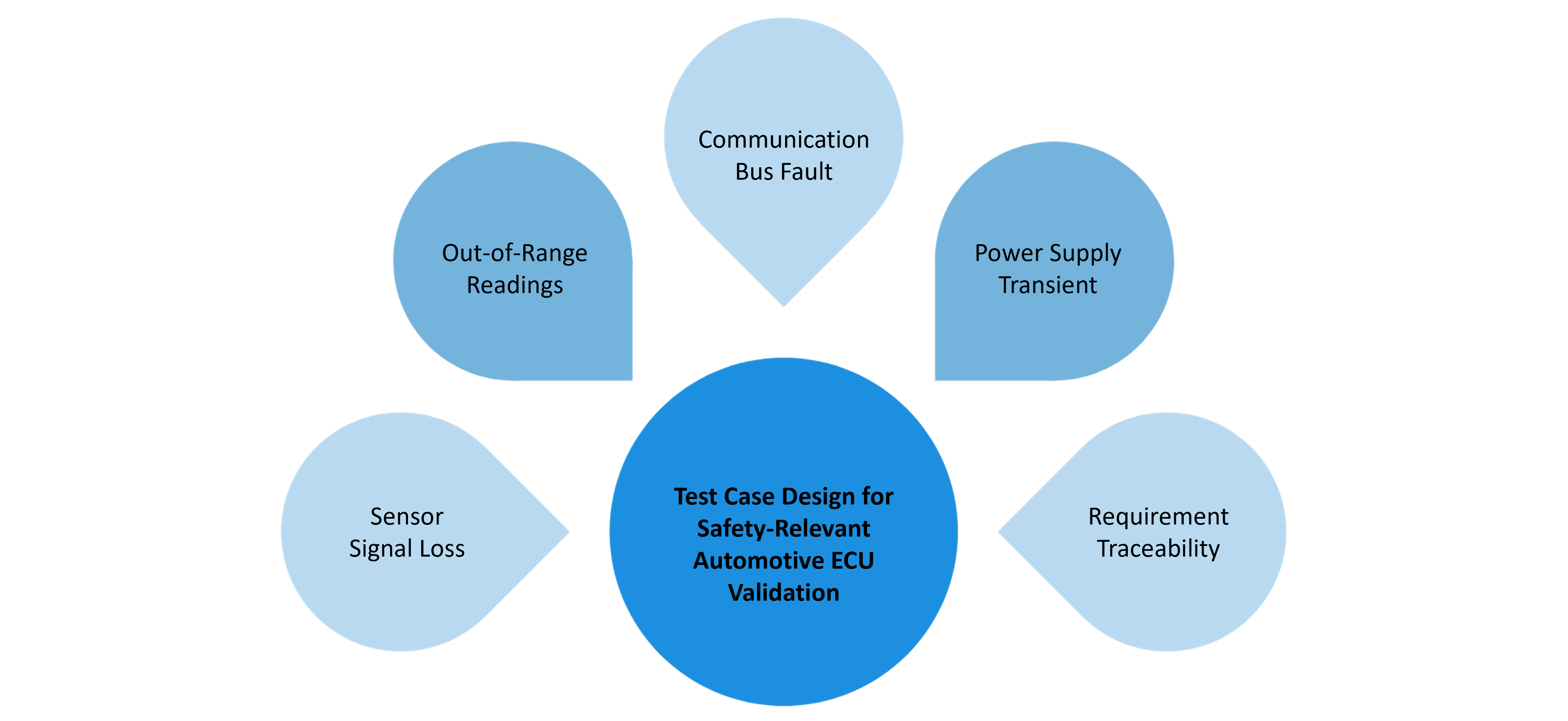
Test case design for safety-relevant automotive ecu validation has to cover far more than the ECU's expected operating range, because a safety-relevant ECU's most important behavior is often how it responds to conditions outside that range — sensor signal loss, out-of-range readings, a communication bus fault, a power supply transient. Structured test case design for safety-relevant ECU validation traces each test case back to a specific requirement or hazard from the ECU's safety case, so that test coverage can be demonstrated against the actual safety argument rather than an arbitrary set of scenarios someone thought to test. This traceability is also what an ISO 26262 functional safety assessment actually looks for, as covered in our piece on ISO 26262 functional safety — a HIL and SIL test bench without that traceability produces test results an assessor can't credit toward the safety case, no matter how thorough the testing actually was.
Regression testing strategy across automotive ecu software iterations is what keeps a HIL and SIL test bench valuable across an ECU's entire development lifecycle rather than just at one validation milestone. Every software change, even one targeting an unrelated feature, can introduce a regression in previously-validated behavior, and an automated test bench that re-runs the full validated test case suite against every build catches that regression immediately rather than weeks later during a formal validation pass. A workable regression testing strategy across automotive ECU software iterations also has to manage test suite runtime as the case count grows, prioritizing safety-relevant and previously-failing test cases so regression testing stays fast enough to run on every build rather than becoming a bottleneck teams start skipping under schedule pressure.
A HIL and SIL test bench validates one ECU, or a small cluster of interacting ECUs, in isolation from the rest of the vehicle, and that isolation is exactly what makes bench testing fast and repeatable — but it also means bench testing alone cannot fully replace vehicle-level validation. Our piece on functional mock-up interface for vehicle co-simulation covers how HIL testing scales up from single-ECU bench validation to multi-domain, whole-vehicle co-simulation, extending the same automated, repeatable testing philosophy to the interactions between ECUs across an entire vehicle rather than one ECU at a time.
HIL and SIL testing validate an ECU's design and software before production, while a separate but related discipline validates that every manufactured unit meets spec as it comes off the line. Our piece on end-of-line testing for automotive ECUs covers that production-side test strategy, and the two disciplines share the same underlying philosophy: automated, repeatable, traceable test coverage rather than manual spot-checks, applied at different points in an ECU's lifecycle from design validation through to production shipment.
Embien Technologies builds hil and sil testing for automotive ecus: building an automated test bench platforms, including TestBot, our purpose-built automated ECU test bench engineered for exactly the test bench architecture, test case traceability, and regression testing strategy this article covers. To discuss HIL and SIL testing or an automated test bench for an automotive ECU program, reach out to Embien's engineering team.

Explore Embien's engineering expertise across Automotive, Medical Devices, Industrial Automation, Semiconductor, Consumer Electronics, and other embedded technology domains.

TestBot enables automated testing of embedded firmware, hardware interfaces, communication protocols, and connected applications through configurable, no-code test workflows.

A case study on developing an automated test bench for an industrial data acquisition device, supporting repeatable testing and systematic validation of device functionality.