
Adaptive cruise control has been engineered, validated, and written about extensively as a Level 1-2 driver assistance feature, one where a human remains the fallback at every moment. Highway pilot and level 3 automation: engineering the driver-system handoff is a fundamentally different engineering discipline, because Level 3 automation is the first automation level where the system, not the driver, is legally and functionally responsible for the driving task under defined conditions. The defining engineering problem highway pilot and Level 3 automation: engineering the driver-system handoff has to solve isn't perception or control under normal operation — it's what happens at the boundary, when the system needs a disengaged human to become an engaged driver again, reliably and in time.
What legally distinguishes level 3 from level 2 vehicle automation? is a question with real regulatory teeth, not just a technical nuance. Under Level 2, the driver is legally required to supervise the system continuously and is responsible for intervening at any time, even while the system is actively steering and controlling speed. Under Level 3, within its defined operational design domain, the system itself is the responsible driving entity, and the human is permitted to disengage from active supervision — checking a phone, for instance — as long as they remain capable of resuming control when requested. That shift in legal responsibility is exactly what makes the handoff problem so consequential: a Level 2 system can assume the driver is already watching, while a Level 3 system has to actively re-engage a driver who, by design, was not.
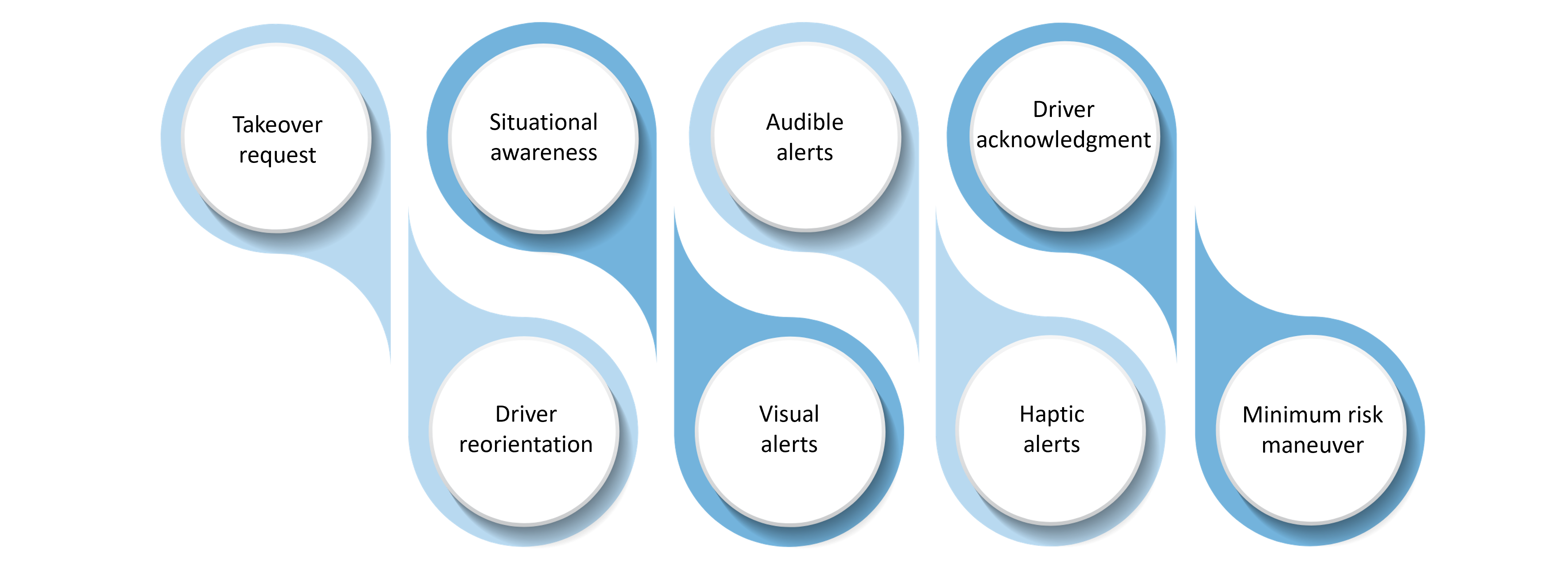
Transferring control back to a driver who may be reading, watching a video, or simply looking away is the core engineering challenge of highway pilot and Level 3 automation. The system has to issue a takeover request early enough that a driver who wasn't watching the road has time to reorient, physically reposition, and build situational awareness before control genuinely reverts — typically several seconds, not a fraction of a second, given how long real human reaction and reorientation takes from a fully disengaged state. The handoff request itself has to be unambiguous and escalate in urgency (visual, then audible, then haptic) if the driver doesn't acknowledge it, because a handoff request that a driver simply doesn't notice is functionally the same as no handoff request at all.
Driver monitoring requirements for level 3 automation handoff readiness exist precisely because the system can't safely issue a handoff request without knowing whether the person it's requesting a handoff from is actually capable of responding. That means continuous monitoring of eye state, head pose, and posture to infer whether a driver is present, awake, and roughly oriented toward the driving task, not just a one-time check at trip start. Driver monitoring requirements for Level 3 automation handoff readiness go further than the always-watching-the-road assumption behind most Level 2 driver monitoring, since a Level 3 system has to distinguish between a driver who is legitimately, permissibly disengaged and a driver who has become unfit to resume control at all — a distinction covered in more depth in Embien's broader look at driver state sensing, Who Drives It.
Minimum risk maneuver design when a driver fails to respond to a handoff request is the fallback layer every Level 3 system needs, because a handoff request is, by definition, not guaranteed to succeed. If escalating alerts go unanswered within a defined time window, the system has to execute a minimum risk maneuver on its own — typically decelerating in-lane, or moving to the shoulder where lane geometry allows, while activating hazard lights and, increasingly, contacting emergency services if driver unresponsiveness looks medical rather than situational. Minimum risk maneuver design when a driver fails to respond to a handoff request has to be validated against the same rigor as any other safety-critical vehicle behavior, since it is the behavior that runs precisely when the system's normal operating assumptions have already broken down.
How does sotif apply to level 3 handoff-related unknown-unsafe scenarios? it applies directly, because most of the genuinely hard handoff failure modes aren't component malfunctions at all — they're performance limitations and unknown-unsafe scenarios in exactly the sense SOTIF (ISO 21448) was written to address. A driver who takes longer than the design assumption to reorient, a handoff request issued in a location with unusual road geometry, a monitoring system that misjudges drowsiness — none of these are hardware failures, yet all of them are safety-relevant. Embien's guide to SOTIF in practice covers the broader methodology for identifying and validating against exactly this class of scenario, and handoff design is one of the clearest places that methodology has to be applied with real discipline.
The small number of production Level 3 systems that have actually reached market — constrained to narrow operational design domains like low-speed traffic jam conditions on mapped highways — reveal just how conservative real handoff design has to be relative to what's technically demonstrable in a controlled test. Tight speed and geography constraints, generous handoff time budgets, and driver monitoring hardware that goes well beyond what Level 2 systems typically carry are common threads across the systems that have actually reached regulatory approval, and they show how much of Level 3's engineering burden sits in the handoff and monitoring layer rather than in the core driving automation itself.
None of this happens without a mature underlying control system, and Level 3 highway pilot systems build directly on the actuator control and closed-loop tracking already proven out in adaptive cruise control, covered in Embien's guide to engineering the modern ACC system. The functional safety architecture underlying that system, detailed in functional safety on adaptive cruise control, is likewise a direct ancestor of the safety case a Level 3 handoff design has to extend, since the underlying longitudinal and lateral control loop doesn't change fundamentally between ACC and highway pilot — what changes is who's legally watching, and what the system does when no one is.
Embien Technologies engineers across the full stack that highway pilot and level 3 automation: engineering the driver-system handoff depends on: driver monitoring sensing and algorithms, minimum risk maneuver logic, and the SOTIF-driven validation work needed to demonstrate handoff safety against unknown-unsafe scenarios, not just known failure modes.

Embien's Digital Transformation Services support automotive innovation through embedded software development, system integration, connected technologies, and intelligent digital solutions.

Embien's Connected Vehicle Development services support vehicle connectivity through embedded systems, wireless communication, telematics, and connected automotive applications.

A case study on developing a tyre pressure monitoring application to display tyre pressure information and support connected vehicle monitoring.