
Body control content on the site covers the body control module as the general electronic hub for a vehicle's comfort, lighting, and access functions, but occupant sensing has grown into its own distinct sensing and safety discipline that deserves dedicated coverage. In-cabin occupant sensing now spans radar and camera systems built specifically to detect who, or what, is sitting in every seat, feeding both seatbelt reminder logic and the mandatory child-presence detection features that regulators increasingly require, and it's a natural extension of good automotive body control module design even though the sensing problem itself sits apart from general body electronics.
What regulatory mandates require child-presence detection in vehicles? is the question driving most current in-cabin sensing programs, since child-presence detection has moved from an optional convenience feature to a regulatory requirement in a growing number of markets, driven directly by hot-car fatality statistics involving children left unattended in rear seats. Euro NCAP has folded child-presence detection into its safety rating criteria, and several national regulators have moved toward mandating it as standard equipment on new vehicles, which has turned what used to be a premium-trim option into a baseline requirement that every body control and occupant sensing program now has to design for from the start.
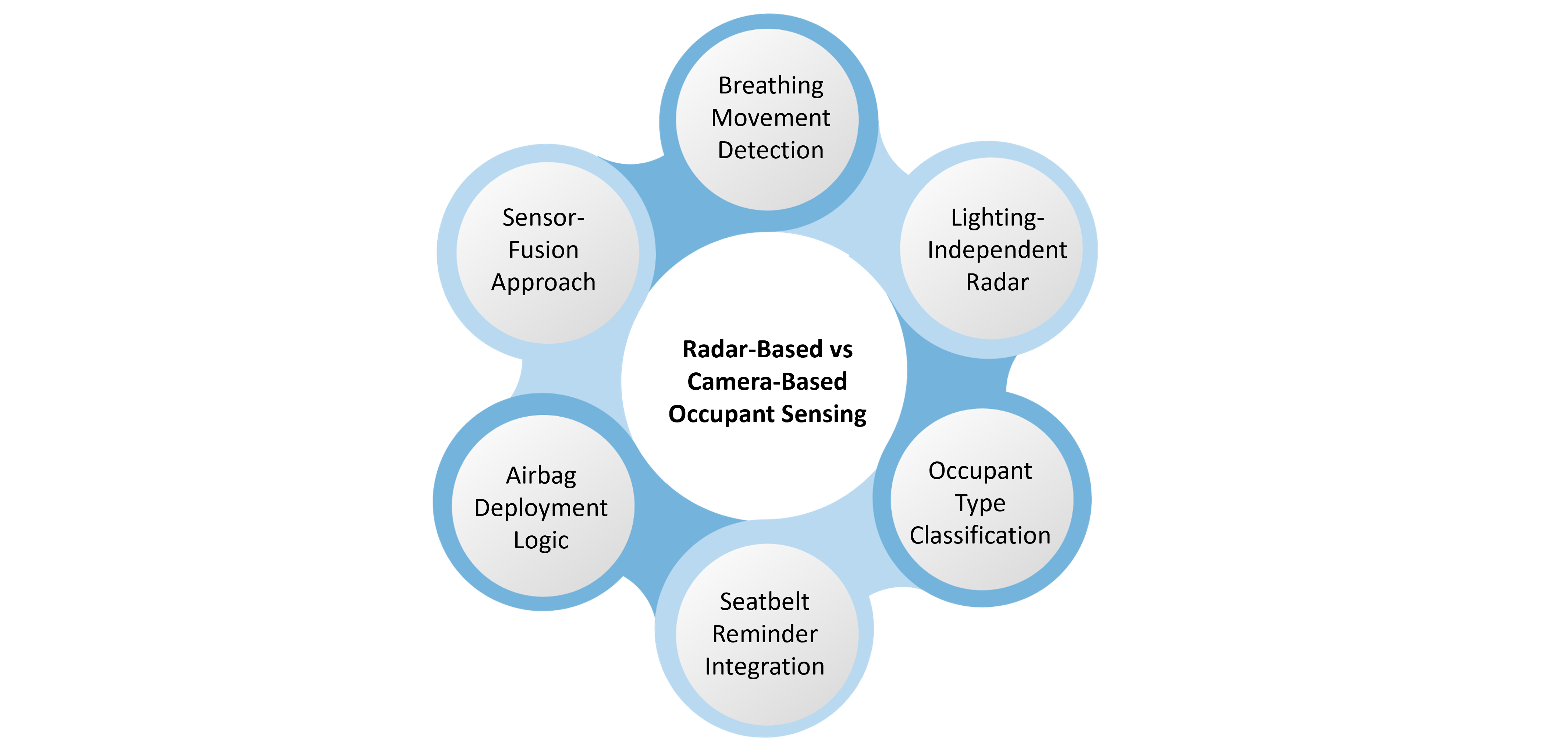
The choice between radar-based vs camera-based occupant sensing for child-presence detection comes down to a real tradeoff between reliability and information richness. Low-power in-cabin radar can detect the faint chest movement of a breathing occupant even under a blanket or behind a rear-facing child seat, and it works regardless of lighting conditions, but it can't classify what it's detecting beyond "something is moving" with much confidence. Camera-based systems, by contrast, can classify occupant type, size, and posture far more precisely, information that's also useful for seatbelt reminder and airbag deployment logic, but they depend on adequate lighting and an unobstructed view and raise the privacy questions that radar-based sensing avoids. Many current-generation systems combine radar-based vs camera-based occupant sensing for child-presence detection into a single sensor-fusion approach, using radar as a reliable presence-detection backstop and camera data for richer classification when conditions allow it.
Seatbelt reminder system integration with occupant classification extends occupant sensing beyond simple presence detection into understanding who's actually in each seat. A seatbelt reminder system that knows an occupant is present, and can classify roughly whether that occupant is an adult, a child in a booster seat, or an infant in a rear-facing child seat, can tailor its reminder behavior and, in more advanced systems, feed that classification into airbag deployment force calculations. Seatbelt reminder system integration with occupant classification is a good example of how in-cabin sensing hardware, originally justified for child-presence detection, ends up serving multiple safety functions once the sensing infrastructure and classification logic already exist in the vehicle.
Because child-presence detection exists specifically to prevent a life-threatening outcome, the false negative and false positive tradeoffs involved carry unusually high stakes for a comfort-adjacent feature. A false negative, failing to detect a child left in the vehicle, defeats the entire purpose of the feature; a false positive, alerting when no one is actually present, erodes driver trust in the system and risks the alert being ignored or the feature being disabled entirely. Tuning detection thresholds for in-cabin occupant sensing has to weight strongly toward catching every real presence event even at the cost of some false alarms, a bias that's the opposite of how many other automotive sensing systems are tuned, where nuisance alerts are treated as the primary problem to avoid.
Privacy considerations for in-cabin camera-based occupant sensing have become a real design constraint, not just a legal afterthought, as camera-based systems have grown more capable of identifying and classifying individual occupants in increasing detail. Most production implementations process camera data entirely on an embedded processor within the cabin sensing module itself, without transmitting raw video off the vehicle or storing identifiable imagery, extracting only the classification data, occupant present, occupant type, seatbelt status, that downstream systems actually need. Privacy considerations for in-cabin camera-based occupant sensing increasingly shape system architecture decisions as much as sensing accuracy does, particularly in markets with strict biometric and in-vehicle data protection regulation.
Occupant sensing modules don't operate in isolation; they report classification and presence data into the broader body control architecture described in our automotive BCM ECU and BCM architecture article, itself a core piece of automotive body control module design, which is where seatbelt reminder chimes, interior alert signals, and, in many vehicles, a connected-app notification for a detected child-presence event actually get triggered. Sound automotive body control module design treats occupant sensing as a first-class input alongside door, lighting, and access status rather than a bolt-on feature layered in afterward. Occupant sensing hardware is also frequently co-located with the door and access electronics covered in our door control units (DCUs) article, since both domains share proximity to the same wiring harness and, in some architectures, the same zonal controller. Seat position data from the systems described in our automotive seat control systems article is also a useful input for occupant sensing, since seat position and orientation affect what a radar or camera sensor can actually see.
Embien Technologies brings deep automotive body control module design expertise to in-cabin occupant sensing programs, from radar and camera sensor integration and classification algorithms to the BCM-level logic that turns a detection event into a seatbelt reminder or child-presence alert. To discuss occupant sensing sensor integration or body control module design for a comfort and safety electronics program, reach out to Embien's engineering team.

Embien's Digital Transformation Services support connected automotive systems through embedded software, intelligent data processing, system integration, and digital engineering solutions.

Embien develops image and video processing algorithms for object detection, classification, tracking, and real-time visual data analysis in embedded applications.
A case study on combining image stitching and object tracking techniques to process visual data and track objects across image frames.