
Aviation settled the black box question decades ago: when something goes wrong, investigators need a reliable, tamper-resistant record of exactly what the system perceived and did in the moments before. Automated driving is now forcing the same question onto the automotive industry, at a scale and complexity the aviation model was never designed for. In-vehicle data recorders and the rise of the black box for autonomous vehicles describes the emerging engineering discipline of capturing, storing, and preserving the sensor, perception, and decision data an automated-driving system generates, so that when an incident occurs, investigators, regulators, and manufacturers can actually reconstruct what the vehicle saw and why it acted the way it did.
Why do autonomous vehicle data recording requirements exceed standard edr scope? A conventional Event Data Recorder captures a narrow, well-defined set of parameters, speed, braking, airbag deployment, seatbelt status, around a crash event, because a human driver's decision-making isn't something the vehicle needs to record. An automated-driving system's decision-making is exactly what needs to be reconstructed after an incident, which means the recording scope has to extend to sensor data, perception outputs, the planning system's situational understanding, and the specific control decisions the automated driving stack made, none of which fits inside standard EDR's much narrower parameter set.
What data needs to be captured to reconstruct an automated-driving incident spans several distinct layers: raw or processed sensor data from camera, radar, and lidar covering the time window around the incident, the perception system's object detection and classification output, the planning system's intended trajectory and the actual control commands issued, and system state data confirming which automation mode was active and whether any fault or degradation condition was present. What data needs to be captured to reconstruct an automated-driving incident is ultimately whatever's necessary to answer the investigator's core question: given what the system perceived, was the decision it made reasonable, and if not, where in the perception-planning-control chain did it go wrong.
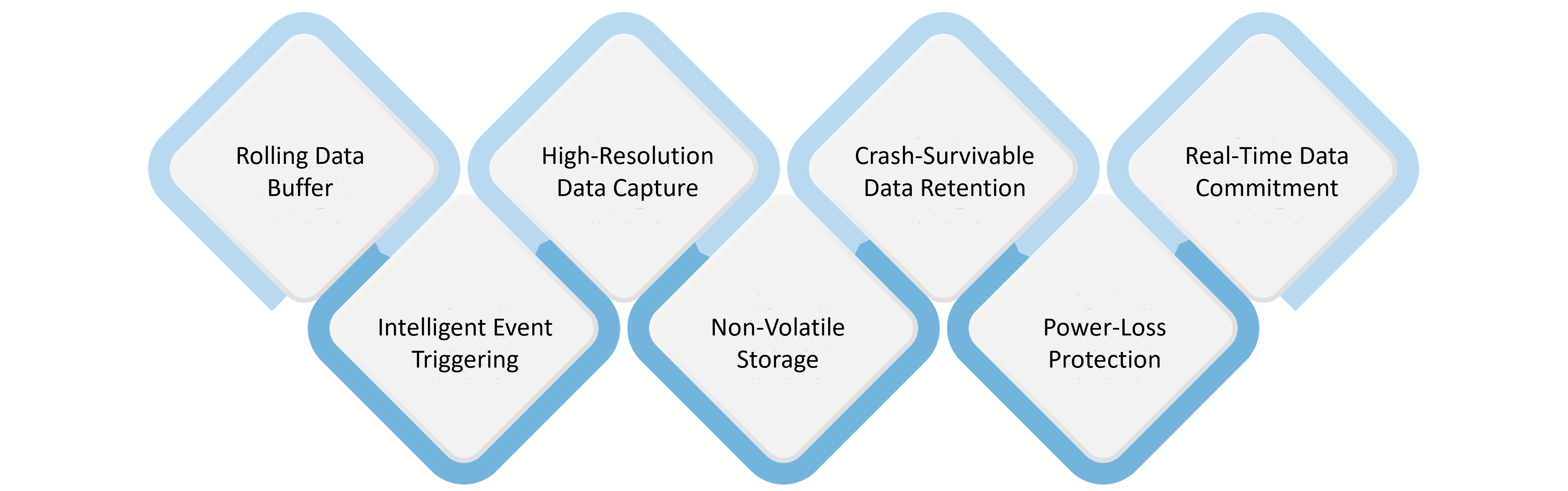
Storage architecture for autonomous vehicle data recording volumes has to solve a problem standard EDR storage never faced: the raw sensor and perception data an automated-driving stack generates is orders of magnitude larger than a crash-event parameter log, far too large to retain continuously for a vehicle's operating life, which means the recording architecture needs intelligent triggering and buffering, continuously holding a rolling window of high-resolution data and permanently committing it to non-volatile, crash-survivable storage only when a triggering event, a collision, a safety-relevant disengagement, a near-miss, actually occurs. Storage architecture for autonomous vehicle data recording volumes also has to guarantee that the write-to-permanent-storage operation itself survives the power loss and physical shock a genuine incident is likely to involve, which is a demanding real-time systems problem in its own right.
Regulators in multiple markets are actively developing automated-driving data recording requirements specifically because standard EDR data is inadequate to determine fault or system behavior in an automated-driving incident, and liability questions, whether the vehicle's automated system or another party bears responsibility for a given incident, are increasingly likely to hinge on exactly the kind of perception and decision data this article describes. Manufacturers deploying automated-driving features have a direct commercial interest in robust, trustworthy incident data recording as well, since a system that can clearly demonstrate it perceived and responded reasonably is a very different liability position than one that can't produce a credible account of what happened.
Data retention and chain-of-custody for autonomous vehicle incident investigation determines whether recorded data actually holds up as reliable evidence when it matters: retention periods need to be long enough to cover the realistic window in which an incident might be investigated or litigated, and the chain of custody, from the moment data is committed to storage through extraction, transfer, and analysis, needs cryptographic integrity protection so no party can credibly claim the record was altered. Data retention and chain-of-custody for autonomous vehicle incident investigation is as much a legal and process design problem as a technical one, since a technically perfect recording system with a weak custody process still produces evidence that's vulnerable to challenge.
Standard vehicle data logging and EDR systems remain the right architecture for conventional, driver-operated vehicles, and our automotive data logging and EDR systems article covers that foundation in depth. Autonomous and highly-automated vehicle black box recording is best understood as an extension of that same discipline, applied to a system whose decision-making now needs to be part of the record. Programs building an automated-driving stack should treat the two as related but distinct requirements, not assume general EDR coverage is sufficient once the vehicle is making its own driving decisions.
Data recorded to reconstruct an automated-driving incident and data used for cybersecurity forensics after a breach draw on overlapping infrastructure, secure logging, tamper-resistant storage, structured post-incident analysis, even though the two exist to answer different questions. Our cybersecurity incident forensics article covers how ECU and network log analysis supports security investigation, and a well-designed in-vehicle data recorders and the rise of the black box for autonomous vehicles architecture shares much of that same secure-logging foundation, along with the runtime detection our intrusion detection article describes for flagging anomalies worth investigating in the first place.
Embien Technologies designs in-vehicle data recorders and the rise of the black box for autonomous vehicles architectures, covering sensor and perception data capture, crash-survivable storage, and chain-of-custody-preserving data pipelines for automated-driving programs. See our companion automotive data logging and EDR systems article for the foundational data-logging architecture this builds on.
To discuss automated-driving data recording architecture for an upcoming program, reach out to Embien's engineering team.

Embien's Digital Transformation Services support connected automotive systems through software engineering, data integration, secure connectivity, and intelligent digital solutions.

Embien's Automotive Electronics expertise covers embedded hardware and software development, vehicle networking, ECU engineering, and connected automotive systems.

A case study on developing a wireless CAN bus bridge using the eStorm-B1 EVK to enable wireless communication between CAN-based automotive systems.