
An EV charger's connector and power electronics get most of the attention, but none of the experience people actually associate with modern EV charging — tapping a car to a charger and having it just start, or a charging network intelligently scheduling load — happens without a communication protocol running underneath the hardware. Iso 15118 and plug & charge: the communication protocol behind ev charging is that protocol layer: the standard that defines how a vehicle and a charger talk to each other, authenticate one another, and negotiate a charging session, independent of the charger hardware level itself. This article covers what ISO 15118 actually standardizes, how Plug & Charge authentication works, and where the protocol's smart-charging and interoperability features fit into the broader EV charging picture.
ISO 15118 sits above the physical charging connector and power delivery standards that define charger hardware levels, and standardizes the digital communication that happens once a vehicle is physically connected to a charger. Where the connector and charger hardware determine how much power can physically flow, ISO 15118 determines how the vehicle and charger identify each other, authenticate a charging session, negotiate power delivery parameters, and exchange billing and smart-charging data over a digital link running across the same charging cable. Our piece on electric vehicle charger hardware levels covers the physical side ISO 15118 builds its communication layer on top of; the two are complementary standards, not competing ones.
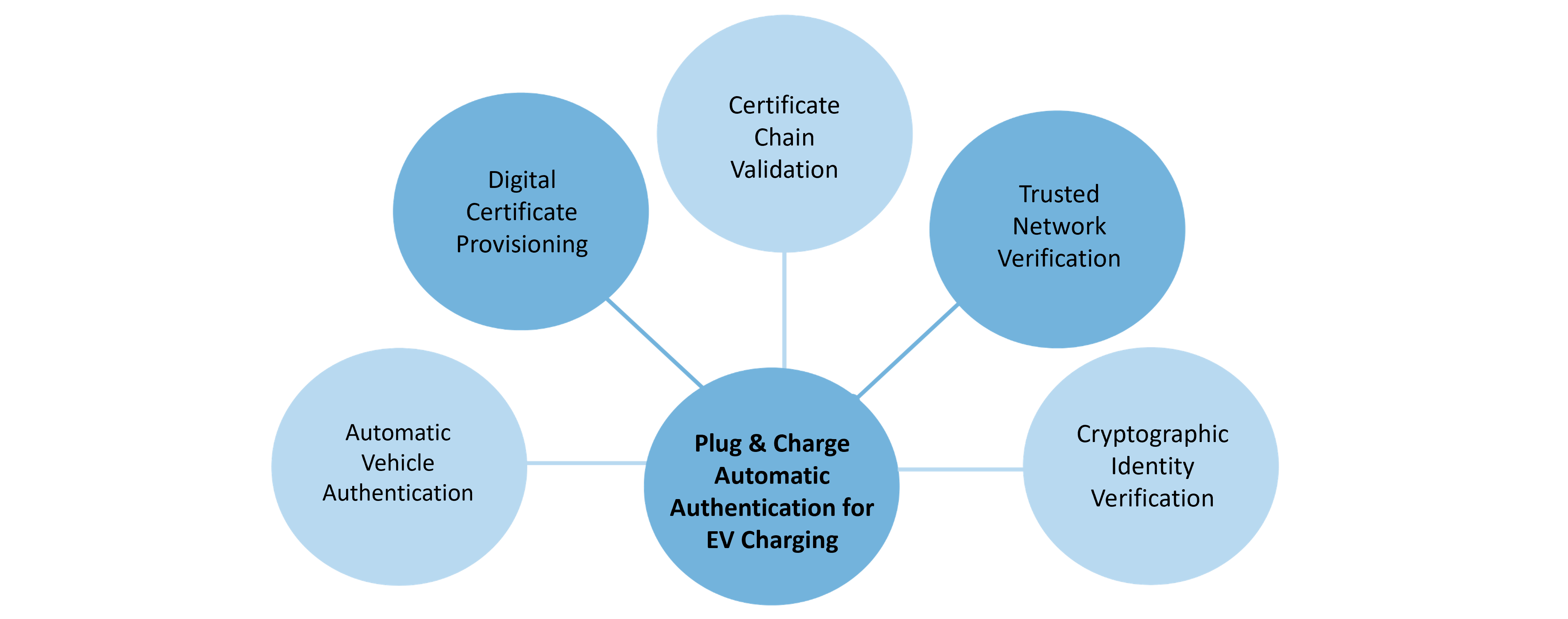
Plug and charge automatic authentication for ev charging is the ISO 15118 feature most drivers actually notice: a vehicle that authenticates itself to a charger automatically the moment it's plugged in, with no card tap, no app interaction, and no manual authorization step. Under the hood, Plug & Charge relies on digital certificates provisioned to the vehicle that a charger can validate against a certificate chain rooted in a trusted charging network operator or industry certificate authority, letting the vehicle prove its identity and payment eligibility cryptographically instead of through a separate physical credential. Plug and charge automatic authentication for EV charging removes the single biggest point of friction in the public-charging experience, but it depends entirely on the certificate provisioning and validation infrastructure working correctly across every network the vehicle might plug into.
Tls-secured communication session between vehicle and charger is what makes Plug & Charge authentication trustworthy rather than exploitable. ISO 15118 establishes its vehicle-to-charger communication over TLS, encrypting the session and authenticating both endpoints using their respective digital certificates, so that a Plug & Charge authorization can't be intercepted, replayed, or spoofed by a compromised or malicious charging station pretending to be a legitimate one. The TLS-secured communication session between vehicle and charger also protects the billing and metering data exchanged during a session, which matters as much for correct settlement between charging network operators as it does for security in the traditional sense.
How does iso 15118 support smart charging load management? by giving the vehicle and charger a shared digital channel to negotiate not just whether to charge, but when and how fast. Through that channel, a charger or charging network can signal available capacity, time-of-use pricing, or grid load conditions, and the vehicle can respond with its own charging preferences and constraints, letting a charging session shift its power draw to cheaper or lower-demand periods without the driver managing any of it manually. This smart charging capability is also the protocol foundation that bidirectional and vehicle-to-grid charging builds on, extending the same negotiated-session model to power flowing back out of the vehicle, as covered in our piece on vehicle-to-grid and bidirectional charging engineering.
Interoperability challenges across ev charging network operators remain one of the harder parts of deploying ISO 15118 at scale, because Plug & Charge's certificate-based trust model only works smoothly when a vehicle's certificate is recognized across every network it might charge on, not just the network that issued it. Different charging network operators, vehicle manufacturers, and certificate authorities have had to build out cross-recognition and roaming agreements so that a Plug & Charge-capable vehicle actually gets the seamless experience the protocol promises everywhere it charges, rather than only on its home network. Interoperability challenges across EV charging network operators are gradually narrowing as the certificate ecosystem matures, but a vehicle program integrating ISO 15118 still has to plan for a charging landscape that isn't fully unified yet.
ISO 15118's communication protocol sits between two pieces of EV architecture the site already covers separately: the charger hardware described in our EV charger introduction, and the vehicle-side battery management system described in automotive BMS ECU architecture. The charging parameters ISO 15118 negotiates over its TLS-secured session ultimately have to match what the vehicle's BMS reports as safe charging limits, making the protocol the digital handshake connecting charger hardware, communication security, and battery management into one coherent charging session.
Embien Technologies engineers iso 15118 and plug & charge: the communication protocol behind ev charging integrations — Plug & Charge authentication, TLS-secured vehicle-to-charger sessions, and smart charging protocol support across BMS and charger hardware platforms. To discuss ISO 15118 or Plug & Charge protocol integration for an EV program, reach out to Embien's engineering team.

Embien's Edge Computing Services enable efficient data processing on embedded devices through optimized software, real-time analytics, and secure edge-to-cloud connectivity.

Embien's Connected Vehicle Development services support automotive connectivity through embedded systems, vehicle communication protocols, telematics, and connected applications.
A case study on using Flint for rapid automotive dashboard development, supporting embedded GUI design and efficient implementation of vehicle instrument cluster interfaces.