
ISO 21434 is the road vehicle cybersecurity engineering standard, and it exists to cover a gap that ISO 26262 was never built to close: ISO 26262 manages functional safety, the risk that a system behaves unpredictably because of a fault, while ISO 21434 manages cybersecurity, the risk that a system behaves unpredictably because someone made it do so on purpose. Iso 21434 cybersecurity engineering lifecycle explained in plain terms means a defined set of activities running from concept through production and decommissioning: item definition, threat and risk assessment, cybersecurity goals and requirements, design and verification, and monitoring the item once it is on the road. Most of the site's existing security content focuses on network-layer mechanics such as MACsec, IPsec, and TLS; ISO 21434 sits above that layer as the engineering-lifecycle standard that decides what those mechanisms are protecting against in the first place, and why a given control was chosen over another.
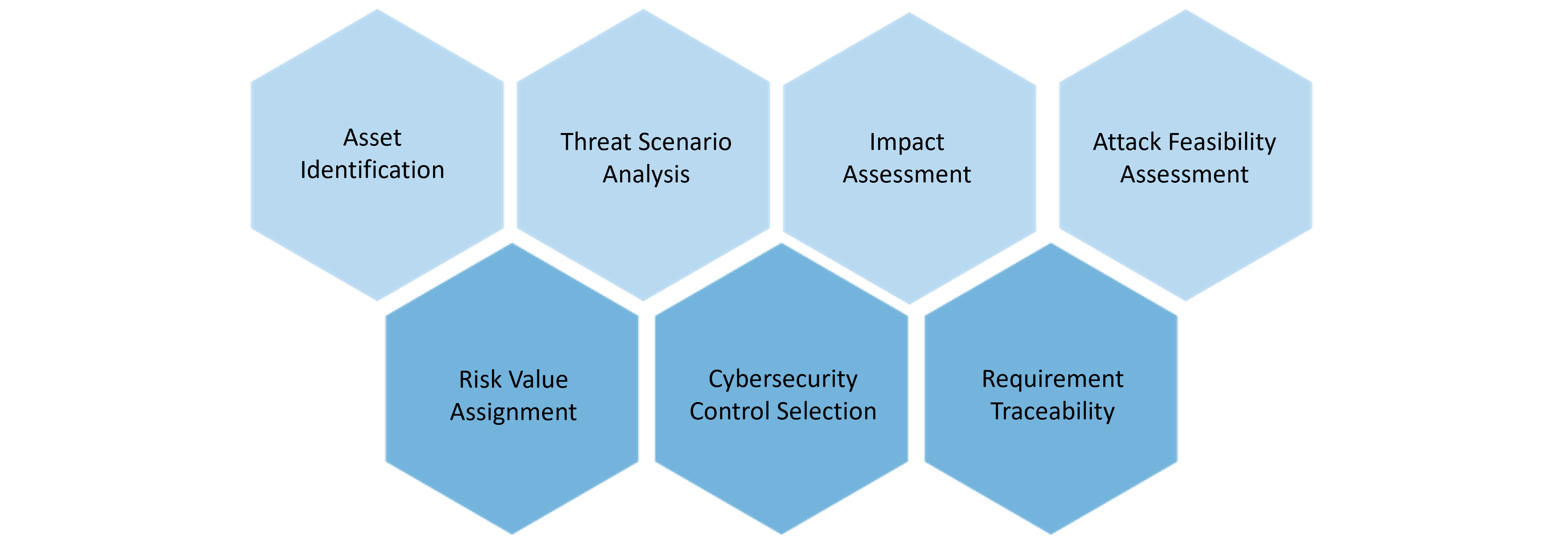
TARA is short for Threat Analysis and Risk Assessment, and it is the method the entire rest of ISO 21434 is built around. A threat analysis and risk assessment methodology for automotive cybersecurity starts by identifying assets in the item under analysis, the data, functions, or interfaces that have value to an attacker or whose compromise creates real consequence, then works through plausible threat scenarios against each asset. TARA scores each scenario on impact, across safety, financial, operational, and privacy dimensions, and on attack feasibility, how much expertise, time, equipment, and access a real attacker would actually need. The combination of impact and feasibility is what TARA uses to assign a risk value to each threat scenario, and that risk value is what determines whether a team accepts the risk, avoids it by design, transfers it, or reduces it with a specific cybersecurity control. Every downstream cybersecurity requirement in an ISO 21434 program should trace back to a TARA finding; a requirement that cannot be traced to a documented threat scenario is a sign the TARA was incomplete or the requirement was added without the analysis behind it.
Cybersecurity assurance levels (CAL) for automotive components are ISO 21434's way of scaling engineering rigor to actual risk, the same logic ASIL brings to functional safety, applied to cybersecurity instead. TARA output, specifically the combined impact and attack feasibility rating for a threat scenario, is what determines the CAL assigned to the corresponding cybersecurity goal. A higher CAL demands more rigorous verification and validation evidence, deeper penetration testing, and tighter change control on the associated requirements and design elements, while a lower CAL still requires documented justification but not the same depth of evidence. Assigning cybersecurity assurance levels for automotive components correctly matters commercially as well as technically, because over-assigning CAL across an entire item burns engineering budget on components that were never genuinely high-risk, while under-assigning it is exactly the gap an assessor or a real attacker will find first.
What is a cybersecurity management system (CSMS) for automotive? is a question every Tier 1 supplier eventually has to answer for an OEM customer, because ISO 21434 compliance is not just a per-project deliverable, it depends on an organization-level CSMS being in place first. A CSMS is the organizational framework, policies, processes, and defined responsibilities, that makes ISO 21434-compliant engineering repeatable across projects rather than something one strong engineering team happens to do well once. UNECE WP.29 R155 references this same CSMS concept as a regulatory type-approval requirement in many markets, which is why a CSMS gap shows up as a business risk, not just an engineering one, well before a specific TARA or work product is ever reviewed.
An ISO 21434 audit or assessment does not simply ask whether a TARA exists; it checks whether the TARA is traceable to the cybersecurity goals and requirements derived from it, whether the CAL assignments are justified by the underlying risk values, and whether verification evidence actually demonstrates that a stated cybersecurity requirement was met rather than merely documented. Assessors also look for a maintained vulnerability management process that covers the item after production, since ISO 21434's lifecycle scope extends well past design sign-off. A program with a technically sound TARA but thin traceability between that TARA and its downstream work products tends to fail an assessment for the same reason a functional safety case fails: the individual pieces exist, but the argument connecting them does not.
ISO 21434's TARA and CAL outputs are what justify a specific network-layer control, not the other way around. A gateway ECU protected with MACsec at Layer 2 or a diagnostic session locked behind mutual TLS is a design decision that should trace back to a threat scenario TARA identified and a CAL that demanded that level of protection. Readers evaluating the underlying network mechanics referenced here, including MACsec, IPsec, and TLS across in-vehicle Ethernet segments, can go deeper in Automotive Ethernet Security Architectures, which treats the same threat landscape at the protocol level that this article treats at the process level.
Most automotive programs now have to run ISO 21434 and ISO 26262 in parallel rather than choosing between them, and the two disciplines share more process structure than their separate standards documents suggest, an item definition, a hazard or threat analysis, assigned assurance levels, and traceable work products through to verification. Teams that already have a mature ISO 26262 functional safety process, covered in depth in our ISO 26262 functional safety explainer, tend to adopt ISO 21434's engineering lifecycle faster because the discipline of traceable, assurance-level-scaled evidence is one they already practice; the TARA method and CAL scoring are new, but the underlying rigor is not.
Embien Technologies supports OEMs and Tier 1 suppliers through the full ISO 21434 cybersecurity engineering lifecycle: item definition, TARA facilitation, CAL determination, CSMS process support, and the traceable work products an assessment actually checks. Our broader automotive cybersecurity services cover this engineering-lifecycle work alongside the network-layer security architecture it justifies. To discuss a TARA, a CAL assignment strategy, or standing up a CSMS for an upcoming program, reach out to Embien's automotive cybersecurity team.

Embien's Product Engineering Services support automotive development through embedded hardware and software engineering, system integration, verification, and product validation.

Embien's Automotive Cybersecurity Services support vehicle security through threat analysis, secure boot, hardware security modules, secure firmware updates, and cybersecurity engineering.

A case study on implementing production-grade secure boot and hardware security module integration for an automotive telematics control unit to strengthen firmware integrity and device security.