
A conventional instrument cluster assumes a rectangular display of a fixed, modest size directly ahead of the driver. That assumption no longer holds across a growing share of the market: large-format displays that curve across the dashboard and stretch from one A-pillar to the other are now a real production direction, not a concept-car novelty, and they demand a different approach to automotive display and graphics software than a conventional cluster does. Our existing guides to embedded graphics libraries for TFT instrument clusters and IVI ECU architecture cover the conventional case; this article covers what changes at pillar-to-pillar scale.
A single curved panel spanning most of the dashboard width presents a rendering surface with real optical curvature, which means content has to be pre-warped or rendered with curvature compensation to avoid visible distortion at the edges of the panel, a correction a flat rectangular cluster display never needed. The sheer pixel count of a pillar-to-pillar display, often several times the resolution of a conventional cluster once instrument, infotainment, and passenger zones are combined into one panel, pushes rendering workload well beyond what a cluster-class MCU or SoC was ever sized for. Automotive display and graphics software built for a large curved panel has to account for both of these realities from the architecture stage, not retrofit them onto a rendering pipeline designed for a small flat cluster.
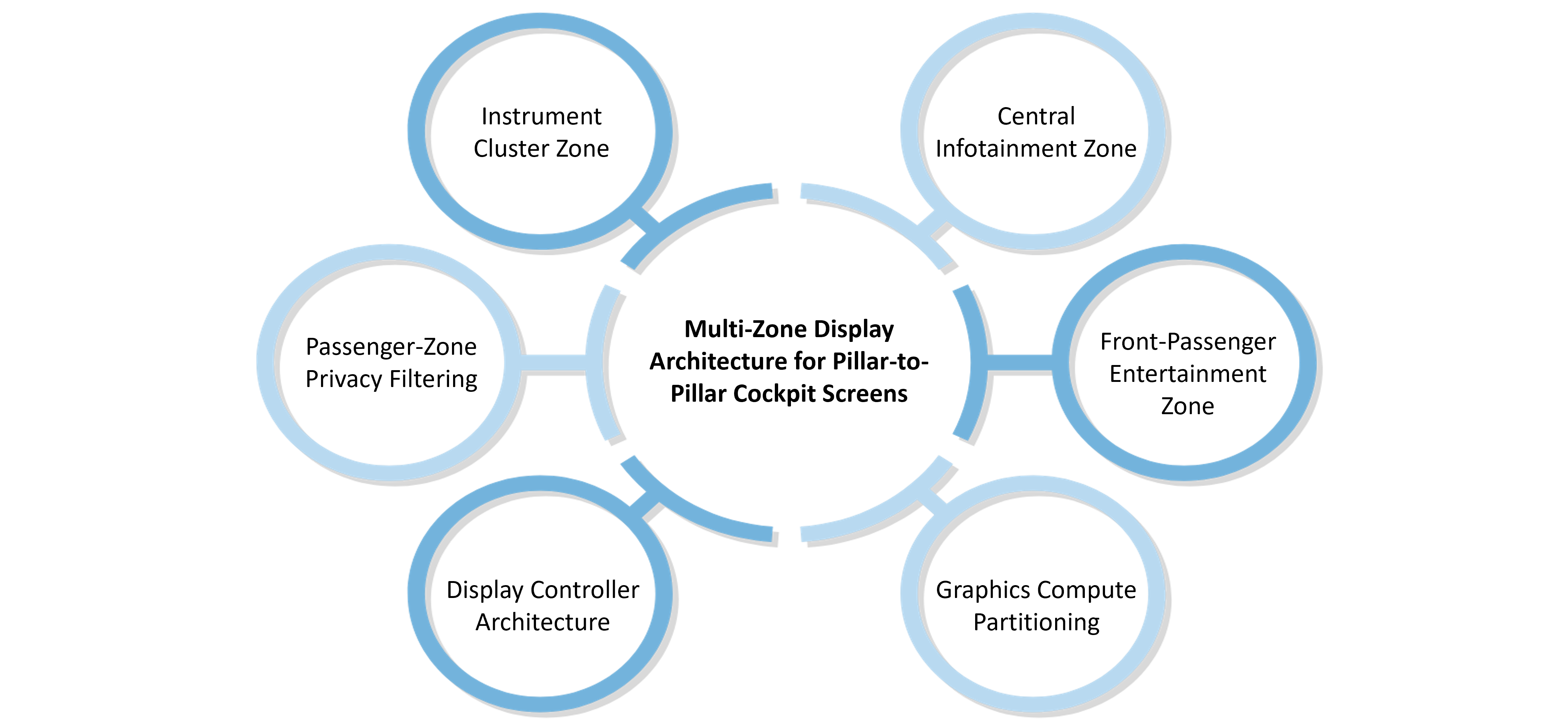
Multi-zone display architecture for pillar-to-pillar cockpit screens divides a single physical panel into logically independent regions, typically an instrument cluster zone directly ahead of the driver, a central infotainment zone, and increasingly a front-passenger entertainment zone, each running content that may need to be visible to one occupant and deliberately not distracting to another, such as video content on the passenger side that should not be visible from the driver's seat. Achieving that regional independence on a single physical panel, rather than three separate displays, requires careful partitioning of the graphics compute and display controller architecture, along with privacy filtering technology on the passenger zone where dual-view or driver-distraction requirements apply. Multi-zone display architecture for pillar-to-pillar cockpit screens is as much a system integration and safety-partitioning problem as it is a graphics problem.
Mechanical and thermal design challenges of large curved cockpit glass scale with the panel's size in ways that are easy to underestimate coming from smaller cluster displays. A large curved glass or plastic cover lens is more susceptible to thermal expansion mismatch with its backing structure across the automotive temperature range, and mounting a single large curved panel securely enough to survive vehicle vibration and crash-safety requirements, without the mounting hardware itself distorting the optical curvature, is a genuinely harder mechanical problem than mounting a small flat cluster. Heat from the backlight and display driver electronics, distributed across a much larger surface area, also needs a cooling strategy that avoids uneven panel temperature, since uneven heating can itself introduce visible optical distortion or accelerate localized component wear.
A dashboard-spanning display puts significantly more visual information within the driver's field of view than a conventional cluster and center stack combination, which raises real driver distraction concerns that regulators and safety standards bodies are actively working through as this display format becomes more common. Safety-relevant design constraints at this scale generally push toward keeping safety-critical information, speed, warnings, ADAS alerts, in a clearly defined, consistently positioned zone directly ahead of the driver regardless of what content is showing elsewhere on the panel, and toward automatically dimming or simplifying non-critical zones during specific driving conditions where distraction risk is highest.
Graphics library and gpu selection for large-format automotive displays has to account for both the raw pixel throughput a pillar-to-pillar panel demands and the safety-partitioning requirements of running instrument-cluster-relevant content alongside infotainment content on the same silicon. A GPU sized comfortably for a conventional cluster's resolution will typically be underpowered for a multi-zone pillar-to-pillar panel, and the graphics library and rendering framework chosen needs to support hardware composition and safety-relevant partitioning between zones, not just raw rendering throughput. Graphics library and GPU selection for large-format automotive displays is consequently a closer decision than it might first appear, weighing safety certification requirements, available automotive-qualified GPU silicon, and the actual rendering complexity each display zone requires.
The graphics library evaluation criteria covered in our existing article on embedded graphics libraries for TFT instrument clusters still apply at pillar-to-pillar scale, rendering performance, hardware acceleration support, and safety certification pedigree, but the bar for each of those criteria rises substantially once a single library and rendering framework has to serve a dashboard-spanning, multi-zone panel rather than one conventional cluster display. The IVI architecture principles covered in our infotainment ECU architecture guide also become more directly relevant, since a pillar-to-pillar panel effectively merges what used to be separate cluster and infotainment display domains.
Custom dashboard display firmware development for a pillar-to-pillar panel has to manage zone partitioning, curvature compensation, thermal monitoring, and multi-source content composition as one coordinated firmware and driver layer, rather than the comparatively simpler single-zone rendering loop a conventional cluster's firmware handles. Custom dashboard display firmware development at this scale increasingly resembles infotainment and AR HUD firmware work, covered in our companion article on AR HUD engineering, more than it resembles traditional cluster firmware, which is part of why large-format cockpit display programs increasingly pull cluster, infotainment, and graphics teams into a single coordinated effort.
Embien Technologies engineers automotive display and graphics software across conventional clusters and large-format pillar-to-pillar cockpit displays alike, including multi-zone architecture, custom dashboard display firmware development, thermal and mechanical design coordination, and graphics library and GPU selection for demanding cockpit display programs. To discuss large-format cockpit display engineering for a new or existing vehicle program, reach out to Embien's engineering team.

Embien delivers embedded engineering solutions across automotive and other industries, supporting display systems, connected technologies, and complex product development.

Embien's Embedded Software Development Services support automotive display systems through firmware development, graphics integration, device drivers, and hardware-software integration.
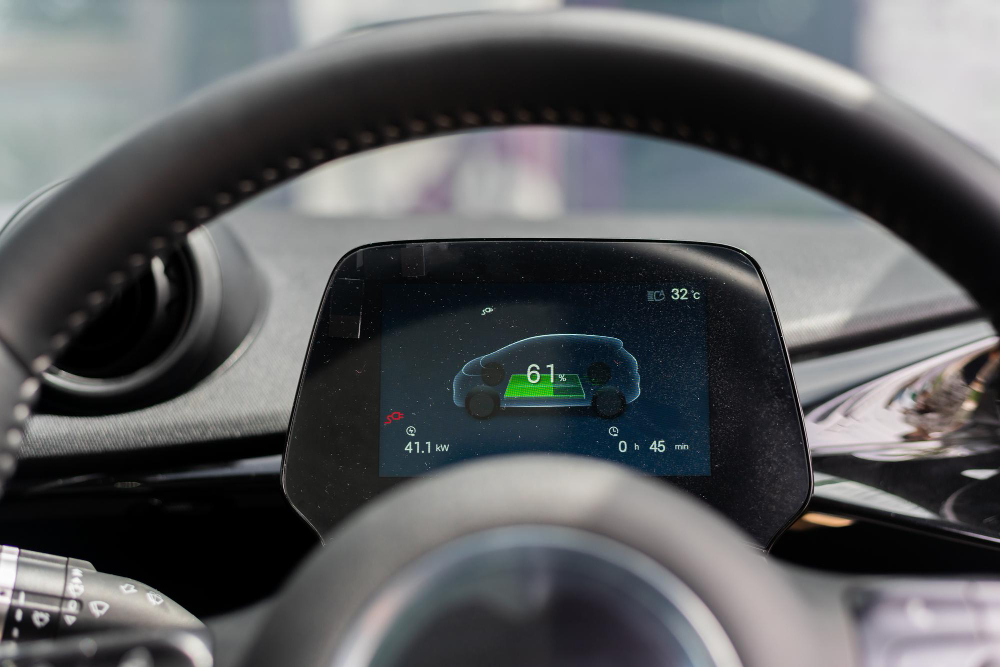
A case study on developing a vehicle dashboard and electric vehicle instrument cluster, covering embedded display design and instrument cluster implementation.