
Braking and powertrain are each covered on the site as their own deep engineering domains, but regenerative braking is the control problem that sits directly between them. Regenerative braking systems: control algorithms and ecu integration covers how a vehicle decides, on every brake pedal press, how much of the requested deceleration to deliver through the electric motor acting as a generator and how much through the conventional friction brakes, and how the electronic control units that own each of those actuators coordinate closely enough that the driver never notices the handoff.
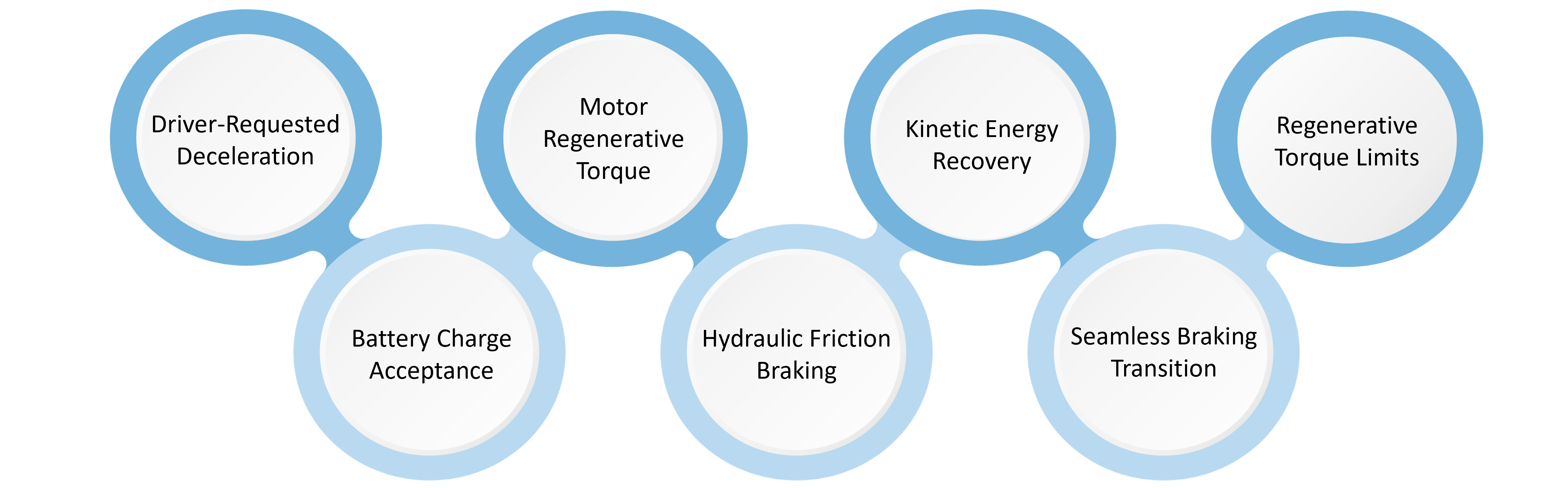
How regenerative braking blends friction and motor braking torque is the core control algorithm question the whole system is built around. When the driver presses the brake pedal, the vehicle first requests deceleration from the motor operating in generator mode, recovering kinetic energy back into the battery, and only brings in the hydraulic friction brakes to make up whatever additional deceleration the motor can't provide, whether because the motor has hit its regenerative torque limit, because the battery can't accept more charge, or because the requested deceleration exceeds what regenerative braking alone can deliver. Getting how regenerative braking blends friction and motor braking torque right, moment to moment and without a perceptible transition, is what separates a smooth-feeling regenerative braking system from one that feels inconsistent or abrupt to the driver.
The control algorithm challenges for consistent pedal feel in regenerative braking come from the fact that regenerative torque availability changes constantly, with vehicle speed, battery state of charge, and motor thermal limits, while the driver expects the same pedal travel to produce the same deceleration every time. A blending algorithm has to actively compensate for a shrinking or growing regenerative torque contribution by adjusting the friction brake contribution in real time, so that the total deceleration curve the driver feels through the pedal stays consistent even though the underlying split between motor and friction braking is shifting underneath it. Poorly tuned blending shows up as pedal feel that changes with speed or state of charge, one of the most common complaints in early regenerative braking calibration work.
ECU coordination between brake controller and motor controller is what actually executes the blending algorithm across two separate control domains that, in a non-hybrid vehicle, would never need to talk to each other at this level of real-time coordination. The brake ECU has to communicate the driver's requested deceleration to the motor controller fast enough and reliably enough that the motor's regenerative torque contribution arrives within the same control cycle as the friction brake response, and the motor controller has to report back its actual available regenerative torque so the brake ECU can adjust the friction brake split accordingly. This tight, bidirectional ECU coordination between brake controller and motor controller, typically over a dedicated high-priority CAN or CAN FD signal path, is what makes blended braking function as one system rather than two independently reacting ones.
Battery state-of-charge constraints on regenerative braking capacity add another variable the blending algorithm has to react to in real time. A nearly full battery can accept little or no additional charge, which sharply limits how much regenerative torque the motor controller can actually deliver regardless of what the driving situation calls for, and the blending algorithm has to shift more of the braking load onto the friction brakes to compensate, seamlessly from the driver's perspective. Cold battery temperatures impose a similar constraint, since charge acceptance rates drop significantly in cold conditions, meaning a regenerative braking system has to treat battery state of charge and battery temperature as continuously monitored inputs rather than a fixed capacity assumption.
Because regenerative braking changes how much of a stop's deceleration is delivered by which actuator moment to moment, functional-safety analysis has to treat the blending algorithm itself as safety-relevant, not just the friction brake hardware it coordinates with. A fault that causes the motor controller to under-report or over-report its available regenerative torque, or a communication fault between the brake ECU and motor controller, has to fail toward the friction brakes taking over the full braking load rather than toward a silent shortfall in total deceleration. That failure mode requirement is why blended braking system design is typically treated as an ASIL-relevant extension of the underlying ABS and stability control system rather than a separate, lower-criticality feature layered on top.
Regenerative braking doesn't replace any of the systems already covered elsewhere on the site; it adds a coordination layer on top of them. The friction brake actuation and wheel-slip control described in our ABS control module article is exactly the system a regenerative braking blending algorithm hands off to when motor torque runs out, and the broader vehicle stability logic in our electronic stability control (ESC) article has to account for the fact that braking torque on the driven axle may now be coming partly from the motor. On the powertrain side, the motor torque control loop that actually delivers regenerative braking is the same one described in our automotive MCU: motor control unit for electric vehicles article, operating in generator mode rather than drive mode.
Embien Technologies engineers the control software and ECU coordination logic that regenerative braking systems: control algorithms and ecu integration depend on, from friction-motor torque blending algorithms to the real-time brake-ECU-to-motor-controller communication that makes blended braking feel seamless to the driver. To discuss regenerative braking control algorithm design or ECU integration for an EV or hybrid powertrain program, reach out to Embien's engineering team.

Embien's Digital Transformation Services support automotive systems through embedded software development, ECU integration, connected technologies, and intelligent vehicle solutions.

Embien supports Software-Defined Vehicle development through embedded software, ECU integration, vehicle communication, and software-driven automotive functionality.
A case study on developing an ASIL-D electric power steering technology demonstrator, highlighting safety-focused control engineering and automotive system integration.