
Real-world driving data has an uncomfortable property for perception model training: the scenarios that matter most for safety are exactly the ones that occur least often in naturally collected data. Simulation and synthetic data for autonomous vehicle perception training exists to fill that gap directly, generating the volume and variety of rare, dangerous, and edge-case scenarios that real-world fleet collection alone cannot practically supply. This article is the natural companion to our piece on training and validating perception models for automotive ADAS, which covers the real-data pipeline side of the same problem.
A fleet can drive millions of miles and still not accumulate a statistically useful number of examples of the scenarios that matter most for perception model safety validation: a child darting from between parked cars, a wrong-way vehicle at night, debris ejected from a truck ahead. These scenarios are rare precisely because they are dangerous, which creates a direct tension: the data a perception model most needs to be trained and validated against is the data that is hardest, and in some cases ethically impossible, to collect by simply driving more real-world miles and waiting for it to occur naturally.
Simulation environments for generating synthetic adas training data solve this by constructing scenarios deliberately rather than waiting for them to occur. A simulation environment renders photorealistic or sensor-realistic scenes, complete with camera, radar, and lidar sensor models, and can place a rare scenario in the scene on demand, at whatever frequency and variation the training and validation sets require. Simulation environments for generating synthetic ADAS training data can also programmatically vary lighting, weather, road surface, and actor behavior across thousands of scenario permutations far faster and more cheaply than any real-world data collection campaign could reproduce the same coverage.
What is the sim-to-real gap in autonomous vehicle perception training? refers to the persistent performance difference between how a perception model behaves on synthetic simulation data versus real sensor data, driven by subtle differences in rendering fidelity, sensor noise characteristics, and real-world scene complexity that even a good simulation environment does not fully reproduce. Closing the sim-to-real gap relies on a combination of techniques: improving simulation fidelity itself, applying domain adaptation methods that adjust synthetic data statistically to better match real sensor characteristics, and mixing synthetic and real data during training rather than training purely on one or the other. The sim-to-real gap in autonomous vehicle perception training has narrowed considerably as simulation fidelity has improved, but it has not disappeared, which is why synthetic data is best treated as a powerful supplement to real-world data rather than a full replacement for it.
Domain randomization strategies for robust perception models take a different approach to the sim-to-real gap: instead of trying to make simulated scenes look as realistic as possible, domain randomization deliberately varies textures, lighting, object placement, and other scene parameters across a much wider range than real-world conditions typically present, forcing the model to learn features that generalize across that variation rather than overfitting to any one rendering style. Domain randomization strategies for robust perception models have proven particularly effective for object detection and segmentation tasks, where the goal is robustness to appearance variation rather than pixel-perfect photorealism, and they are often used alongside, rather than instead of, high-fidelity simulation for scenarios where realism matters more directly.
Validating that synthetic data improves real-world adas model performance is a step teams cannot skip, because synthetic data that looks impressive in simulation metrics does not automatically translate into better real-world behavior. The only reliable validation is measuring real-world performance, on held-out real sensor data and, where possible, real-world fleet or closed-course testing, before and after incorporating synthetic data into training, and specifically checking performance on the edge-case scenario categories the synthetic data was meant to address. Validating that synthetic data improves real-world ADAS model performance closes the loop and prevents a team from investing further simulation effort into an approach that isn't actually translating to real-world gains.
Synthetic data and simulation work best as one input into the broader perception model training and validation pipeline covered in our companion article on training and validating perception models for automotive ADAS, not as a standalone alternative to it. Real-world fleet data anchors the model in genuine sensor and environmental characteristics, and synthetic data fills the specific edge-case and rare-scenario gaps that real-world collection struggles to cover at sufficient volume; a mature perception program treats both as parts of a single continuously updated training and validation loop rather than two competing approaches.
Embien Technologies supports ADAS and autonomous vehicle programs in building the simulation and synthetic data infrastructure that simulation and synthetic data for autonomous vehicle perception training depends on, including simulation environment integration, domain randomization pipelines, and the validation methodology that confirms synthetic data is actually improving real-world outcomes. This work connects directly to our broader HIL and co-simulation engineering, including work on FMI-based vehicle co-simulation. To discuss simulation and synthetic data strategy for a perception model program, reach out to Embien's engineering team.

Embien's Product Engineering Services support ADAS and autonomous vehicle development through embedded software engineering, system integration, algorithm development, and product validation.

Embien's Automotive Electronics expertise covers embedded hardware and software, automotive systems integration, sensor interfaces, and intelligent vehicle technologies.
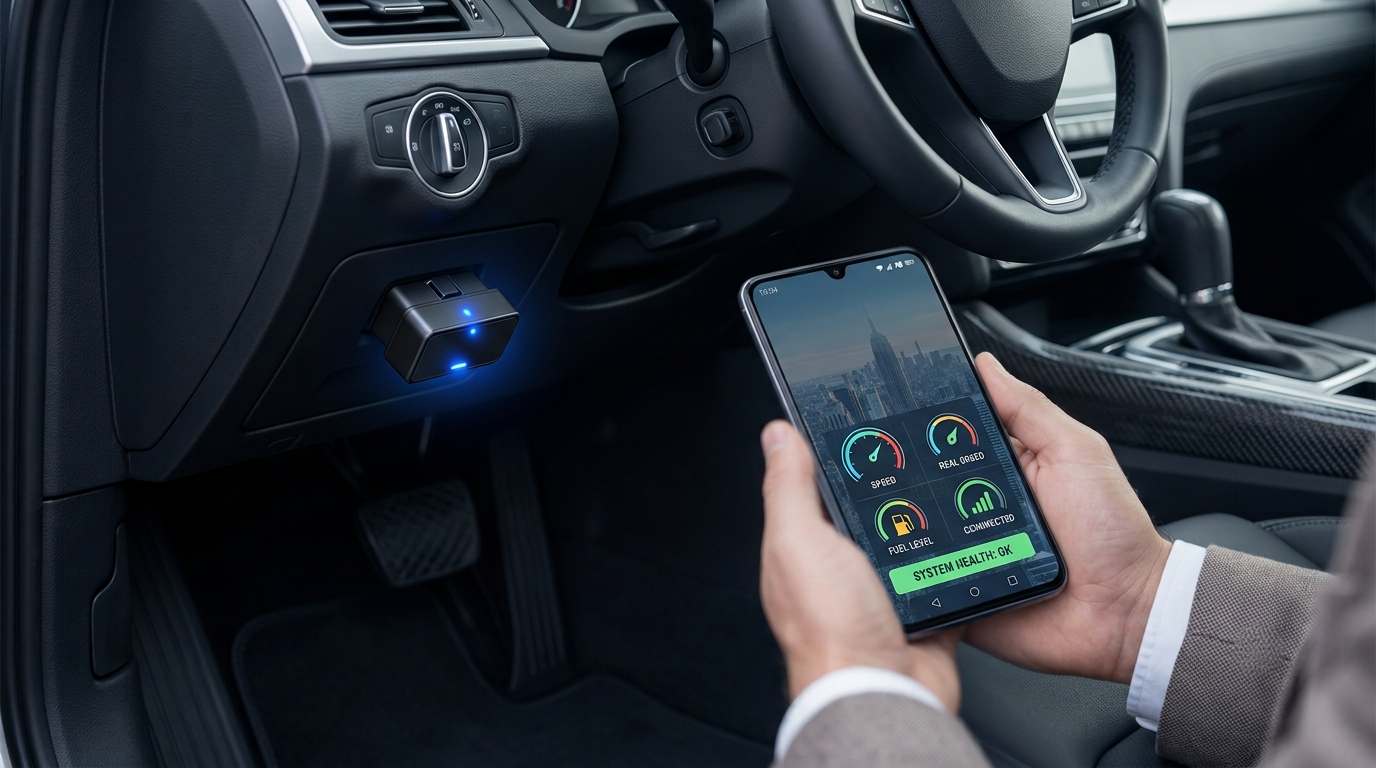
A case study on developing a BLE-enabled OBD device that connects to vehicle diagnostic systems and enables wireless access to vehicle data.