
A vehicle's diagnostic protocols already surface a huge amount of data about what's happening inside every ECU, but most of that data is used reactively, read out during a service visit after a fault has already occurred. Predictive maintenance for vehicles: engineering automotive edr systems is about the other half of the problem: capturing and logging that same diagnostic data continuously and systematically enough that patterns predicting an eventual failure can be identified before it happens, not just diagnosed after the fact. This article covers what an Event Data Recorder actually captures, how logging architecture choices shape what's usable for prediction, and where the privacy and regulatory considerations around vehicle data recording come in.
An Event Data Recorder captures a defined set of vehicle parameters — speed, braking, steering input, seatbelt status, airbag deployment timing — around a triggering event, most commonly a crash or a near-crash, preserving a short window of data immediately before and during that event for later analysis. EDR systems exist primarily for crash reconstruction and safety analysis, giving investigators and manufacturers objective data about what the vehicle was actually doing in the moments before an incident rather than relying purely on witness accounts. Predictive maintenance for vehicles, engineering automotive EDR systems specifically for that use case, extends the same underlying data-capture discipline beyond crash events to the broader mechanical and electrical health signals that predict a component failure well before it happens.
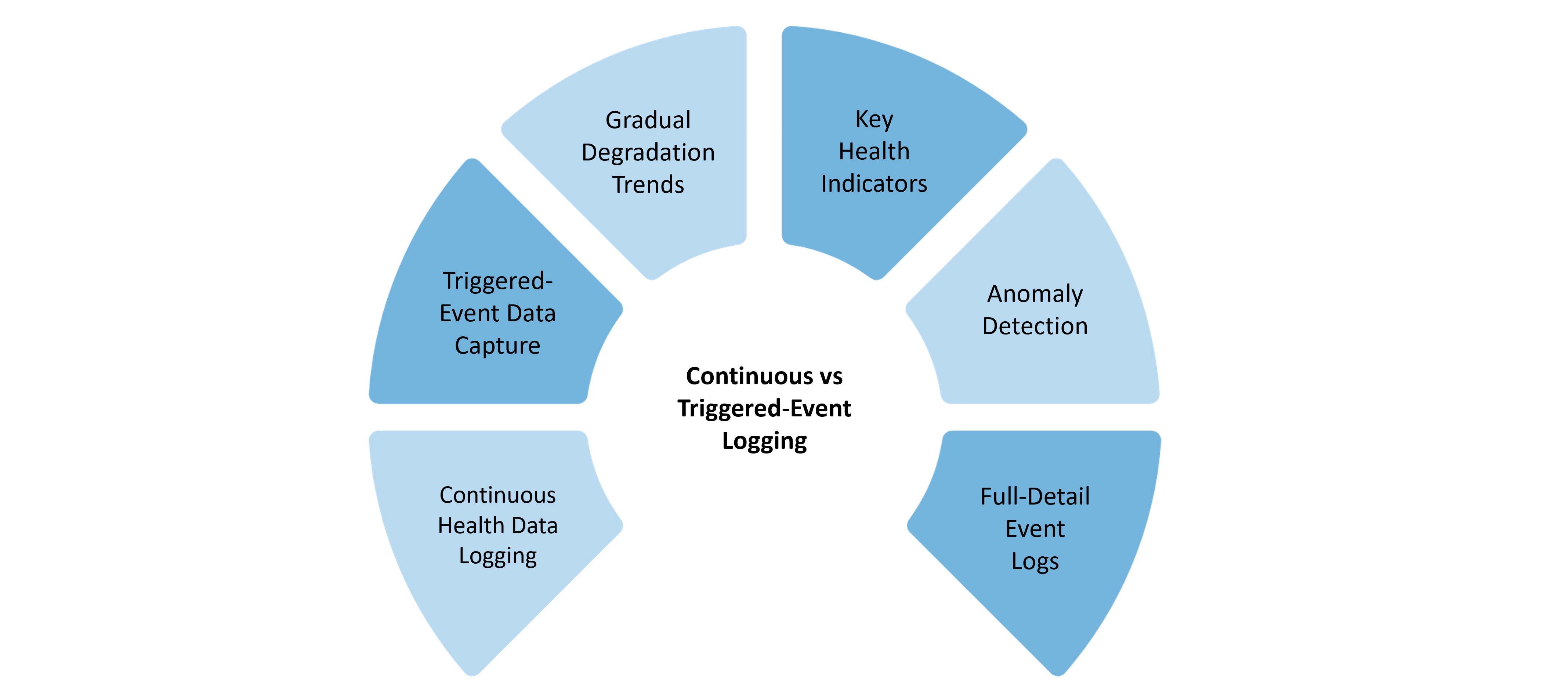
Event data recorder (edr) architecture: continuous vs triggered-event logging is the core design decision shaping what an automotive data logging system can actually be used for. Triggered-event logging captures data only around a defined trigger condition — a crash, a specific fault code, an out-of-range sensor reading — keeping storage and processing requirements modest but missing the gradual, slow-building trends that precede many mechanical failures. Continuous logging instead records vehicle and component health data on an ongoing basis, capturing exactly the slow degradation trends — a bearing's vibration signature drifting over months, a battery's internal resistance climbing gradually — that predictive maintenance depends on, at the cost of significantly higher data volume and storage demand. Most practical automotive data logging architectures for predictive maintenance combine the two: continuous logging of a smaller set of key health indicators, layered with triggered-event logging that captures full detail around anomalies flagged by that continuous stream.
Turning logged diagnostic data into predictive maintenance signals is where raw logged data actually becomes useful, and it's a meaningfully harder problem than the logging itself. Raw sensor and diagnostic trouble code data has to be processed into trend indicators, compared against known failure signatures or degradation curves, and scored for confidence before it becomes an actionable maintenance recommendation, rather than just an alert that fires on every anomaly regardless of whether it actually predicts a coming failure. Turning logged diagnostic data into predictive maintenance signals reliably requires enough historical failure data to validate that a given signal genuinely correlates with an eventual fault, which is why predictive maintenance systems tend to improve meaningfully as a fleet's logged data history accumulates over time rather than working well from day one.
Continuous data logging at the resolution predictive maintenance ideally wants generates far more data than a vehicle's onboard storage or its available uplink bandwidth can practically retain and transmit indefinitely, forcing real engineering tradeoffs. Onboard systems typically retain full-resolution data locally only for a rolling window, transmitting summarized trend data continuously while preserving full-detail logs only around flagged anomalies, similar in spirit to the continuous-versus-triggered logging tradeoff already discussed. Getting the balance right between data richness and storage or bandwidth cost is as much a part of predictive maintenance for vehicles: engineering automotive edr systems as the analysis algorithms that eventually consume the logged data.
Privacy and regulatory considerations for vehicle data recording shape what an EDR or predictive maintenance logging system can capture and how long it can retain it, independent of what's technically useful. Vehicle data recording regulations in many markets require disclosure to owners that an EDR is present and what it captures, restrict how crash-event data can be accessed and by whom, and increasingly extend similar transparency expectations to the broader continuous health-monitoring data a predictive maintenance system logs. A predictive maintenance architecture that treats privacy and regulatory considerations for vehicle data recording as a design constraint from the outset, rather than a compliance review bolted on afterward, avoids having to re-architect its data model once those requirements are actually enforced.
Much of the raw diagnostic data an automotive data logging system draws on is already exposed through the uds protocol, covered in our piece on automotive UDS protocol for vehicle diagnostics, and increasingly accessed remotely over the DoIP protocol described in our ISO 13400 DoIP guide. Predictive maintenance and EDR logging architecture is a natural extension of that same diagnostic protocol foundation, applying it to continuous health monitoring rather than only interactive, on-demand fault readout.
The same data logging discipline this article covers scales into a much higher-stakes requirement once autonomous driving functions are involved, where regulators and investigators expect a detailed, tamper-resistant record of exactly what an automated driving system perceived and decided. Our piece on in-vehicle data recorders and the rise of the black box for autonomous vehicles covers that higher-stakes extension of the same underlying EDR and data logging architecture.
Embien Technologies engineers predictive maintenance for vehicles: engineering automotive edr systems — continuous and triggered-event logging architecture, diagnostic data pipelines built on UDS and DoIP, and privacy-aware vehicle data recording design. To discuss predictive maintenance or EDR system engineering for a vehicle program, reach out to Embien's engineering team.

Embien's Digital Transformation Services support connected automotive systems through embedded software, vehicle data integration, diagnostic solutions, and intelligent data-driven applications.

Embien's Predictive Maintenance with Digital Twin Services use data-driven monitoring and digital twin technologies to identify performance trends, anticipate potential failures, and improve maintenance planning.
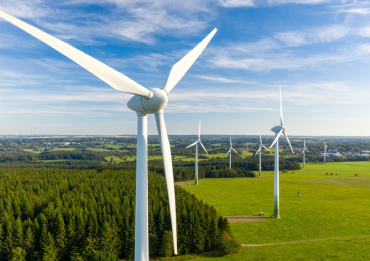
A case study on applying predictive maintenance to wind turbine systems to monitor equipment health, identify potential failures, and support proactive maintenance planning.