
The electric power-assisted steering content already on the site covers a system that adds electric motor assist to a steering effort that's still transmitted mechanically, through a physical column, from the steering wheel to the rack. Steer-by-wire: functional safety and redundancy design for mechanical-free steering covers a different architecture entirely, one where that mechanical column is removed altogether and every degree of steering angle at the road wheels is commanded electronically, which turns steering into the same category of redundancy-without-a-mechanical-fallback problem that brake-by-wire presents on the braking side.
How does steer-by-wire differ architecturally from epas power-assist steering? comes down to what happens if the electronics fail. In an EPAS system, if the assist motor or its control unit fails, the driver can still steer the vehicle by turning the wheel and pushing the rack mechanically, just with more required effort; in a steer-by-wire system, there is no mechanical path left to fall back to, so an equivalent failure has to be caught and compensated entirely within the electronic system. That single difference, the presence or absence of a mechanical fallback, is what separates how steer-by-wire differs architecturally from EPAS power-assist steering from a simple matter of degree, it's a difference in what has to be true about the redundancy architecture for the system to be considered safe at all.
A redundant actuator and sensor architecture for asil d steer-by-wire system typically duplicates the steering wheel angle sensor, the road-wheel actuator control unit, and the communication path between them, so that a single sensor, controller, or wiring fault doesn't leave the vehicle without a way to steer. Some production and near-production steer-by-wire designs go further and use two independent electric motors driving the same steering rack, each capable of providing full steering authority on its own if the other fails. Redundant actuator and sensor architecture for ASIL D steer-by-wire has to be designed so that the failure of any single redundant element is detected quickly enough, and the transition to the surviving path is smooth enough, that the driver never experiences a gap in steering control.
Force-feedback simulation without a mechanical steering column connection replaces the road feel a driver would otherwise get naturally through a mechanical steering column, where forces from the tires and road surface transmit back up through the rack and column to the driver's hands. With no mechanical connection to transmit those forces, a steer-by-wire system needs a dedicated feedback actuator on the steering wheel itself, driven by a control algorithm that estimates appropriate resistance from vehicle speed, lateral acceleration, and road-wheel actuator load, and reproduces it as torque at the wheel. Force-feedback simulation without a mechanical steering column connection is one of the harder calibration problems in steer-by-wire development, since drivers are highly sensitive to steering feel and quick to notice feedback that feels artificial, laggy, or inconsistent with what the vehicle is actually doing.
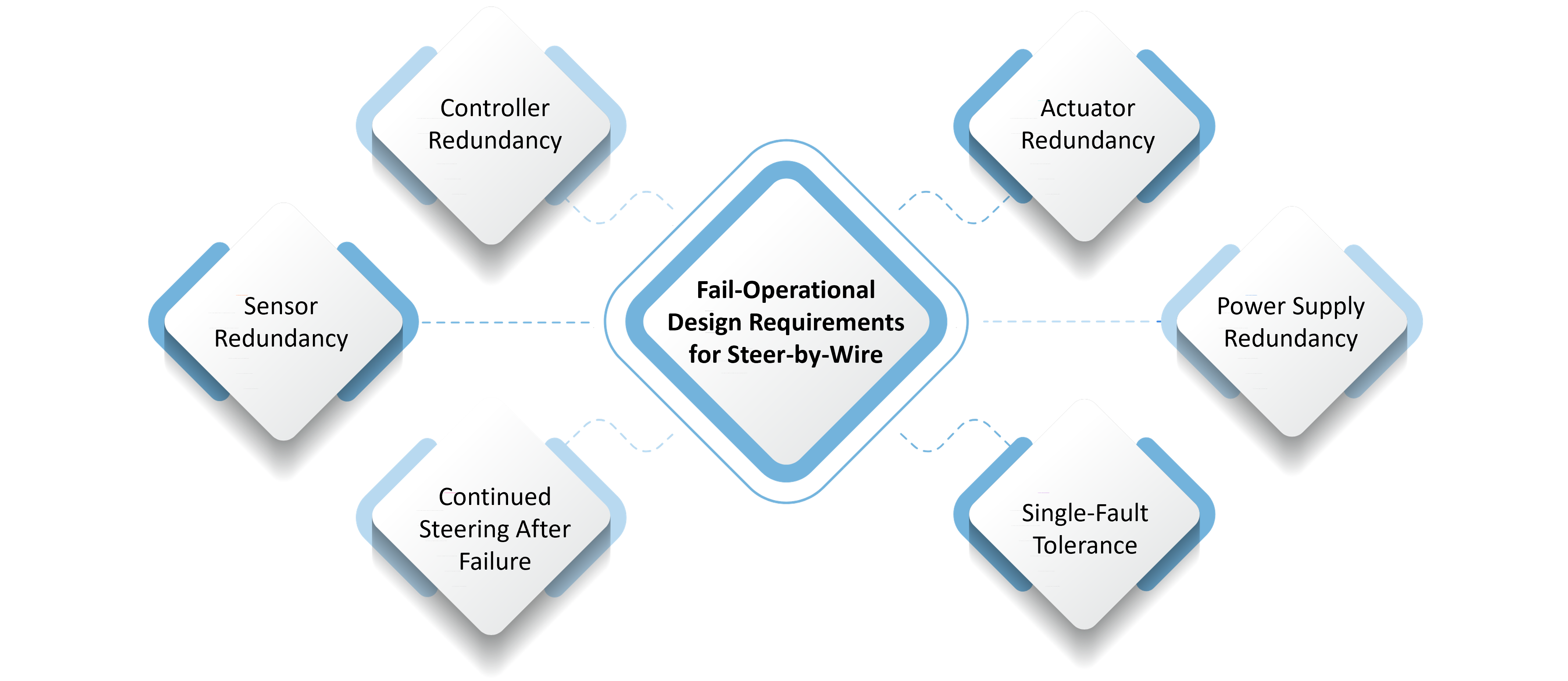
The fail-operational design requirements for steer-by-wire systems go beyond the fail-safe requirements common elsewhere in automotive electronics, because steering, unlike many other vehicle functions, can't simply shut down or hand control back to a mechanical fallback if a fault occurs, the vehicle has to keep steering. That means a steer-by-wire system has to remain fully operational, not just safely degraded, through at least one point of failure in its sensors, controllers, actuators, or power supply, which is why redundancy in steer-by-wire design is built around continued operation rather than a controlled stop. Fail-operational design requirements for steer-by-wire systems drive much of the cost and complexity of these architectures relative to EPAS, and they're a large part of why steer-by-wire adoption has moved more cautiously than assisted-steering technology did.
The steer-by-wire systems that have reached production so far tend to retain a mechanical or clutch-engageable backup column as an interim design choice, engaging it automatically if the electronic system detects a fault it can't otherwise handle safely. That choice reflects both regulatory caution and the practical difficulty of proving a fully mechanical-free steer-by-wire system's redundancy architecture is trustworthy enough to certify without any physical fallback at all. As sensor and actuator redundancy matures and gets more real-world validation, the industry trend is toward removing that mechanical backup column entirely, following roughly the same maturity curve that brake-by-wire is on.
Steer-by-wire and brake-by-wire are, at the architectural level, the same functional-safety problem applied to two different actuators: both remove a mechanical fallback that used to make failure modes degrade gracefully, and both compensate with redundant sensors, redundant actuators, and fail-operational rather than fail-safe design targets. Our brake-by-wire systems article covers the braking side of this same redundancy-without-a-mechanical-backup design problem in detail, and the two domains increasingly share design patterns, certification approaches, and even, in some vehicle programs, common redundant power and compute architecture.
Embien Technologies applies the same redundant sensor and actuator architecture, fail-operational design discipline, and functional safety engineering used across ASIL D automotive programs to steer-by-wire: functional safety and redundancy design for mechanical-free steering, building on the electric power steering control expertise behind our EPAS work. To discuss steer-by-wire redundancy architecture, force-feedback simulation, or fail-operational safety engineering, reach out to Embien's engineering team.

Embien's Product Engineering Services support automotive system development through embedded hardware and software engineering, control system integration, functional safety, and product validation.

Embien's Connected Vehicle Development services support vehicle connectivity through embedded systems, in-vehicle communication, telematics, and integration of connected automotive technologies.
A case study on developing an ASIL-D electric power steering technology demonstrator, highlighting safety-focused steering control, system integration, and functional safety engineering.