
Our blog post What Is SOTIF (ISO 21448) and Why ADAS Teams Can't Ignore It introduces the concept at a plain-language level: SOTIF is about the hazards a system creates through its own performance limitations, not through a component fault. SOTIF in practice: unknown-unsafe scenario identification and validation targets is the practitioner-depth companion that blog post deliberately doesn't attempt, the actual ISO 21448 process an ADAS or automated driving engineering team runs to find those scenarios and turn them into something a validation program can be built against.
ISO 21448 organizes a system's entire scenario space into four categories: known-safe, known-unsafe, unknown-safe, and unknown-unsafe. Known-unsafe scenarios get handled like any functional safety hazard, they're identified and mitigated. The genuinely hard part of SOTIF in practice: unknown-unsafe scenario identification and validation targets is the fourth category, scenarios the team hasn't identified yet where the system's performance limitations, a perception algorithm's blind spot in certain lighting, a sensor's degraded performance in specific weather, actually create a hazard. The SOTIF process flow is fundamentally about systematically shrinking that unknown-unsafe region, moving scenarios into the known-safe or known-unsafe categories through analysis and testing, faster than the vehicle encounters them in the field.
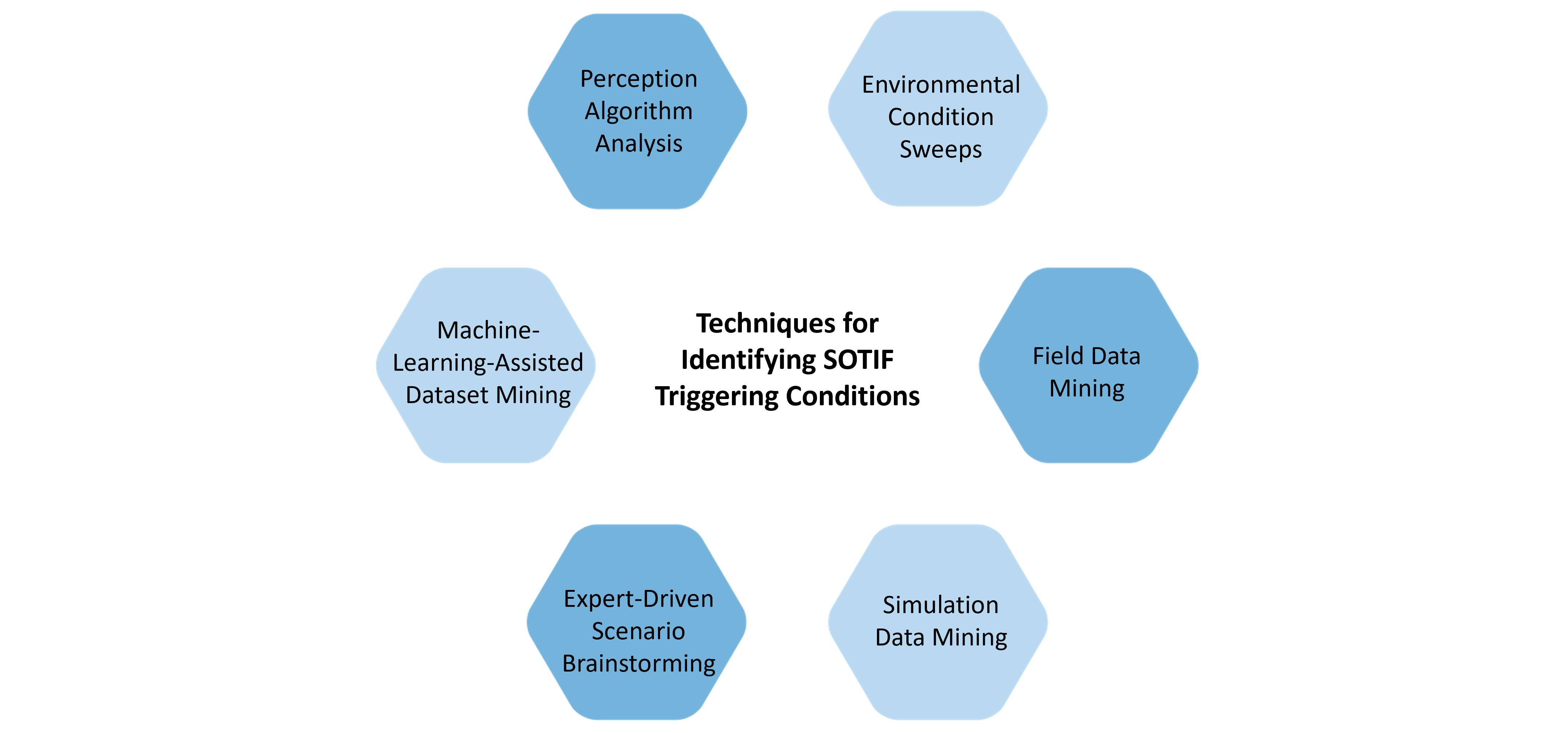
Techniques for identifying triggering conditions in SOTIF analysis combine structured hazard analysis with the kind of edge-case thinking functional safety analysis alone doesn't demand. Structured techniques include functional insufficiency analysis of perception and planning algorithms, systematic environmental condition sweeps (lighting, weather, road surface, sensor occlusion combinations), and field data and simulation mining for scenarios the system handled poorly without triggering an obvious fault. Techniques for identifying triggering conditions in SOTIF analysis also draw heavily on expert-driven scenario brainstorming and, increasingly, on machine-learning-assisted mining of large driving datasets to surface rare combinations of conditions a manual review would likely miss.
Identifying a triggering condition is only half the process; deriving validation targets from unknown-unsafe scenarios is what turns an identified scenario into something a test and validation program can actually be measured against. That means translating a scenario, say, a pedestrian partially occluded by a parked vehicle in low light, into a quantified performance target, a required detection rate or false-negative bound under that specific condition, and a defined acceptance criterion for how much residual risk is tolerable. Deriving validation targets from unknown-unsafe scenarios is where SOTIF work gets genuinely difficult, because unlike a binary pass/fail functional safety test, the targets often have to be expressed statistically, an acceptable residual risk rate rather than a clean pass or fail.
Scenario-based testing and simulation for SOTIF validation is how a program actually verifies that a validation target has been met, since exhaustively testing every unknown-unsafe scenario on public roads is neither safe nor practical. Simulation lets a team run thousands of variations of an identified scenario, adjusting lighting, distance, occlusion percentage, and sensor noise, far faster and more safely than closed-course or public-road testing alone, while closed-course testing validates that the simulation model itself reflects real sensor and algorithm behavior. Scenario-based testing and simulation for SOTIF validation only produces a credible result when the simulation environment has itself been validated against real-world sensor data; an unvalidated simulator just produces confident-looking numbers about the wrong thing.
How does SOTIF validation feed back into ADAS system design? A validation target the system fails isn't just a test result to record, it's a design input. A perception algorithm that can't meet its detection-rate target under a specific lighting and occlusion combination sends the finding back to the algorithm or sensor-fusion team, a design change, additional sensor coverage, a modified operational design domain restriction, or a new fallback behavior, rather than treated as an acceptable residual gap. How SOTIF validation feeds back into ADAS system design is what keeps SOTIF from becoming a documentation exercise performed after the design is already frozen; the loop only works if findings can still change the design.
SOTIF doesn't replace ISO 26262, and the two standards' work products need to describe the same system consistently even though they analyze different kinds of risk. Our ISO 26262 functional safety explainer covers the fault-driven hazard analysis SOTIF's scenario-based analysis has to sit alongside; an item definition, an architecture description, or a safety goal that diverges between the two analyses is a sign the safety case as a whole has an internal inconsistency an assessor will find, regardless of how sound either individual analysis is on its own.
SOTIF's unknown-unsafe scenario space becomes especially consequential at Level 3 automation, where the handoff between an automated driving system and the human driver is itself a scenario space full of performance-limitation edge cases: a system that fails to recognize it's approaching its operational design domain boundary, or a driver who doesn't respond to a handoff request in time. Our sibling article on highway pilot and Level 3 automation engineering covers this handoff problem directly, and SOTIF in practice: unknown-unsafe scenario identification and validation targets is the analysis discipline that has to run underneath that handoff design.
Embien Technologies supports ADAS and automated driving programs through SOTIF in practice: unknown-unsafe scenario identification and validation targets, including triggering-condition analysis, validation target derivation, and scenario-based test and simulation program design consistent with the ISO 26262 functional safety work already underway. To discuss a SOTIF validation program for an upcoming ADAS project, reach out to Embien's functional safety engineering team.

Embien's Edge Computing Services support real-time data processing, embedded analytics, and intelligent edge applications for automotive and industrial systems.

TestBot enables automated testing of embedded firmware, hardware interfaces, and communication protocols through configurable, no-code test workflows for systematic validation.

A case study on developing a wireless CAN bus bridge using the eStorm-B1 EVK to enable wireless communication between CAN-based systems for testing and data exchange.