
Most public discussion of automotive AI stays at the conceptual level: what a vehicle could perceive, understand, or respond to. Training and validating perception models for automotive adas is the engineering reality underneath that discussion, the data pipelines, labeling processes, and validation strategies that turn a perception concept into a model a safety-relevant ADAS feature can actually rely on. Our own EI Cars AI core content explores that conceptual layer; this article covers the real engineering depth beneath it, centered on the ai vision systems that do the actual perceiving.
Data pipeline architecture for collecting and labeling adas training data is the unglamorous foundation everything else in perception model development depends on, and it is typically where the majority of program time and budget actually goes, far more than the model architecture work that gets most of the public attention. Raw sensor data from camera, radar, and lidar streams across a fleet has to be ingested, time-synchronized across sensors, filtered for scenes worth labeling, and routed through a labeling pipeline that produces consistent, high-quality ground truth annotations at a volume measured in millions of frames. Data pipeline architecture for collecting and labeling ADAS training data also has to track data provenance and labeling quality metrics over time, since a perception model trained on inconsistently labeled data will reproduce that inconsistency as unpredictable real-world behavior no amount of downstream model tuning can fully correct.
Why do edge cases dominate real perception model training effort? is a question every ADAS perception team eventually has to answer, because the common driving scenarios that make up the bulk of naturally collected fleet data are, almost by definition, the scenarios a model learns to handle well early and without much special effort. It is the rare, unusual, and safety-critical scenarios, an unusual lighting condition, a partially occluded pedestrian, debris in the road, an emergency vehicle in an atypical position, that determine whether a perception model is actually safe to deploy, and those scenarios are exactly the ones that are hardest to find enough real-world examples of. A disproportionate share of engineering effort in any serious perception model program goes into identifying, sourcing, and specifically targeting edge cases for the training and validation sets, because a model's average-case accuracy number says very little about how it behaves in the cases that matter most for safety.
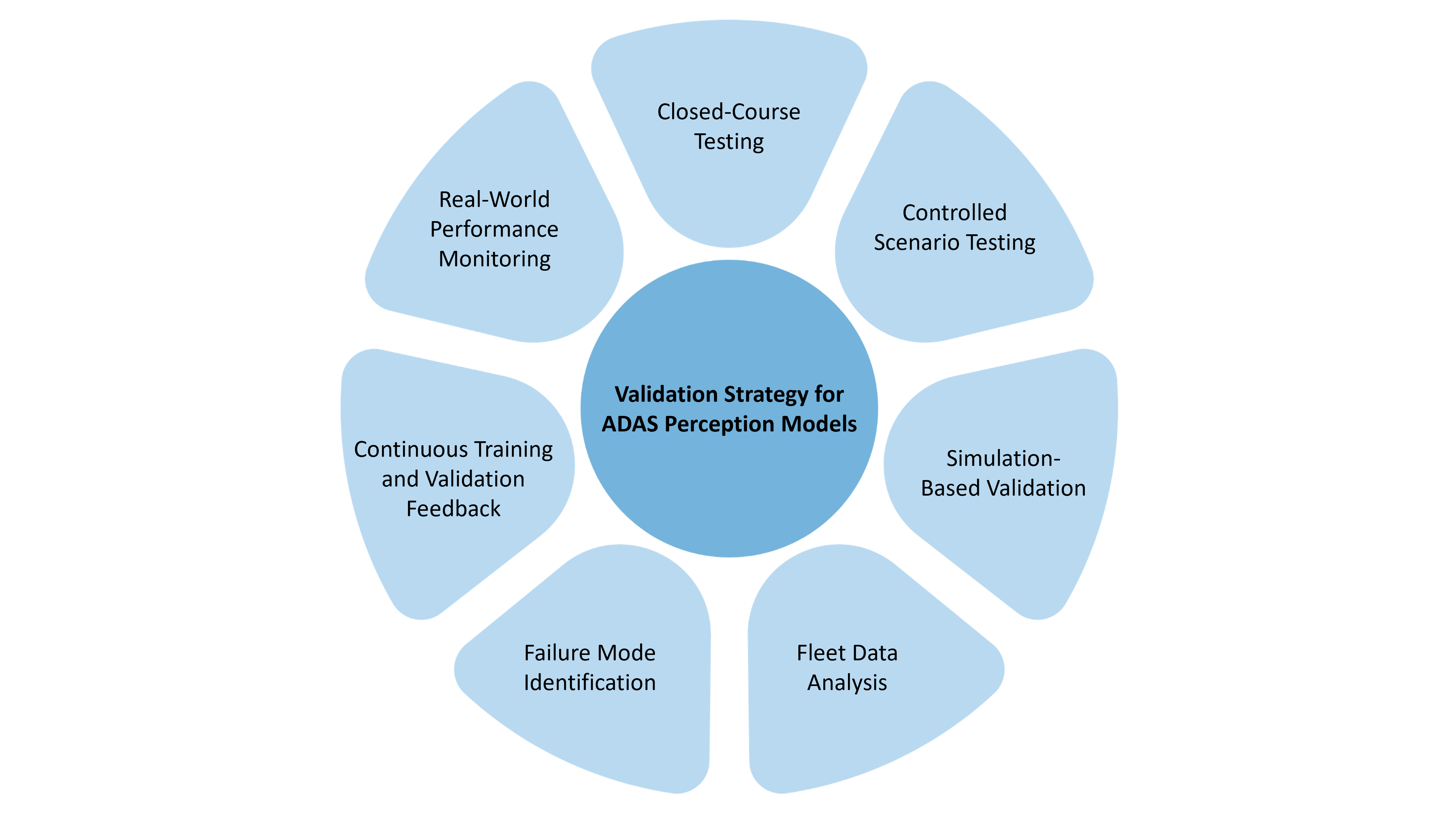
A credible validation strategy for an ADAS perception model draws on three complementary sources rather than relying on any single one. Closed-course testing allows controlled, repeatable exposure to specific scenarios, including genuinely hazardous ones that can never be safely tested on public roads, but it is expensive and slow to scale across the full range of scenarios a model needs to be validated against. Simulation, covered in more depth in our companion article on simulation and synthetic data for perception training, fills much of that scale gap. Fleet data from real-world deployment closes the loop, surfacing scenarios and failure modes that neither closed-course testing nor simulation anticipated, and feeding them back into the next training and validation cycle.
Handling distribution shift between training data and real-world adas deployment is a persistent challenge because the data a model was trained on, however large and carefully curated, is always a snapshot of a particular set of geographies, seasons, sensor hardware revisions, and traffic conditions, while real-world deployment continuously presents the model with conditions outside that snapshot. A model that performs well on its validation set can still degrade meaningfully when deployed into a new market's traffic patterns, a winter it wasn't trained on, or a sensor hardware revision with different noise characteristics. Handling distribution shift between training data and real-world ADAS deployment requires continuous monitoring of live model performance signals, not just a one-time validation pass before release, so that drift gets caught and fed back into retraining before it becomes a safety concern.
A perception model in production is never really finished; it gets retrained as new data, new edge cases, and new sensor hardware revisions come in, and every one of those retraining cycles carries the risk of a regression, an improvement in overall accuracy that quietly makes performance worse on some specific scenario the previous version handled correctly. Rigorous model versioning, keeping a fixed, expanding regression test set that every candidate model version has to pass before it can replace the version in production, is what prevents that kind of silent regression from reaching the field. Treating perception model releases with the same discipline as safety-critical software releases, rather than as ad hoc model swaps, is what separates a mature ADAS AI program from one that is still finding its process.
Perception model quality is bounded by the quality of the image data reaching it, which means the camera ISP pipeline feeding an ADAS vision system is not a separate concern from perception model training, it is an upstream input that directly shapes what the model can learn and how it performs. Noise, dynamic range handling, and demosaicing choices made in the ISP change what information actually reaches the model, and AI vision systems trained on one ISP tuning can see accuracy shifts when deployed against a different ISP configuration on new hardware. Coordinating ISP tuning and perception model training as one connected pipeline, rather than two teams working in isolation, measurably improves real-world perception performance.
Embien Technologies supports automotive AI/ML programs across the full perception stack: data pipeline architecture, labeling workflow design, validation strategy spanning closed-course, simulation, and fleet data, and the camera ISP and embedded compute integration that ai vision systems depend on. Our work on training and validating perception models for automotive adas is grounded in real embedded systems engineering, not just algorithm research, which is what it takes to get a perception model from a promising accuracy number to a deployable, safety-relevant ADAS feature. To discuss ADAS perception model engineering for a new or existing program, reach out to Embien's engineering team.

Embien's edge computing services support the deployment of AI/ML models closer to the data source, enabling real-time data processing, low-latency inference, and efficient integration with embedded hardware for automotive ADAS perception systems.

Embien's automotive electronics engineering capabilities support the development and integration of embedded systems for intelligent vehicles, including automotive computing platforms, sensor interfaces, camera-based vision systems, and ADAS-related electronics.

A case study on developing a tyre pressure monitoring application, demonstrating embedded automotive system integration, real-time tyre pressure data monitoring, and application-level visualization for vehicle safety and monitoring.