
Remote keyless entry and passive entry passive start systems solved convenience decades ago, but both leave a security gap that has become a real-world attack vector: a relay attack that extends a key's signal range far beyond what its designers intended. Uwb digital key: engineering the ccc digital key specification is the technology actually closing that gap in current vehicle programs, replacing or supplementing the traditional key fob with a smartphone- or wearable-based digital key secured by Ultra-Wideband's precise, hard-to-spoof ranging. This article covers why the relay-attack problem exists, how UWB solves it at the protocol level, and what a migration from RKE and PEPS to UWB digital key actually involves.
Why do bluetooth-only digital key solutions have relay-attack vulnerabilities? because Bluetooth Low Energy, on its own, measures signal strength rather than true distance, and signal strength can be relayed between two devices by an attacker's equipment without either legitimate party noticing. A relay attack works by capturing the key's signal near its actual location and retransmitting it next to the vehicle, tricking the vehicle into believing the key is close enough to authorize unlock or start, even though the key and its owner might be nowhere near the car. Bluetooth-only digital key implementations that rely purely on received signal strength as a distance proxy inherit this same vulnerability that has plagued traditional RF key fobs, because the underlying problem - no reliable way to verify true physical distance - is unchanged by simply moving the key onto a smartphone.
How uwb precise ranging closes the relay-attack gap in digital key systems comes down to what UWB actually measures: time of flight. Ultra-Wideband radio measures the precise time a radio pulse takes to travel between the key device and the vehicle, calculating true physical distance directly from the speed of light rather than inferring rough proximity from signal strength. Because a relay attack has to introduce real, physical delay to retransmit a signal across distance, UWB's time-of-flight measurement detects that added delay and rejects a session that shows an implausible or inconsistent distance reading, closing the relay-attack gap that signal-strength-based systems cannot close on their own. This is the core reason UWB, not just a faster or newer Bluetooth variant, is the technology actually being adopted for anti-relay digital key.
Car connectivity consortium (ccc) digital key specification architecture is the industry standard defining how a UWB-based digital key actually works across vehicles and phones from different manufacturers, rather than every OEM building an incompatible proprietary system. The CCC Digital Key specification defines the provisioning process that securely installs a digital key onto a smartphone or wearable, the secure element and trusted execution environment requirements that protect the key's cryptographic material on the device, and the UWB ranging and BLE-based communication protocols the vehicle and device use together during an actual unlock or start session. Car Connectivity Consortium Digital Key specification architecture matters commercially as much as technically: it's what lets a digital key provisioned through one OEM's app work reliably across the specific phone and vehicle hardware combinations that support the standard.
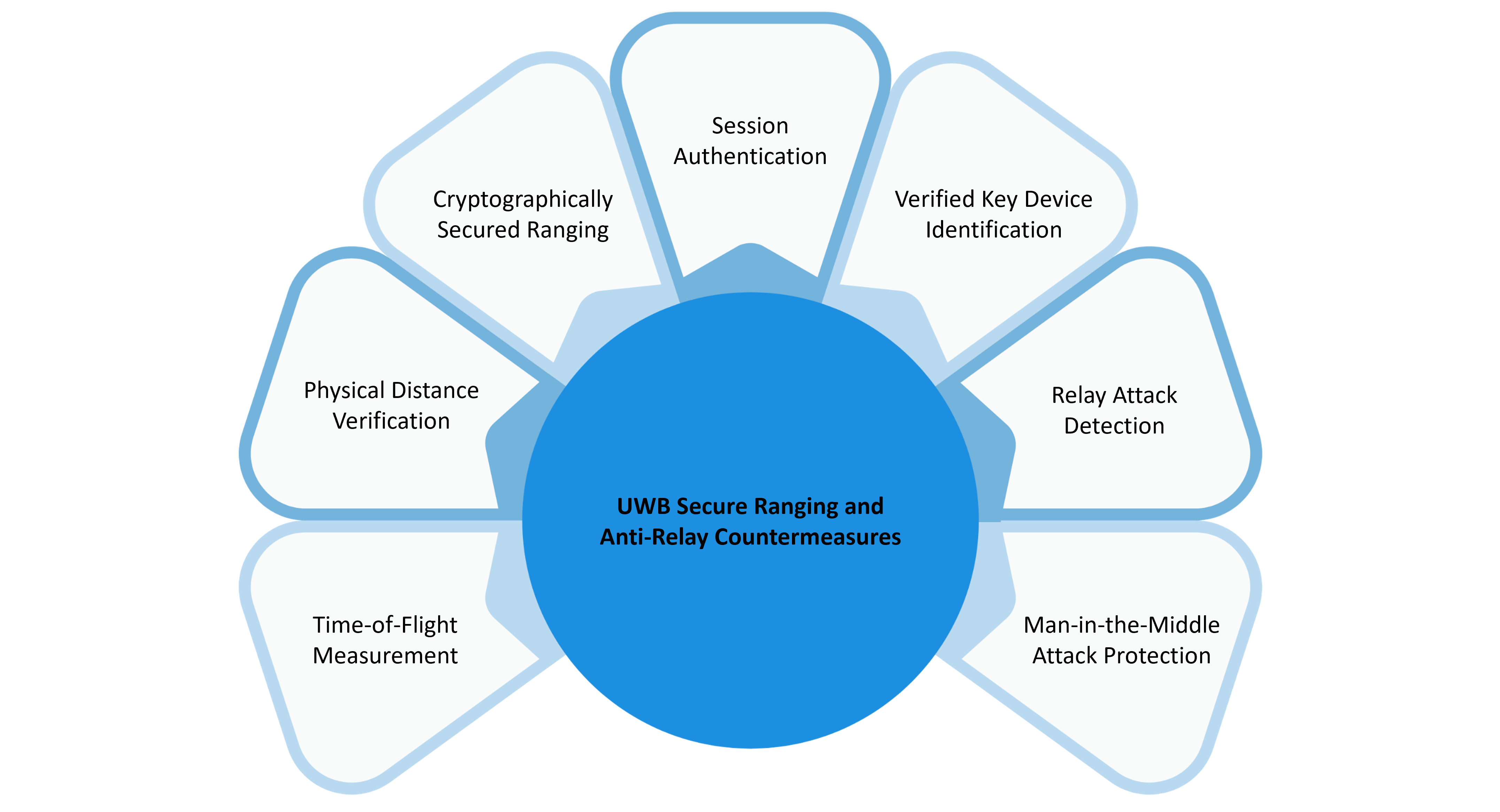
Beyond raw time-of-flight measurement, the CCC Digital Key specification layers additional protocol-level countermeasures on top of UWB ranging to further harden the system against sophisticated relay and man-in-the-middle attacks. These include cryptographically-secured ranging exchanges that prevent an attacker from manipulating the timing measurement itself, not just relaying the underlying signal, and session authentication that ties a ranging measurement to a specific, verified key device rather than trusting an anonymous radio response. Secure ranging at the protocol level is what elevates UWB digital key from "harder to relay than Bluetooth" to a system engineered specifically against the relay-attack threat model from the ground up.
A UWB digital key only delivers on its convenience promise if it integrates cleanly with the smartphone and wearable hardware people already carry, which means working within the UWB chipset, secure element, and background-process constraints each device platform imposes. Battery consumption from maintaining a ranging-ready background state, the device's own security model for provisioning and storing the digital key credential, and platform-specific UWB antenna placement all shape how reliably a digital key session establishes in practice, and a vehicle program integrating CCC Digital Key has to validate across the real device population its owners actually carry, not just a reference test device.
Migration path from rke/peps to uwb-based digital key systems is rarely an overnight replacement; most vehicle programs run UWB digital key alongside the RKE and PEPS systems described in our pieces on remote keyless entry systems and passive entry passive start mechanics, so an owner without a compatible phone or a dead battery on their device still has a working key. Over time, UWB digital key is positioned to become the primary access method with RKE or a physical key card retained as a fallback, and the migration path from RKE/PEPS to UWB-based digital key systems is as much about integrating the new system cleanly alongside the old one as it is about the UWB technology itself.
Embien Technologies engineers uwb digital key: engineering the ccc digital key specification integrations - secure ranging, CCC-compliant provisioning, and migration architecture alongside existing RKE and PEPS systems. To discuss UWB digital key or CCC Digital Key specification engineering for a vehicle program, reach out to Embien's engineering team.

Embien delivers embedded engineering solutions across automotive and other industry domains, supporting connected vehicle technologies, digital key systems, secure wireless communication, and automotive electronics integration.

Embien's embedded system security services help develop secure connected devices through cryptographic implementation, secure authentication, secure boot, hardware security integration, and protection against unauthorized access and communication attacks in automotive applications.

A case study on developing a secure key fob for an automotive Remote Keyless Entry (RKE) system, highlighting wireless communication, secure authentication, embedded firmware development, and vehicle access control.