
"Connected Cars" is one of the site's most-used content tags, but connectivity as a marketing term and V2X as an actual communication architecture are two different things. V2x and c-v2x communication architecture for vehicle-to-everything connectivity is the real engineering underneath the term: how a vehicle exchanges safety-relevant, low-latency messages with other vehicles, roadside infrastructure, and pedestrians, over which radio technology, using which message standards, and secured how. This article covers the architecture end to end - the competing radio technologies, the use cases they enable, the message standards that define them, and the security layer that makes any of it trustworthy on the road.
Dsrc vs c-v2x: comparing v2x radio technologies has been the central architecture debate in V2X for most of the technology's history. Dedicated Short-Range Communications, based on the IEEE 802.11p Wi-Fi variant, was the original V2X radio standard, purpose-built for direct vehicle-to-vehicle and vehicle-to-infrastructure links with no need for cellular network coverage. Cellular V2X, built on 3GPP standards, instead reuses cellular radio technology for the same direct-link communication while also offering a path to network-assisted V2X over an existing cellular infrastructure. C-V2X has gained the stronger regulatory and OEM momentum in most major markets over the last several years, largely on the strength of its upgrade path to 5G-based V2X, but DSRC remains deployed in some existing roadside infrastructure, and an architecture built for real deployment has to account for both.
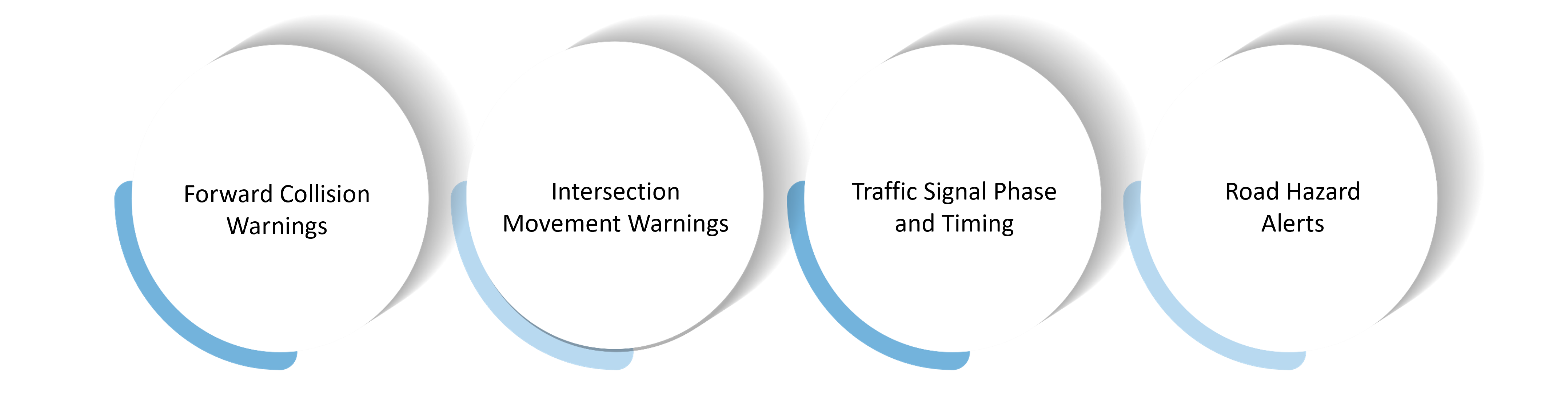
V2v v2i and v2p communication use cases cover the three basic message directions V2X architecture supports.Vehicle-to-vehicle communication lets nearby vehicles share position, speed, and heading directly, enabling cooperative safety functions like forward collision and intersection movement warnings that see around obstructions no onboard sensor can see through. Vehicle-to-infrastructure communication connects a vehicle to roadside units - traffic signals broadcasting signal phase and timing, work-zone warnings, road hazard alerts - extending a vehicle's awareness beyond what it can directly sense. Vehicle-to-pedestrian communication, often mediated through a pedestrian's smartphone, extends the same safety-relevant messaging to vulnerable road users who have no vehicle-grade radio of their own. A V2X architecture supporting V2V, V2I, and V2P use cases at once, rather than just one of the three, is what actually delivers on the connected-vehicle safety case.
What message sets and standards define v2x communication? is the layer above the radio technology that actually makes V2X interoperable across vehicles from different manufacturers. SAE J2735 defines the message set used predominantly in North America - Basic Safety Message, Signal Phase and Timing message, and others - specifying exactly what data a message carries and how it is structured. ETSI ITS-G5 defines the equivalent European message standard, including Cooperative Awareness Messages and Decentralized Environmental Notification Messages. These standards matter because V2X's entire safety value depends on a message broadcast by one vehicle being correctly interpreted by every other vehicle and roadside unit that receives it, regardless of who built either end of that exchange.
A V2X safety message that arrives late or not at all is worse than no message at all, because a system architected around receiving it has already built a warning or intervention decision on the assumption it will show up in time. Safety-relevant V2X messages - a forward collision warning, an intersection movement alert - carry latency budgets measured in tens of milliseconds, and the radio technology, network architecture, and message prioritization scheme all have to be engineered to that budget under real-world radio conditions, not just in a clean lab test. V2X architecture that treats latency and reliability as a post-deployment tuning problem rather than a first-order design constraint produces a system that looks like it works in a demo and degrades exactly when traffic density and radio congestion are highest - which is exactly when the safety case matters most.
Security architecture for v2x misbehavior detection and certificate management exists because a V2X system that trusts every message it receives without verification is trivially exploitable - a spoofed collision warning or a falsified position report can trigger unwanted braking or mask a genuine hazard. V2X security architecture relies on a public-key infrastructure issuing short-lived, pseudonymous certificates to authenticate every broadcast message without revealing a vehicle's persistent identity, alongside misbehavior detection systems that flag vehicles broadcasting implausible or inconsistent data - a reported position that contradicts physically possible vehicle motion, for instance - and can revoke their credentials. Our piece on ISO 21434 cybersecurity engineering covers the broader lifecycle discipline V2X's certificate management and misbehavior detection sit inside.
V2X deployment today is real but uneven: pilot corridors and select production vehicle programs run C-V2X in limited geographic areas, while nationwide roadside infrastructure buildout lags the vehicle-side radio hardware that is already shipping in some markets. The core adoption barrier is not the technology itself but the chicken-and-egg problem of infrastructure investment: V2X's safety value scales with how many vehicles and roadside units are actually broadcasting and listening, so early deployments deliver a fraction of the eventual benefit until adoption reaches critical mass. Use cases like automated valet parking, covered in our piece on automated valet parking infrastructure architecture, are among the applications where V2I connectivity is proving out its value in more contained, controlled deployments ahead of broader public-road rollout.
Embien Technologies designs v2x and c-v2x communication architecture for vehicle-to-everything connectivity - radio and message-stack integration, latency-budgeted safety messaging, and the certificate management and misbehavior detection layer that makes a connected vehicle deployment trustworthy, building on our broader work in vehicle telematics system architecture. To discuss a V2X or C-V2X connectivity architecture for a vehicle program, reach out to Embien's engineering team.

Embien's product engineering services support the development of connected automotive and embedded products, covering hardware and software integration, communication interfaces, wireless connectivity, and end-to-end product development for V2X and C-V2X applications.

Embien's embedded software development services support automotive communication systems through firmware development, protocol stack integration, device driver development, real-time communication, and secure connectivity for V2X, C-V2X, and vehicle telematics applications.

A case study on developing a telematics control unit for electric two-wheelers, highlighting embedded software development, vehicle data acquisition, communication interface integration, and connected vehicle functionality for automotive telematics applications.