
Most EV charging engineering, including the plug-and-charge communication protocol covered elsewhere on this site, assumes power flows in one direction: from the grid, through the charger, into the vehicle's battery. Vehicle-to-grid (V2G) and bidirectional charging: engineering the EV as a grid asset breaks that assumption, treating the vehicle's battery as a power source the grid can draw from as well as a load it charges, which turns a parked EV into a genuine grid resource but also introduces a substantially harder engineering problem than one-directional charging ever posed, spanning communication protocol, power electronics, and battery management all at once.
One-directional charging only needs power conversion and control logic in one direction, AC grid power to DC battery power, with the charger or onboard converter handling that single conversion path. Bidirectional charging needs the inverter and control system to reliably run that conversion in reverse as well, DC battery power back to grid-synchronized AC, safely, on demand, and without compromising the primary job of charging the vehicle when that's what's actually needed. What changes technically when charging becomes bidirectional isn't a single component change, it touches the power electronics, the communication protocol negotiating when and how much power flows in which direction, and the battery management system that now has to account for a very different charge/discharge duty cycle than one-directional charging ever created.
Iso 15118-20's role in enabling v2g communication is foundational, the earlier ISO 15118 versions our plug-and-charge article covers were built around one-directional charging and don't natively support negotiating bidirectional power flow, while ISO 15118-20 extends the protocol specifically to support V2G, vehicle-to-home, and vehicle-to-building use cases, letting the vehicle and charging equipment negotiate not just how much power to draw but which direction it should flow and under what conditions. ISO 15118-20's role in enabling V2G communication also covers the authorization and billing complexity V2G introduces, a bidirectional transaction needs to account for energy flowing both ways, which is a materially different metering and settlement problem than a standard charging session.
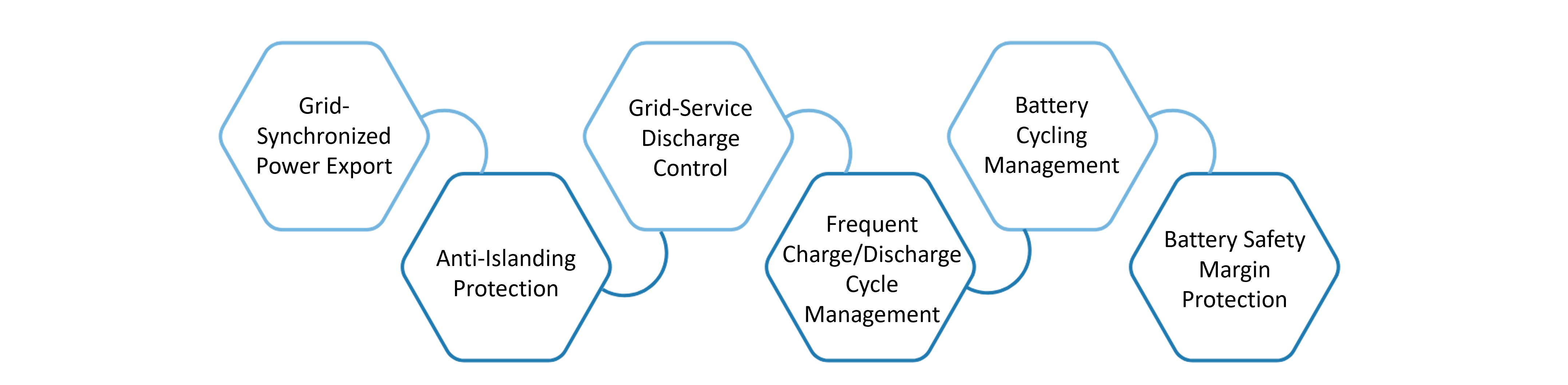
Bms and inverter requirements for bidirectional ev power flow extend well beyond what a one-directional onboard charger needs: the inverter has to support grid-synchronized power export with the same safety and power quality standards a grid-tied inverter is held to, including anti-islanding protection so the vehicle doesn't continue exporting power into a de-energized grid segment during an outage. BMS and inverter requirements for bidirectional EV power flow also mean the battery management system needs discharge control logic tuned for grid-service duty cycles, frequent, often shallow charge/discharge events driven by grid signals, that look meaningfully different from the battery's normal daily driving-charge pattern, and the BMS has to manage that additional cycling without compromising the safety margins the battery pack was designed around.
What does a utility actually need from a v2g-capable vehicle? A utility isn't primarily interested in any single vehicle's battery capacity, it needs predictable, dispatchable capacity it can call on, which means it needs standardized communication for requesting power, confirming availability and state of charge, and verifying the vehicle actually delivered the committed power when called. What a utility actually needs from a V2G-capable vehicle also includes aggregation-friendly behavior, since a single EV's contribution to grid services is small, a utility's V2G value proposition depends on aggregating many vehicles into a coordinated, predictable capacity pool, which places real requirements on how consistently and reliably individual vehicles respond to dispatch signals.
Battery degradation implications of using an ev for grid services are a legitimate technical and commercial concern that any V2G program has to address directly: additional charge/discharge cycling from grid services adds wear beyond what driving alone would produce, and depending on depth of discharge and cycling frequency, that additional wear can measurably affect battery life over the vehicle's ownership period. Battery degradation implications of using an EV for grid services are manageable through BMS-level constraints, capping how deep and how frequent grid-service discharge cycles are allowed to go, and through commercial models that compensate owners for the wear their battery absorbs, but a V2G program that ignores degradation entirely is setting up a difficult conversation with vehicle owners once real-world battery health data starts coming in.
V2G and bidirectional charging build directly on two engineering foundations already covered elsewhere on this site. Our ISO 15118 and plug-and-charge article covers the communication protocol foundation ISO 15118-20 extends for bidirectional use cases, and our battery pack thermal management and BMS engineering article covers the thermal and safety engineering that bidirectional cycling adds new demands on top of. Vehicle-to-grid (v2g) and bidirectional charging: engineering the ev as a grid asset is best understood as where those two disciplines meet a genuinely new use case.
V2G is one of several fast-moving areas where automotive engineering is extending established platforms into new territory faster than standards and field experience can fully mature, a pattern also visible in the compute architecture shifts our automotive chiplet and zonal SoC architecture article describes. Programs building V2G capability should expect the same kind of standards and hardware maturity curve, treating early deployments as genuinely new engineering territory rather than a straightforward extension of proven one-directional charging.
Embien Technologies engineers vehicle-to-grid (V2G) and bidirectional charging: engineering the EV as a grid asset systems, covering ISO 15118-20 communication integration, bidirectional inverter and BMS coordination, and grid-service duty cycle management that protects battery longevity. See our companion battery pack thermal management and BMS engineering article for the safety foundation this builds on.
To discuss V2G and bidirectional charging engineering for an upcoming EV program, reach out to Embien's engineering team.

Embien delivers embedded engineering solutions across automotive, industrial, and IoT domains, supporting connected energy systems, battery monitoring, power management, and intelligent embedded product development for emerging EV and V2G applications.

Embien's automotive electronics engineering capabilities support electric vehicle systems through embedded hardware and firmware development, battery management integration, power electronics control, vehicle communication interfaces, and connected EV technologies for bidirectional charging applications.
.jpg)
A case study on developing an IoT-based remote battery monitoring system, highlighting real-time battery parameter monitoring, remote data acquisition, wireless connectivity, and battery health tracking relevant to connected EV battery management and V2G applications.