
Introduction
Custom driver development, getting a piece of custom hardware to work correctly and reliably across every host operating system a product needs to support, is one of the most consistently underestimated line items in a consumer electronics program's schedule and budget. A Windows and Linux driver pair that looks like a straightforward, well-understood engineering task on a project plan routinely turns into a multi-month effort once real hardware quirks, OS-specific driver model requirements, and certification processes are actually accounted for, and the programs that plan for that reality upfront consistently fare better than the ones that treat driver work as an afterthought.
In short: driver development gets underestimated because it looks like a single task when it's actually several OS-specific engineering efforts with their own architecture, tooling, and certification requirements, real hardware and driver-model edge cases routinely turn a planned quick driver into a genuine schedule risk, and deciding whether to build this expertise in-house or bring in specialized outside help early, rather than after a driver effort has already gone off the rails, is one of the highest-leverage planning decisions a consumer electronics program can make.
Why Driver Development Gets Underestimated in Project Planning
Driver development gets planned optimistically for a predictable reason: from a product-management view, "write a driver for the device" reads like one task, when it's actually several structurally different engineering efforts bundled under one label, one driver architecture and toolchain per host operating system the product needs to support, each with its own debugging environment, its own OS-specific driver model to work within, and in some cases its own certification process before the driver can even be legally distributed. A project plan that estimates driver development as a single line item, rather than as several OS-specific efforts with genuinely different risk profiles, is planning against an inaccurate model of the actual work from the outset.
The Real Complexity of a Kernel Mode Driver Across Multiple Host OSes
Each host operating system a device needs to support brings its own architecture and constraints that don't transfer cleanly from one platform to another. A kernel mode driver on Windows has to work within Windows' specific driver model, following Microsoft's kernel-mode driver framework conventions and passing the OS's own driver verification tooling, while macOS driver development, working within Apple's own kernel extension or, increasingly, its more restricted DriverKit user-space driver framework, imposes a meaningfully different architecture and its own separate notarization and code-signing requirements. Linux driver development brings a different complexity again, working against an actively evolving kernel API with less API stability guaranteed across kernel versions than either Windows or macOS commit to, meaning a Linux driver that works cleanly against one kernel version can require real rework to keep working against a newer one. None of these efforts meaningfully transfer to another platform, a working Windows driver provides essentially no code reuse for the corresponding macOS or Linux effort, even though the underlying hardware and its low-level command protocol are identical across all three.
Common Failure Points That Turn a Quick Driver Into a Schedule Risk
Certain failure patterns recur often enough across driver development programs to be genuinely predictable rather than unlucky surprises. Hardware edge cases discovered only during driver bring-up, timing quirks, unexpected device state transitions, undocumented register behavior, that weren't visible from the hardware specification alone, routinely surface only once real driver-level integration testing begins. Host OS version fragmentation, a driver working correctly against one OS version or kernel release but failing against another the product also needs to support, is a second recurring failure point, particularly acute for Linux given its comparatively rapid kernel API evolution. And underestimating the certification and signing process specifically, treating it as a final rubber-stamp step rather than a real gate with its own lead time and potential rejection cycles, routinely turns an otherwise-finished driver into an unplanned schedule delay right before a product's planned launch.
Testing and Certification Burden Across Platforms
Driver testing has to validate correct behavior across every combination of host OS version, hardware revision, and real-world usage pattern a product will encounter in the field, a combinatorial testing burden that grows with every additional OS and hardware variant a product needs to support. How to get a Windows driver signed? is a concrete illustration of the certification overhead this work carries: Windows kernel-mode drivers generally need to pass Microsoft's Hardware Lab Kit testing and be submitted through Microsoft's driver signing and certification process before they can be distributed and loaded without triggering security warnings, a process with its own lead time, testing requirements, and potential for rejection and rework that a project schedule needs to account for explicitly rather than treating as a formality.
A Concrete Illustration: Porting a Custom Pointing Device Driver to Mac OS X
Embien's work developing a Mac OS X driver for an Indian consumer electronics OEM's custom pointing device illustrates the full scope this kind of work typically involves, well beyond the low-level driver itself. The delivered solution included a full Cocoa GUI application built in Swift for device calibration and tuning, a preference pane integrated into the Mac's native System Preferences interface, and an agent application coordinating between the low-level driver and the user-facing tuning tools, a complete, Mac-native software suite rather than a bare low-level driver alone. This scope, a driver plus the platform-appropriate user-facing tooling that makes it actually usable day to day, is routinely underestimated when a driver development effort is planned as just the kernel-level component in isolation.
A Second Illustration: Windows CE BSP Bring-Up on New Silicon
Embien's Windows CE 7 board support package development on NXP's iMX6 UltraLite platform, targeting medical device applications, illustrates a related but distinct driver-development challenge: bringing up an entire peripheral set, LVDS display, capacitive and resistive touch, USB Host and OTG, HDMI, Ethernet, RS232/RS485, SPI, I2C, and GPIO with DMA, under Windows CE's driver model on a new SoC platform where, unlike Linux, no community-maintained BSP or mainline kernel support already existed. Each peripheral required dedicated driver development and validation against real hardware individually, illustrating how BSP-level driver work on an unsupported platform can represent a substantially larger effort than driver development for an already-mainstream, well-supported host OS and silicon combination.
Services to Port Windows Driver to Linux: A Recurring, Specific Need
A recurring specific need across consumer electronics programs is exactly this: services to port Windows driver to Linux functionality for a device whose driver was originally developed for one platform and now needs equivalent capability on the other, whether because a product is expanding to new host platforms or because an OEM customer's own product line has shifted its host OS strategy. This work isn't a mechanical translation exercise, it requires understanding the original driver's functional behavior deeply enough to reimplement it correctly within Linux's substantially different kernel driver architecture, effectively a fresh implementation informed by the original's functional requirements rather than a code port in any literal sense.
When to Build In-House vs Bring In Specialized Driver Expertise
A team facing multi-platform driver requirements has a genuine build-versus-buy decision to make, and the right answer depends on how central driver development is to the company's ongoing product strategy versus how much it's a one-time or infrequent need for a specific program. Building in-house driver expertise makes sense for a company whose product roadmap will require recurring driver work across multiple future products, justifying the investment in building and retaining that specialized skill set internally. Bringing in specialized outside driver development expertise makes more sense for a one-time or infrequent driver need, where the cost of building comparable in-house capability from scratch for a single program's requirement exceeds what an experienced outside partner, already fluent in the relevant OS driver models and certification processes, can deliver faster and with lower risk.
Cross-Platform Driver Development Cost for Consumer Electronics: Planning It In From the Start
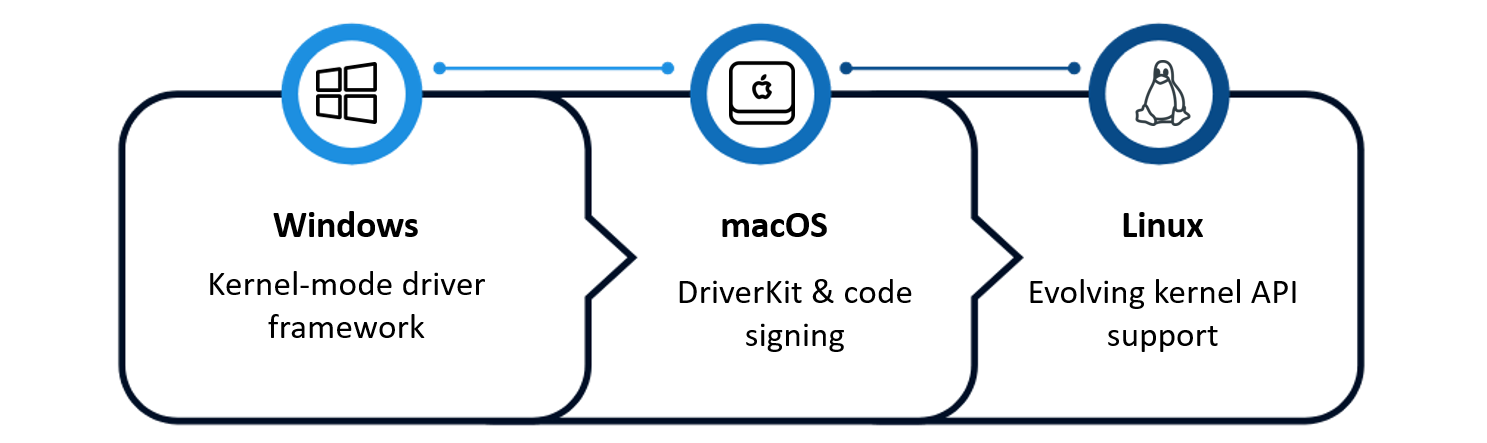
That cost is best planned as a per-OS line item with its own realistic timeline and risk buffer, rather than a single bundled estimate that obscures how differently the Windows, macOS, and Linux efforts actually behave, and factoring in certification lead time, hardware-edge-case discovery risk, and the real possibility of OS-version fragmentation issues from the start gives a program a schedule and budget that survives contact with the actual engineering work, rather than one that looks reasonable on a project plan and then breaks down once driver bring-up actually begins.
Embien's Capabilities
Embien brings cross-platform driver development experience spanning Windows kernel-mode drivers, Mac OS X and macOS driver and native application development, Linux kernel driver porting, and full board support package bring-up on new silicon, including a Cocoa-based Mac OS X driver suite for a consumer electronics OEM and a comprehensive Windows CE 7 BSP for a new ARM SoC platform. Our engineering process plans driver work per host OS with realistic certification and hardware-integration timelines rather than treating multi-platform driver support as a single undifferentiated task.
To discuss Windows and Linux driver development or cross-platform driver porting for a consumer electronics program, reach out to Embien's engineering team. Whether the immediate need is a single Windows and Linux driver pair or a full multi-OS BSP, planning the effort per platform from the outset is what keeps the schedule honest.