
Electric two-wheelers are not simply small electric cars. The volumes are higher, the price sensitivity is far more extreme, and the mechanical envelope is smaller in every dimension that matters to an ECU designer.Two-wheeler ev ecu architecture: engineering for cost durability and compact powertrains is a distinct engineering discipline from four-wheeler EV electronics, not a scaled-down version of it, and treating it that way is one of the more common and expensive mistakes a program can make. A companion piece on the market and localization side of this boom is available on our blog; this article covers the actual ECU and BMS architecture decisions behind it.
A four-wheeler EV ECU stack assumes redundant compute domains, generous thermal headroom inside a larger chassis, and a bill-of-materials that can absorb automotive-grade components priced for a premium platform. None of those assumptions hold for a two-wheeler. The controller, motor driver, and BMS typically share a single compact enclosure mounted close to the motor or under the seat, with far less shielding and airflow than a four-wheeler's engine bay or underbody pack. Wiring harness length and connector count are minimized aggressively because every gram and every centimeter of harness adds cost across a production run measured in hundreds of thousands of units rather than tens of thousands. A four-wheeler-derived architecture simply carries too much silicon, too much redundancy, and too much cost into a segment where the entire vehicle may retail for a fraction of an entry-level electric car. Getting two-wheeler ev ecu architecture: engineering for cost durability and compact powertrains right at this first architectural decision point sets the ceiling on how far the rest of the design can be optimized.
Embedded electronics for electric vehicles at this scale means every functional block is evaluated against a single question: does this need to exist in the two-wheeler, or is it a four-wheeler assumption that crept in unexamined? Embedded electronics for electric vehicles built for two-wheelers typically consolidate motor control, vehicle control, and lighting/indicator logic onto a single MCU rather than distributing them across a domain-controller topology, because the integration and communication overhead of a distributed architecture costs more, in both silicon and engineering time, than the flexibility it buys back. The result is a tighter, more purpose-built embedded electronics stack than what a four-wheeler EV program would ever consider sufficient.
Cost-optimized mcu and sensor selection for two-wheeler ev platforms starts with matching compute headroom to the actual control loop requirements of a single motor and a modest set of vehicle functions, rather than defaulting to a higher-tier MCU family carried over from four-wheeler projects out of familiarity. A field-oriented control loop for a single hub or mid-drive motor, basic vehicle state management, and lighting and indicator control fit comfortably on a lower pin-count, lower-cost MCU tier, and that single decision often has more BOM impact than any other choice in the design. Sensor selection follows the same logic: current and voltage sensing accuracy requirements are set by what the motor control loop and BMS actually need, not by the tightest tolerance part available, and every sensor added beyond that functional requirement is pure cost with no corresponding benefit at two-wheeler price points. Cost-optimized MCU and sensor selection for two-wheeler EV platforms is ultimately a discipline of subtraction as much as selection.
A simplified bms architecture for two-wheeler ev battery packs reflects the much smaller cell count and lower pack voltage typical of a two-wheeler, often a fraction of the series-cell count in a four-wheeler pack, which means cell balancing, voltage sensing, and state-of-charge estimation can run on a simpler analog front-end and a lighter software stack than a full four-wheeler BMS. This is a case where the general BMS architecture principles covered in our broader automotive BMS ECU guide still apply, but the implementation is right-sized: fewer balancing channels, a smaller cell-voltage sensing IC, and less redundancy in the monitoring path, all matched to a pack that is physically and electrically simpler. Thermal behavior at this smaller scale still matters, and the pack-level thermal design considerations covered in our battery pack thermal management article apply proportionally even when the pack itself is compact.
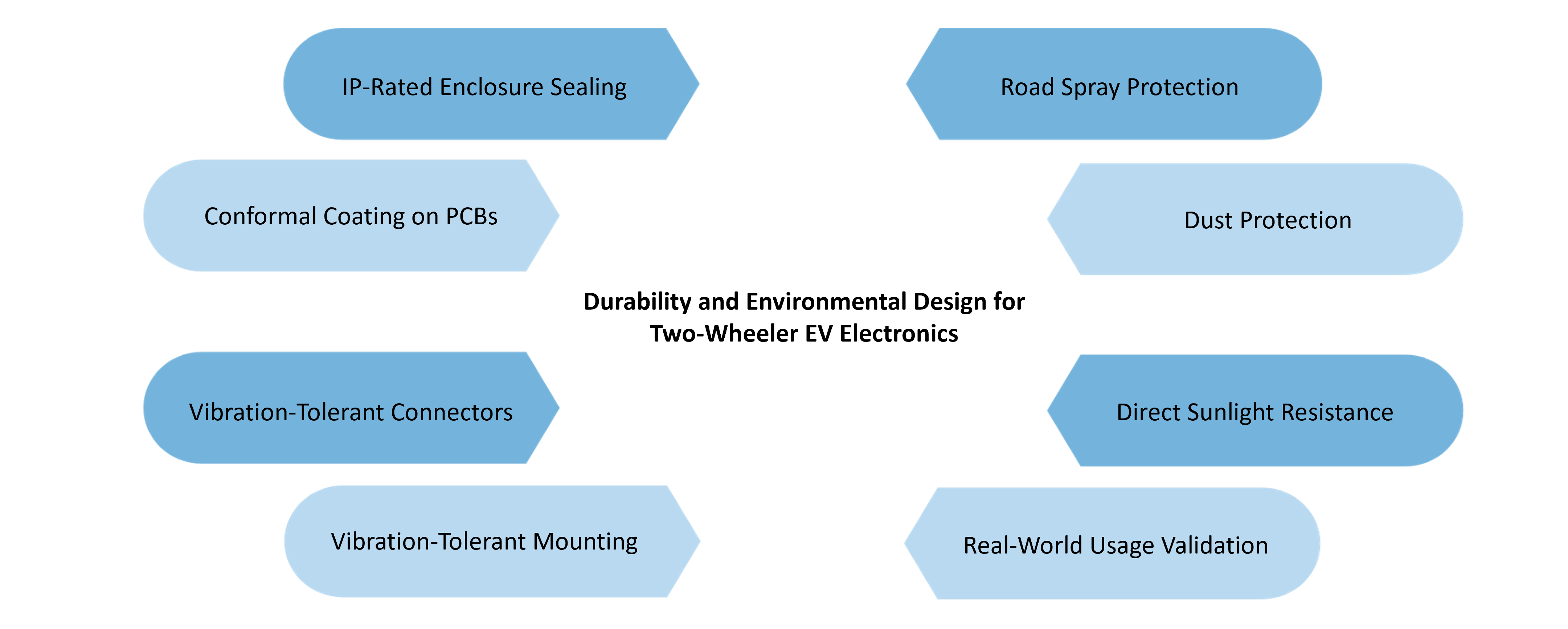
Durability and environmental design for two-wheeler duty cycles is arguably harder than the equivalent four-wheeler problem, not easier, because a two-wheeler ECU and BMS enclosure sits fully exposed to road spray, dust, vibration, and direct sun with none of the protection a passenger cabin or sealed underbody compartment provides a car. IP-rated sealing, conformal coating on exposed PCBs, and vibration-tolerant connector and mounting choices are not optional line items on a two-wheeler program the way they might be treated as premium options on a car platform; they are baseline requirements for a product that will be ridden daily in monsoon conditions, on unpaved roads, and parked outdoors for years. Durability and environmental design for two-wheeler duty cycles has to be validated against real-world usage patterns specific to the segment, not against a four-wheeler test profile that assumes a controlled cabin environment.
Telematics on a two-wheeler EV has to earn its BOM cost far more directly than on a car, where connectivity is often bundled into an infotainment budget that already exists for other reasons. A two-wheeler telematics unit typically strips down to GPS location, basic ride and battery health data, over-the-air firmware updates for the controller and BMS, and theft/geofence alerting, delivered over a low-cost cellular module rather than a full connected-car modem stack. Every additional sensor input or cloud feature has to be weighed against a subscription and hardware cost structure that two-wheeler buyers, especially in high-volume price-sensitive markets, are far more sensitive to than car buyers are. Getting this trade-off right is as much a product and business decision as an engineering one, but the embedded electronics for electric vehicles that make it possible still have to be designed with that constraint in mind from the first schematic. It is one more example of how two-wheeler ev ecu architecture: engineering for cost durability and compact powertrains touches every layer of the design, from motor control silicon down to the connectivity module.
Embien Technologies has built real production experience across two-wheeler EV programs, including HMI cluster and telematics unit development that reflects exactly the cost, durability, and compact-powertrain trade-offs this article describes. Our two-wheeler ev ecu architecture: engineering for cost durability and compact powertrains work spans MCU and sensor selection, simplified BMS design, environmental hardening, and connected-vehicle telematics, applied specifically to the volume and price realities of the two-wheeler EV segment rather than adapted after the fact from four-wheeler platforms. To discuss two-wheeler EV ECU architecture for a new or existing platform, reach out to Embien's engineering team.

Embien's product engineering services support end-to-end development of compact, cost-optimized embedded products, covering hardware design, MCU selection, firmware development, sensor integration, and product validation for electric two-wheeler platforms.
Embien's automotive engineering services support electric vehicle electronics development, including ECU architecture, motor control integration, battery management systems, embedded firmware, telematics, and vehicle electronics designed for performance, durability, and cost efficiency.
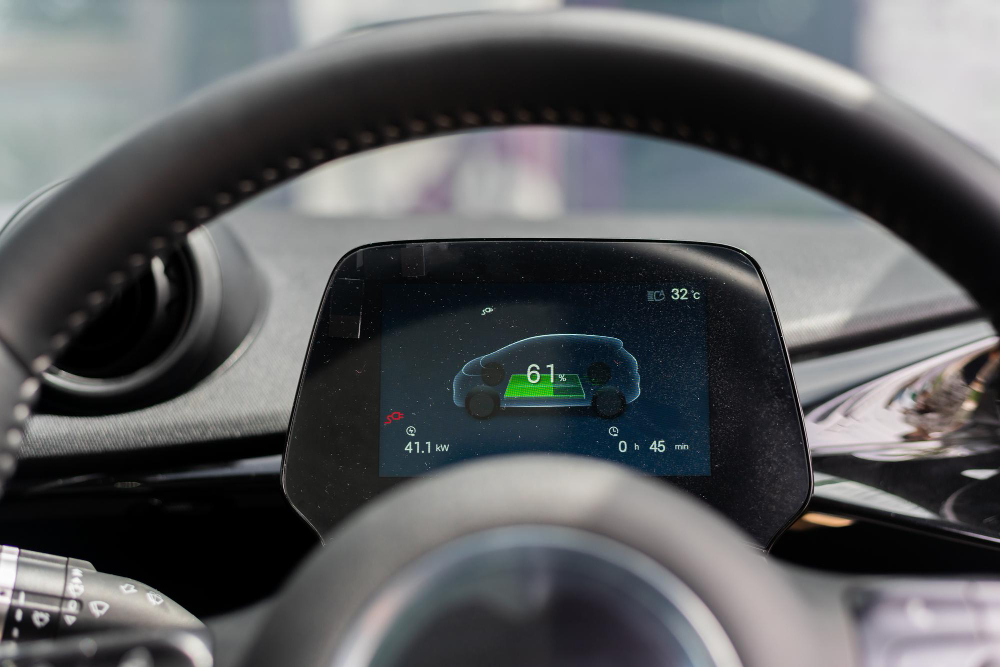
A case study on developing an electric vehicle instrument cluster, highlighting embedded HMI development, vehicle data integration, real-time display of driving information, and dashboard design for electric two-wheelers.